Cuisines and takeaway
Are Quesadillas Healthy? Tortillas, Cheese and Fillings
Are quesadillas healthy? Compare three calculated fillings, tortilla size, cheese, oil and sides for protein, fiber, saturated fat and sodium per meal.
The short answer
Sometimes A quesadilla can make a useful meal, but count tortillas and filling amounts before judging it by the number of wedges. An example using one 60 g flour tortilla and 28 g cheddar provides about 291 calories, 11.2 g protein and 628 mg sodium before cooking oil or sides. Adding beans or chicken changes the balance in different ways.
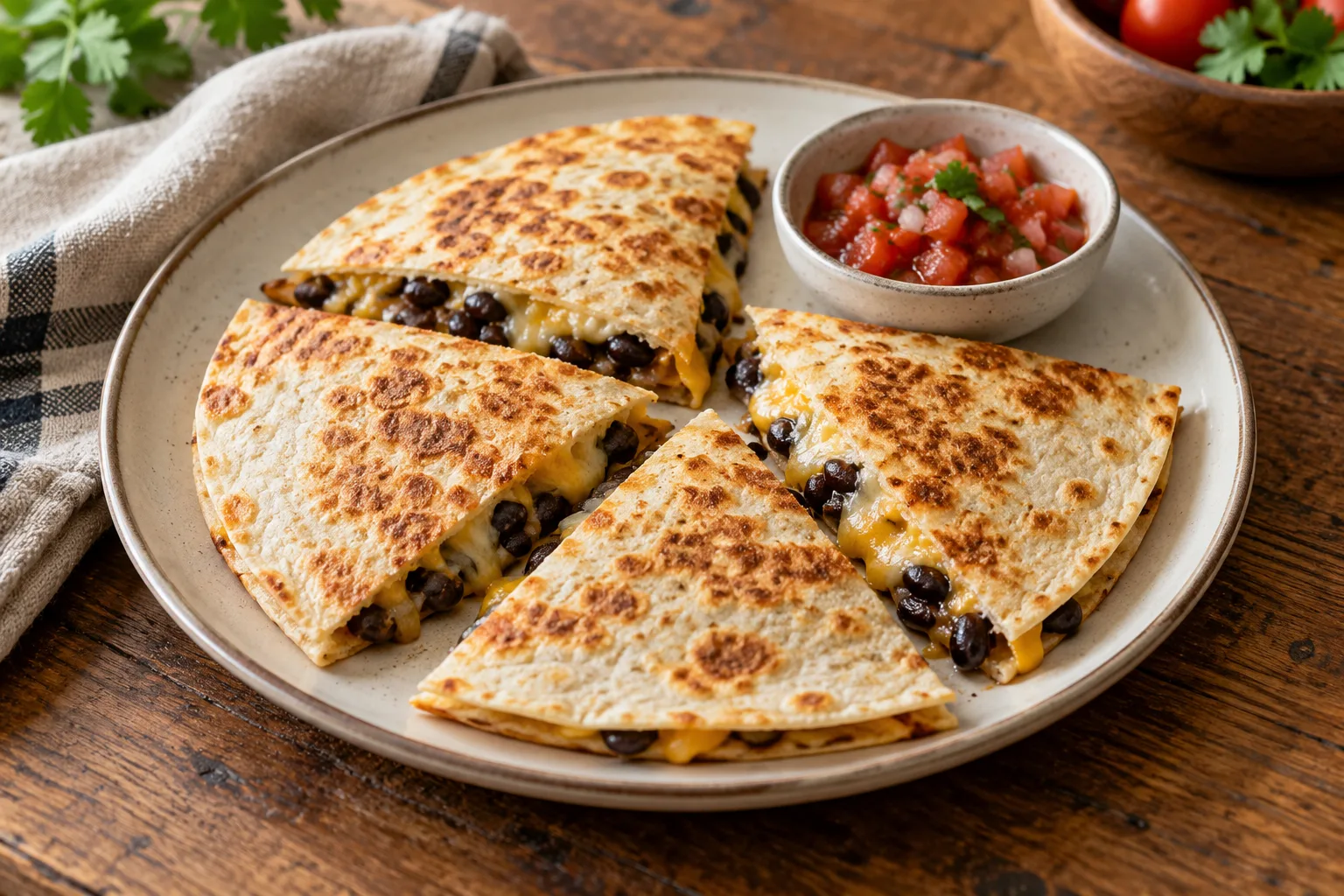
| Nutrient | Calculated: 60 g flour tortilla, 75 g unsalted beans, 14 g cheddar |
|---|---|
| Calories | 334 kcal |
| Protein | 14.7 g |
| Fiber | 8.0 g |
| Saturated fat | 3.5 g |
| Sodium | 537 mg |
USDA SR Legacy identified edible-weight references, summed without intermediate rounding; ingredient and calculation assumptions are stated in the article.
A quesadilla can make a useful meal, but count tortillas and filling amounts before judging it by the number of wedges. An example using one 60 g flour tortilla and 28 g cheddar provides about 291 calories, 11.2 g protein and 628 mg sodium before cooking oil or sides. Adding beans or chicken changes the balance in different ways.
Choose the change for your goal: beans for more fiber, chicken for more protein, or less cheese for a smaller saturated-fat contribution. Tortilla count and cooking oil change the result independently of the filling name.
A wedge is a shape, not a nutrition serving
A folded tortilla cut into four wedges still contains the same food as that tortilla before cutting. A two-tortilla quesadilla cut into four wedges can contain much more. Restaurant menus may also use oversized tortillas, substantial oil and a larger cheese layer than a home version.
Start by asking how many tortillas are used and how much they weigh. Next identify cheese, meat or beans and any cooking fat. Sour cream, guacamole, salsa, rice and chips are separate components even when everything arrives on the same plate.
For a packaged quesadilla, use its finished-product label. For a restaurant, use the dish-specific information if available and check whether sides are included. The FDA’s label-reading guide helps with serving amounts; it does not turn an unweighed restaurant wedge into a precise nutrition estimate.
Three calculated quesadillas with the same tortilla
The following examples use one 60 g shelf-stable flour tortilla and ready-to-eat filling weights. They are ingredient calculations, not tested recipes or restaurant averages. Each row describes the entire one-tortilla assembly, regardless of how many wedges it is cut into. No cooking oil, sauce or side dish is included.
| Example | Filling inside one 60 g tortilla | Calories | Protein | Fiber | Sodium |
|---|---|---|---|---|---|
| Cheese | 28 g cheddar | 291 | 11.2 g | 1.4 g | 628 mg |
| Bean and cheese | 75 g unsalted cooked black beans, 14 g cheddar | 334 | 14.7 g | 8.0 g | 537 mg |
| Chicken and cheese | 75 g cooked breast meat, 14 g cheddar | 358 | 31.3 g | 1.4 g | 592 mg |
The calculations use USDA flour tortilla, FDC 167535, cheddar, FDC 173414, cooked unsalted black beans, FDC 173735 and roasted chicken breast, FDC 171477. Substituting a salted canned bean product or seasoned chicken changes the sodium estimate.
The bean example has more calories than the simple cheese example because it contains more total food. It also has substantially more fiber and slightly more protein. Calling it better or worse solely from calories would miss the purpose of adding the beans.
The chicken version supplies much more protein, while fiber remains low because the chicken adds none in the selected reference. You could choose vegetables or a bean side if fiber is the nutrient you want to add. More meat is a different change from more plant food.
Cheese amount is an effective saturated-fat adjustment
The cheese-only example contains about 6.0 g saturated fat. The bean-and-cheese version has about 3.5 g, and the chicken-and-cheese version about 4.1 g. The latter examples use half as much cheddar, so their different fat profile is not an effect of the filling name alone.
If you want the same cheese-only filling with a smaller saturated-fat contribution, using less cheese directly addresses that ingredient. If you add beans or chicken without reducing cheese, the original cheese contribution remains and the added food increases the total meal.
Cheese can provide flavor, protein and calcium, but a thicker layer is not necessary merely because the tortilla is large. Decide how much cheese you want, weigh it once and spread it evenly. For another cheese comparison, Planrity’s provolone guide shows why slice thickness and gram weight matter more than slice count.
Reduced-fat cheese may have a different composition, melting behavior and sodium level. Use its label rather than assuming that lower fat also means lower sodium. Likewise, a dairy-free cheese alternative needs its own protein and allergy check; the shape of the product does not establish nutritional equivalence.
A real tortilla changes the calculation
The earlier models use a generic 60 g tortilla. Mission Soft Taco Homestyle Flour Tortillas instead lists one 64 g tortilla with 190 calories, 4 g protein, 1 g fiber and 320 mg sodium on its linked panel. Other Mission varieties have different formulas.
Using that specific tortilla with the same USDA cheddar and cooked-bean references gives these whole-assembly estimates, without oil or sides:
| Assembly | Calories | Protein | Fiber | Sodium |
|---|---|---|---|---|
| One tortilla, 28 g cheddar | 303 | 10.4 g | 1.0 g | 503 mg |
| Two tortillas, the same 28 g cheddar | 493 | 14.4 g | 2.0 g | 823 mg |
| One tortilla, 14 g cheddar and 75 g beans | 345 | 13.8 g | 7.5 g | 412 mg |
Cutting the first two rows into four wedges each does not make their portions equivalent. The second has another whole tortilla. The bean version changes the filling and uses less cheese; it supplies more fiber, with a different saturated-fat profile.
This product’s 320 mg tortilla sodium is lower than the generic 60 g tortilla’s approximately 445 mg, despite the slightly larger weight. That is a recipe difference as well as a portion difference. Use your own packet rather than assuming all flour tortillas match either example.
The FDA’s sodium guide helps with that comparison. A whole-wheat or low-carbohydrate name does not by itself establish less sodium. Planrity’s pita guide covers the same distinction between bread type, piece size and filling.
Cooking oil and sides deserve separate entries
Five grams of olive oil contributes approximately 44 calories using USDA FDC 171413. Add that only if the model assumes all five grams end up in the food eaten. Oil left in the pan and oil absorbed by a restaurant preparation cannot be determined precisely from appearance.
For a home meal, measure the fat you add and follow a suitable cooking method. Avoid describing a lightly oiled pan as adding no oil at all. If you prefer a larger oil amount for texture, include it honestly rather than changing the serving description to hide it.
Salsa or pico de gallo can add flavor, but packaged versions vary in sodium. The pico de gallo guide distinguishes ingredients and portions, while salsa chips are a separate food from salsa itself. A side of chips does not become nutritionally invisible because it is used for dipping.
If you choose sour cream, rice or guacamole, decide on the amount and count that food separately. There is no need to remove every accompaniment. A complete description of what you enjoy gives a more useful estimate than labeling the quesadilla alone while overlooking half the plate.
Prepare fillings safely and make the next choice simple
The examples above start with cooked chicken and cooked beans. They do not instruct you to put raw chicken into a tortilla and assume the outside browning proves the filling is done. For poultry, the FoodSafety.gov temperature chart specifies 165°F, or 74°C, checked with a thermometer. Leftovers also need reheating to 165°F.
Check the current tortilla and cheese labels when allergies matter. Flour tortillas commonly involve wheat, and the cheddar example contains milk. Restaurant sauces, cooking surfaces and substitute products can introduce other ingredients, so ask about the actual preparation.
For your next quesadilla, make one useful change: choose beans for fiber, cooked chicken for more protein, less cheese for a smaller saturated-fat contribution, or a different tortilla for a smaller sodium amount. Then choose the sides you want. You can keep a familiar meal while making the part that matters to you more deliberate.
Frequently asked questions
Is a chicken quesadilla healthier than a cheese quesadilla?
It can provide more protein, but the tortilla, cheese amount, oil and sides still matter. The chicken example here has about 31.3 g protein because it includes 75 g cooked chicken and 14 g cheddar. It is not directly comparable with a restaurant version using more cheese or two tortillas. Compare actual ingredients and portions before choosing from the name alone.
Do beans make a quesadilla high in fiber?
They can make a substantial difference. In this calculation, 75 g unsalted cooked black beans plus a flour tortilla and 14 g cheddar supplies about 8 g fiber, compared with 1.4 g in the cheese-only version. A different bean product or amount changes the result. Refried or canned seasoned beans also need their own sodium and fat figures.
Are four quesadilla wedges one serving?
Wedge count does not establish food amount. Four pieces may come from one folded tortilla or a much larger two-tortilla quesadilla. Identify tortilla count and weight, filling and oil first. Cutting the same food into more pieces changes its shape, not its nutrients. Use a finished-product panel or restaurant serving description when one is available.
Sources
- FDA: How to Understand and Use the Nutrition Facts Label, FDA
- FDA: Sodium in Your Diet, FDA
- FoodSafety.gov: Safe Minimum Internal Temperatures, FoodSafety.gov
- USDA FoodData Central: Tortillas, ready-to-bake or -fry, flour, shelf stable (FDC 167535), USDA FoodData Central
- USDA FoodData Central: Oil, olive, salad or cooking (FDC 171413), USDA FoodData Central
- USDA FoodData Central: Chicken, broilers or fryers, breast, meat only, cooked, roasted (FDC 171477), USDA FoodData Central
- USDA FoodData Central: Cheese, cheddar (Includes foods for USDA's Food Distribution Program) (FDC 173414), USDA FoodData Central
- USDA FoodData Central: Beans, black, mature seeds, cooked, boiled, without salt (FDC 173735), USDA FoodData Central
- Mission Foods: Soft Taco Homestyle Flour Tortillas, Mission Foods
- Mission Foods: Soft Taco Homestyle Flour tortilla nutrition panel, Mission Foods