Snacks
Are Chips and Salsa Healthy? Portions and Nutrition
Compare chips and salsa as a measured snack, including sodium and serving size. See how a fresh pico de gallo swap changes the calculated combination.
The short answer
Sometimes Chips and salsa can be a reasonable snack when you count both portions. The example here—1 oz (28 g) chips with 60 g salsa—supplies about 150 calories and 518 mg sodium. Most of that sodium comes from the selected salsa, so checking the dip can matter as much as choosing the chips.
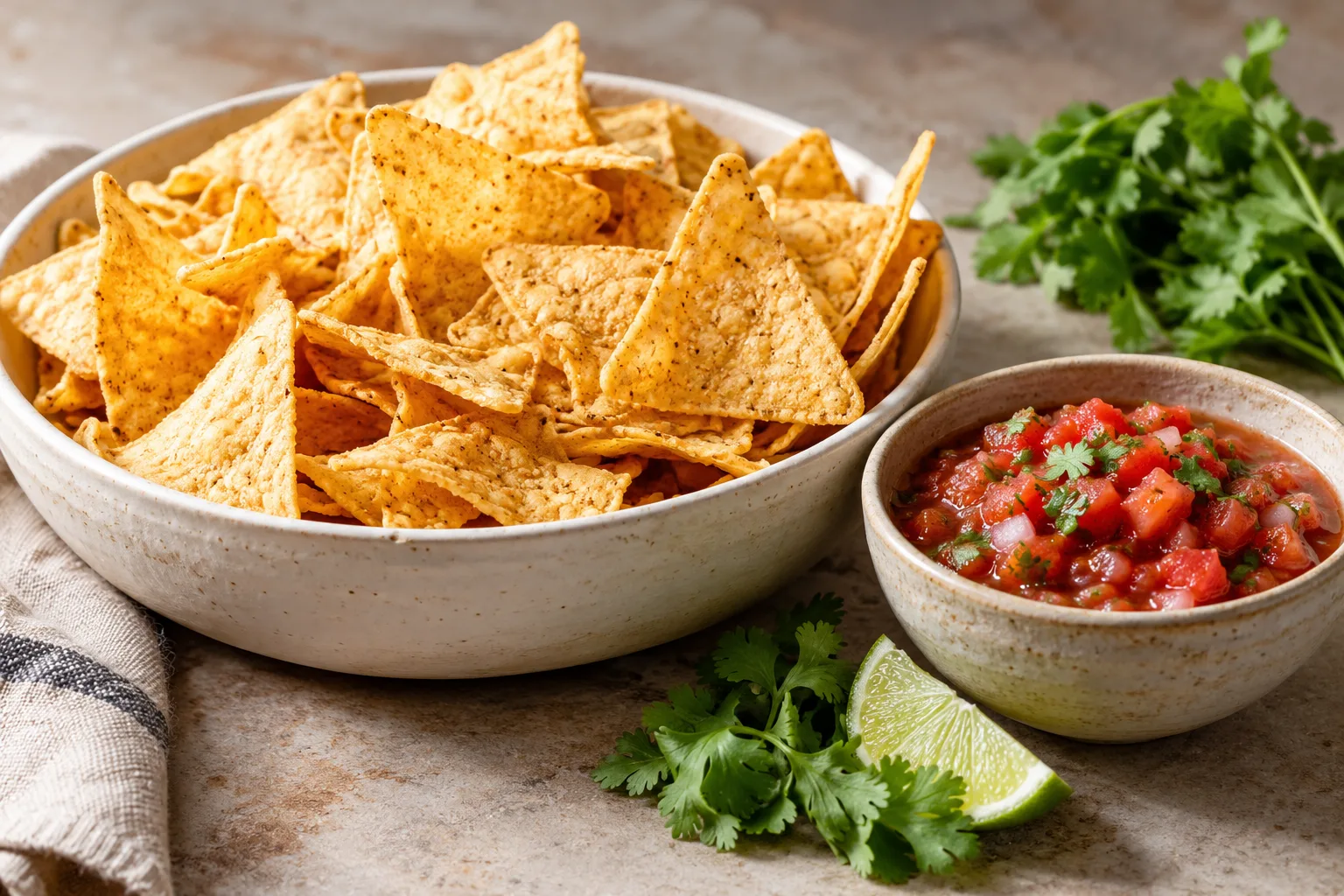
| Nutrient | 28 g chips plus 60 g salsa (88 g) | Per 100 g |
|---|---|---|
| Calories | 150 kcal | 170 kcal |
| Protein | 2.9 g | 3.3 g |
| Total fat | 5.9 g | 6.7 g |
| Saturated fat | 0.8 g | 0.9 g |
| Carbohydrate | 23.0 g | 26.1 g |
| Fiber | 2.7 g | 3.0 g |
| Total sugar | 2.6 g | 3.0 g |
| Sodium | 518 mg | 589 mg |
| Calcium | 48 mg | 54 mg |
| Iron | 0.7 mg | 0.8 mg |
| Potassium | 216 mg | 245 mg |
Estimated from the USDA ingredients listed below. Ingredient weights and portions are stated in the recipe.
“Salsa chips” can also mean salsa-flavored chips. This article addresses tortilla chips served with salsa. For salsa-flavored chips, use that product’s label; the dip calculations here describe a separate snack.
What is being compared?
Tortilla chips vary in corn ingredients, oil, seasoning and thickness. Salsa may be fresh or cooked, smooth or chunky, salted or unsalted. The number of chips in an ounce depends on their size and breakage, so a gram weight is a more reliable starting point than a universal piece count.
Do not assume all tortilla chips are made from refined corn or all baked chips contain more fiber. Read the ingredients and panel. Fresh and shelf-stable salsas can each contain substantial salt, so compare their labels.
A defined snack
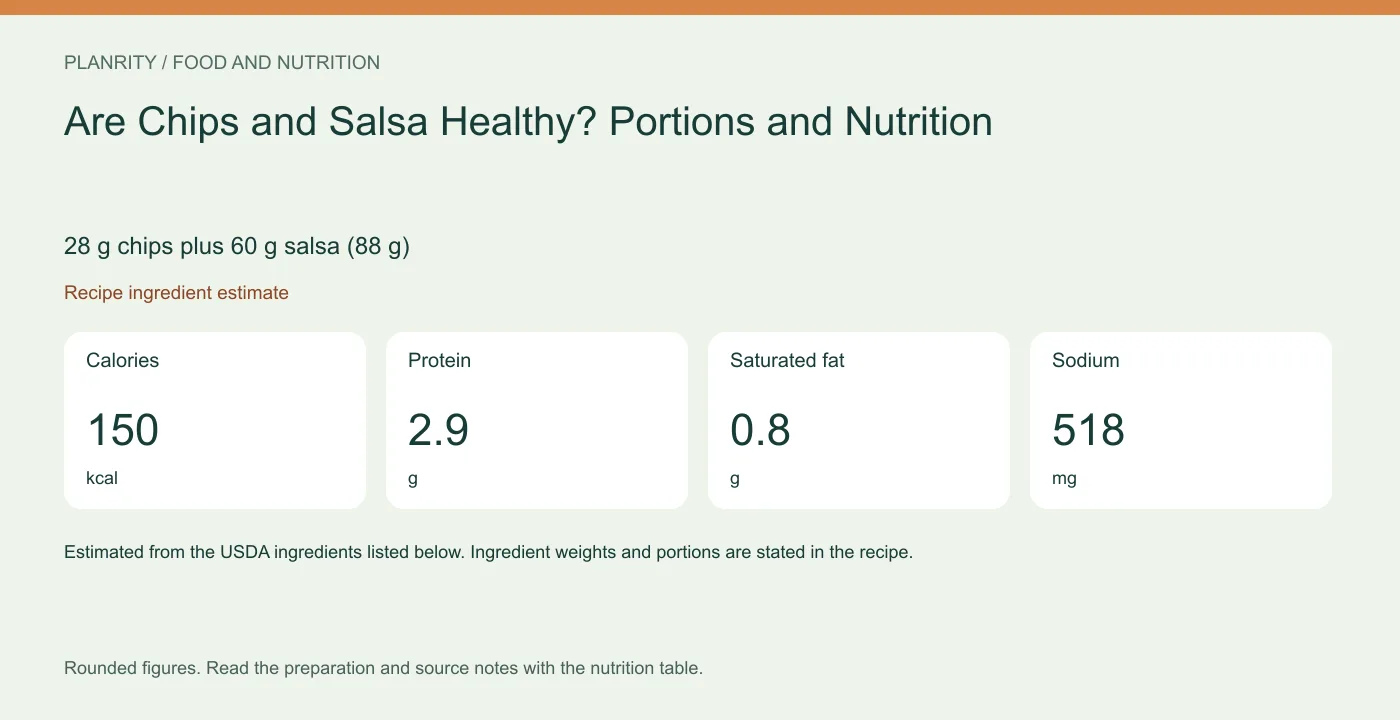
The example contains 28 g chips and 60 g ready-to-serve salsa. This is a practical snack calculation, not an official recommended amount. The serving is a weighed assembly with no cooking changes, so adding the two ingredient contributions is straightforward.
Ingredients for Chips and salsa snack
| Ingredient record | Grams |
|---|---|
| Snacks, tortilla chips, plain, white corn, salted; 167558 | 28 |
| Sauce, salsa, ready-to-serve; 174524 | 60 |
The calculation counts everything served. If you leave some salsa uneaten, the amount consumed changes. Restaurant baskets and shared bowls do not come with this assumed portion, so their totals cannot be inferred from the table.
Compare density and serving purpose
All rows below use the same 100-g weight.
| Food | Calories (kcal) | Protein (g) | Fat (g) | Saturated fat (g) | Fiber (g) | Sodium (mg) |
|---|---|---|---|---|---|---|
| Snacks, tortilla chips, plain, white corn, salted | 472 | 7.1 | 20.7 | 2.8 | 5.4 | 328 |
| Sauce, salsa, ready-to-serve | 29 | 1.5 | 0.2 | 0.0 | 1.9 | 711 |
| Pico de gallo, no added salt | 23 | 0.9 | 0.2 | 0.0 | 1.3 | 5 |
| Chips and salsa snack | 170 | 3.3 | 6.7 | 0.9 | 3.0 | 589 |
Chips are more energy-dense than the identified salsa and pico examples, but equal weight does not describe equal volume or a complete snack. The combination provides a more useful answer to “what am I eating?” than saying one ingredient has a multiple of another’s calories using mismatched measures.
The salsa record also shows that a vegetable-based condiment can contribute sodium. In this example, extra salsa adds sodium even though it adds fewer calories per gram than more chips.
Ingredients for Chips with homemade pico de gallo
| Ingredient record | Grams |
|---|---|
| Snacks, tortilla chips, plain, white corn, salted; 167558 | 28 |
| Pico de gallo, no added salt | 60 |
| Nutrient | One calculated portion (88 g) | Per 100 g |
|---|---|---|
| Calories (kcal) | 146 | 166 |
| Protein (g) | 2.5 | 2.9 |
| Total fat (g) | 5.9 | 6.7 |
| Saturated fat (g) | 0.8 | 0.9 |
| Carbohydrate (g) | 22.1 | 25.1 |
| Fiber (g) | 2.3 | 2.6 |
| Total sugar (g) | 1.9 | 2.2 |
| Sodium (mg) | 95 | 108 |
| Calcium (mg) | 38 | 43 |
| Iron (mg) | 0.6 | 0.7 |
| Potassium (mg) | 182 | 207 |
The pico substitution uses the same chips and the same topping weight. It changes only the dip in the snack example. That makes it a clearer comparison than swapping both the chips and portion at once. It also avoids claiming that every fresh salsa has the low sodium of a recipe made without added salt.
What the snack can offer
Enjoyable flavor and texture: Crunch and acidity can make a small snack satisfying to eat. Serve the chips with a dip you enjoy, choosing the amount and texture that suit the snack.
A produce-containing dip: Salsa contributes vegetables in the amount actually consumed. Use a vegetable side when you want more produce than a small dip portion supplies.
A flexible format: You can combine chips with vegetable dippers, beans or another food according to the occasion. Each addition changes the snack’s role and should be counted if you are calculating it.
Limitations and practical trade-offs
The chips in this example contribute fat and carbohydrate. Their small size can make it easy to eat directly from a bag without noticing the amount. Serving an initial portion into a bowl is a practical way to understand the amount, not a rule that you must stop eating regardless of hunger.
Sodium comes from both components. A less-salted chip paired with a salty salsa may still contribute a meaningful total. For a medically restricted sodium intake, use current labels rather than relying on the generic records alone.
Chips and salsa may not provide the protein or total amount of food you need for a meal. Add an appropriate protein and other meal components if the snack is replacing lunch or dinner. Beans, for example, can add protein and fiber; include their actual portion in any meal total.
Buying and serving decisions
| Your priority | What to compare | Avoid assuming |
|---|---|---|
| Less sodium | Both chips and dip at the amount eaten | Fresh salsa is always unsalted |
| More fiber | Actual fiber per equal chip weight | Baked always means whole grain |
| A larger snack volume | Vegetables or a suitable dip alongside chips | More dip is nutritionally identical across recipes |
| Allergy management | Full ingredients and handling | Plain corn eliminates every cross-contact concern |
For homemade fresh salsa, wash produce under running water and use clean cutting surfaces. Refrigerate cut produce and follow safe handling. Citrus flavor does not make a fresh vegetable mixture shelf-stable, and an improvised salsa recipe is not a validated canning recipe. Selecting and Serving Produce Safely | FDA
People with a corn, wheat or another relevant allergy should check the exact product. Someone monitoring carbohydrate intake needs the amount in the entire snack, including chips and any additions. Individual dietary instructions take priority over a generic “healthy snack” verdict.
Portion checklist
- Confirm whether the query concerns flavored chips or chips with salsa.
- Use the bag’s gram serving rather than a universal chip count.
- Measure the salsa amount when calculating sodium.
- Compare baked and fried products using actual panels.
- Add other foods if this needs to become a meal.
- Handle fresh dips as perishable food.
- Recalculate if the chip or dip is changed.
Set out the snack you intend to eat
Look at the two sources of sodium in this snack. Before rounding, the 28-g chips contribute 91.84 mg sodium and the 60-g salsa contributes 426.6 mg, for about 518 mg combined. Choosing a low-sodium dip can therefore make a larger difference than choosing between chips with only a small sodium difference. This result belongs to the selected records; your jar may be different.
Put the chips and dip into separate bowls, then decide whether you want a snack or a meal. For a snack, that may be all you need. For lunch, add foods that supply enough protein and a useful amount of produce for you. If you refill either bowl, include the refill rather than treating the original portion as the whole amount eaten. A fresh dip is one option, not a guarantee of a low-sodium recipe.
What to take away
A measured bowl of chips and salsa can be an enjoyable snack. The dip adds vegetables, but it can also supply more sodium than the chips in a particular pairing. Compare both labels, choose the amounts you want and include refills. If the snack needs to become lunch, add a protein food and other meal components deliberately. Choosing a lighter-looking dip does not turn an unknown chip portion into a measured serving.
Related food guides
Frequently asked questions
How many chips are in a serving?
Use the gram weight on the actual package. Thickness, size and breakage change the number of chips per ounce, so a universal piece count is unreliable. The example uses 28 grams rather than assuming that every brand has the same number of chips.
Is fresh salsa always lower in sodium?
No. Fresh salsa can contain added salt, and shelf-stable products have different formulations. The calculated pico recipe has no added salt, but that is a recipe choice rather than a property of all fresh salsa.
Are baked chips always better?
Baking describes a preparation method. Compare calories, fat, sodium, fiber and ingredients for the actual products at equal weights. A baked chip can still be salty, and a lower-fat product is not necessarily higher in fiber.
Can salsa make this a complete meal?
Salsa adds produce, but the snack may still need protein and a larger amount of food to serve as a meal. Consider the whole plate and your appetite. Adding beans or another suitable protein changes the nutritional balance and should be included in calculations.
Sources
- Snacks, tortilla chips, plain, white corn, salted; 167558, USDA
- Sauce, salsa, ready-to-serve; 174524, USDA
- How to Understand and Use the Nutrition Facts Label | FDA, FDA
- Sodium in Your Diet | FDA, FDA
- Selecting and Serving Produce Safely | FDA, FDA
- Added Sugars on the Nutrition Facts Label | FDA, FDA
- USDA FSIS: Leftovers and Food Safety, USDA