Snacks
Healthiest Olives: Compare Varieties, Sodium and Portions
Compare olive varieties by equal weight and realistic portions. Understand brine, sodium, fats and label differences before choosing olives for a meal.
The short answer
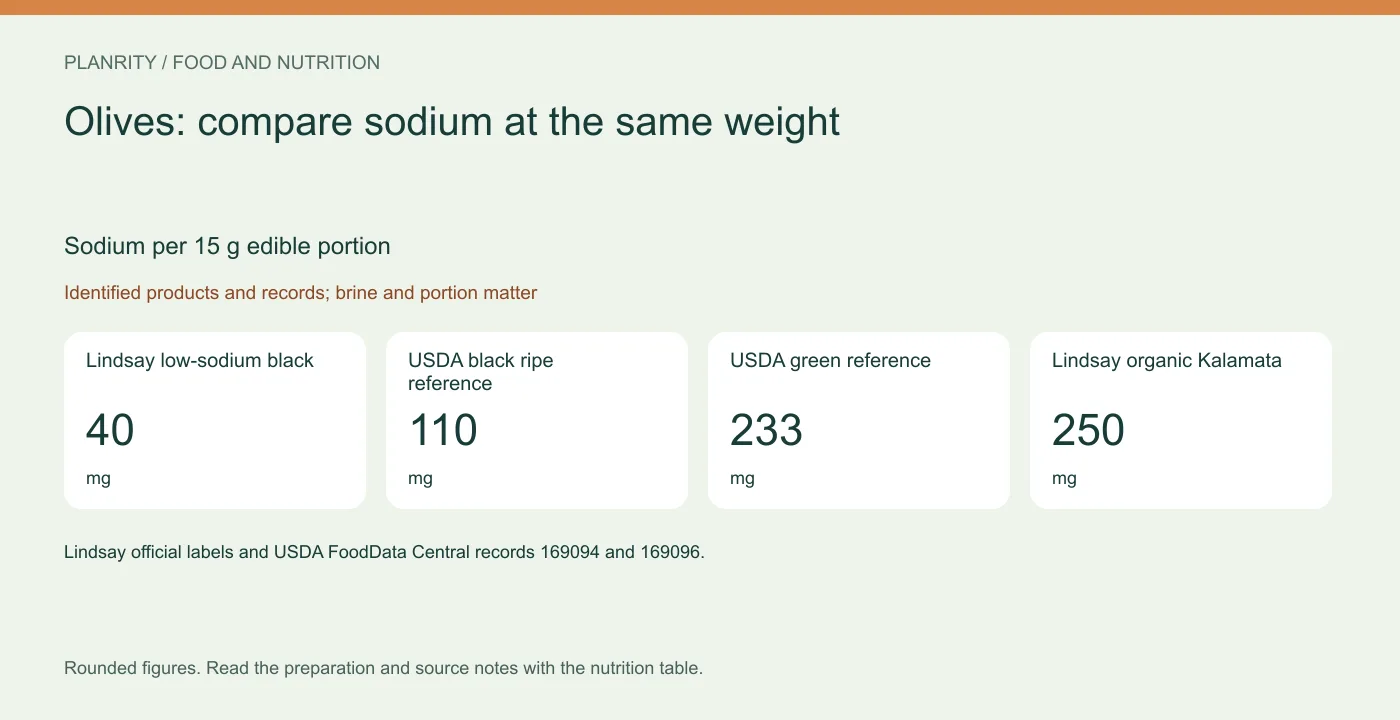
For lower sodium, choose by label rather than olive color. Lindsay Low Sodium Black Ripe Olives list 40 mg sodium per 15 g, compared with 250 mg for the same weight of Lindsay Organic Kalamata Olives. Green, black and Kalamata olives can all work in a meal; the brine and portion make the practical difference.
| Nutrient | Small weighed olive portion (15 g) | Per 100 g |
|---|---|---|
| Calories | 22 kcal | 145 kcal |
| Protein | 0.2 g | 1.0 g |
| Total fat | 2.3 g | 15.3 g |
| Saturated fat | 0.3 g | 2.0 g |
| Carbohydrate | 0.6 g | 3.8 g |
| Fiber | 0.5 g | 3.3 g |
| Total sugar | 0.1 g | 0.5 g |
| Sodium | 233 mg | 1556 mg |
| Calcium | 8 mg | 52 mg |
| Iron | 0.1 mg | 0.5 mg |
| Potassium | 6 mg | 42 mg |
USDA FoodData Central, FDC 169096.
Olives can add flavor and fats to a meal, but curing, brining, stuffing and packing ingredients change the nutrition. A lower-sodium version may be useful when sodium is a priority; a different variety may better suit taste, price or a recipe.
Understand the product names
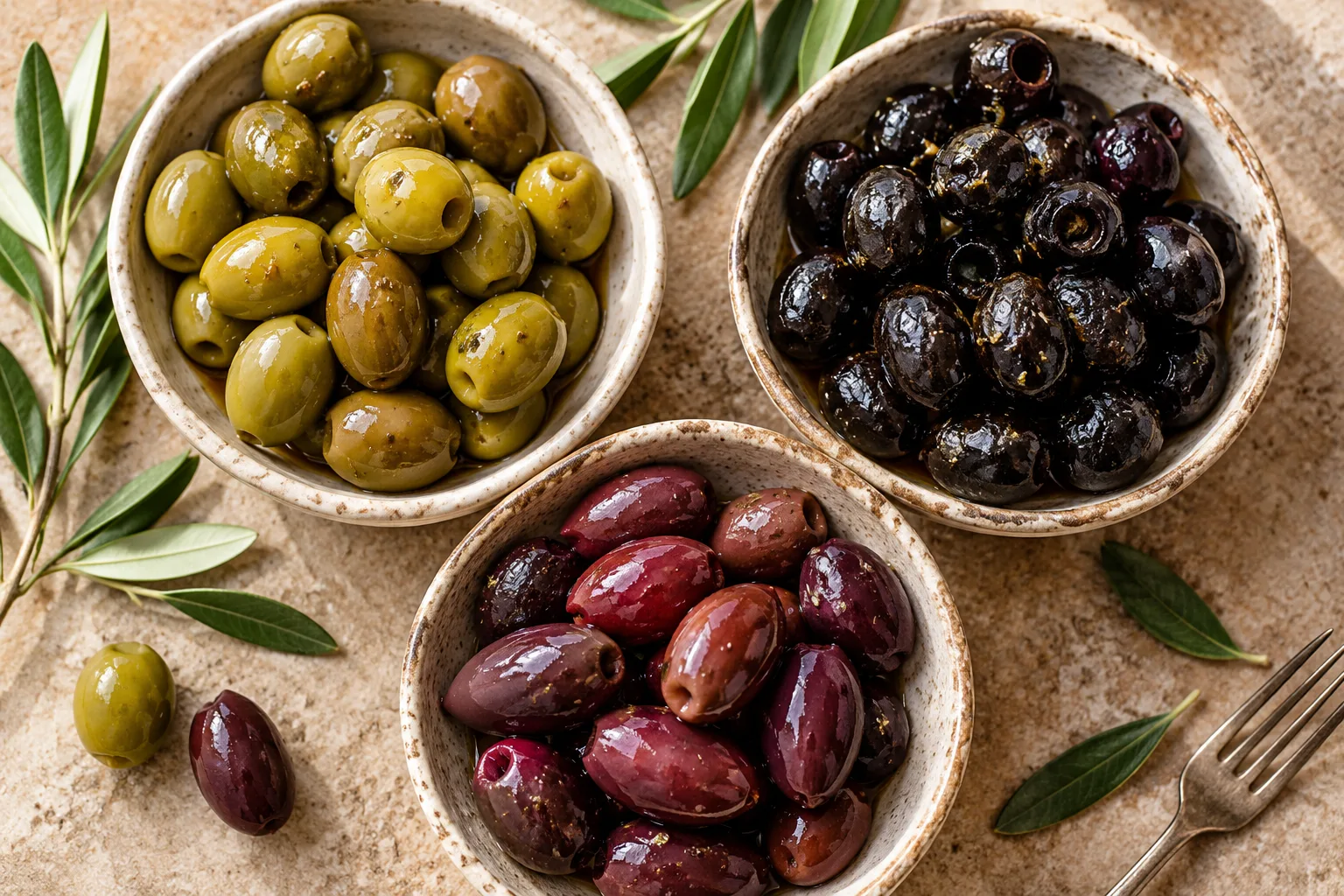
Green and black describe appearance rather than one standardized nutrient profile. Ripeness and processing can both affect color. Kalamata describes a particular olive type or associated style, while “black ripe” canned olives are a different product category.
Stuffed olives introduce other ingredients, such as cheese, peppers or anchovies. Oil-packed products can include additional oil. Read the ingredient list and use edible drained weight when that is the basis of the panel. A serving that includes substantial packing liquid answers a different question.
Nutrition for a small serving
Source: USDA FoodData Central, FDC 169096.
Fifteen grams is a practical small portion. It is not a fixed number of olives because fruit size and whether pits are included can vary. Weigh the edible portion if you need a reliable comparison.
Green versus black ripe references
All rows below use the same 100-g weight.
| Food | Calories (kcal) | Protein (g) | Fat (g) | Saturated fat (g) | Sodium (mg) |
|---|---|---|---|---|---|
| Olives, pickled, canned or bottled, green | 145 | 1.0 | 15.3 | 2.0 | 1556 |
| Olives, ripe, canned (small-extra large) | 116 | 0.8 | 10.9 | 2.3 | 735 |
| Lindsay Organic Kalamata Olives; four olives (15 g), official online panel | 167 | 0.0 | 13.3 | 0.0 | 1667 |
The green record has substantially more sodium per equal weight than the identified black-ripe record. That establishes a difference between these two USDA foods, not a rule that all green olives are saltier than all black olives. Brand formulation and curing can change the result.
The records also show that fiber is modest in the small serving. A small olive portion supplies much less fiber than a substantial serving of beans or vegetables; use olives mainly for the flavor they add.
Add named products before ranking Kalamata or low-sodium choices
Lindsay’s US website identifies an Organic Kalamata product with a 15-g serving of four olives. Its Nutrition Facts panel lists 25 calories and 250 mg sodium per serving. Use the label on your jar, since Kalamata products differ in brining and serving size. Lindsay Organic Kalamata.
The manufacturer also offers a low-sodium black-ripe product with a 15-g serving of five olives. Its official online panel lists 25 calories, 2.5 g total fat and 40 mg sodium for that portion. The comparison below uses the quantified sodium values on the labels. Lindsay: Low Sodium Black Ripe Olives
For the identified Kalamata product, dividing 250 mg by 15 g and multiplying by 100 gives approximately 1,667 mg sodium per 100 g. The low-sodium black-ripe panel similarly gives about 267 mg per 100 g. These normalize rounded label figures; they are not recommendations to eat 100-g portions.
| Identified product or record | Sodium per 15 g | Sodium per 100 g |
|---|---|---|
| USDA green olives, 169096 | 233 mg | 1,556 mg |
| USDA black ripe olives, 169094 | 110 mg | 735 mg |
| Lindsay Organic Kalamata, official online panel | 250 mg | 1,667 mg |
| Lindsay Low Sodium Black Ripe, official online panel | 40 mg | 267 mg |
This four-way comparison addresses sodium specifically. Four Kalamata olives (15 g) supply 25 calories, 2 g fat, 250 mg sodium and 0 g protein. Carbohydrate is listed as less than 1 g. The manufacturer describes fiber, sugars, calcium and iron as not significant sources but gives no exact amounts for them. The same serving weight makes the sodium comparison fairer than comparing four large olives with five smaller ones. Lindsay: Organic Kalamata Olives Lindsay: Low Sodium Black Ripe Olives
What olives can contribute
Flavor: Their salty, bitter or fruity character can make a small amount useful in a salad, grain dish or sauce. That role is often more relevant than treating them as a large snack portion.
Fats: Olives contain fat, with composition depending on the product. The type of fat is part of a food’s nutritional profile, but a claim that olives themselves treat high cholesterol would go beyond this comparison. American Heart Association guidance on dietary fats
Flexible portions: Chopping a measured amount can distribute flavor through a dish. That is a culinary strategy, not evidence that chopping changes the nutrients in the amount used.
Limits and trade-offs
Brine-derived sodium: A small amount of olives can contribute a noticeable amount. Count other salty ingredients such as cheese, cured meat or dressing in the same dish.
Added ingredients: Stuffing and oil packing can change fat, allergens and sodium. “Mediterranean” is not a complete nutrition label.
Portion differences: Five small olives and five large olives are not equal weights. Compare grams first when assessing density, then the actual serving you plan to eat.
Incomplete ranking criteria: A product with less sodium might have a different texture, price or flavor. Be explicit about which feature makes it a better choice for your purpose.
A useful decision framework
| Your main need | Start with | Then check |
|---|---|---|
| Lower sodium | Current sodium per equal drained weight | The amount in your actual portion |
| A salad garnish | Flavor and texture you enjoy | Other salty ingredients in the salad |
| Allergy management | Complete stuffing and packing ingredients | Cross-contact information when needed |
| A recipe calculation | Edible gram weight | Whether oil or liquid is retained |
Rinsing can remove surface brine, but do not assume it removes a fixed percentage of sodium from every product. That would require evidence for the particular olives and method. If sodium restriction is strict, select a documented product rather than relying on an unmeasured rinse.
Who should pay closer attention?
Someone following a sodium-restricted diet should use their individual target and the actual label. People with allergies need to inspect stuffed varieties. For children, remove pits and prepare the olives in an age-appropriate form.
Follow the package’s refrigeration instructions after opening. A jar’s unopened shelf stability does not mean that an opened serving bowl can be left without temperature control indefinitely. Storage times vary with processing and packing, so use the directions for your own jar.
Shopping checklist
- Identify the variety and curing or packing style.
- Compare equal edible weights.
- Read sodium per serving and per calculated equal weight.
- Include stuffing and retained oil in calculations.
- Use current labels for reduced-sodium claims.
- Avoid antioxidant rankings without direct evidence.
- Follow storage and serving instructions for the actual package.
Choose for the dish and the sodium
At 15 g, the reviewed lower-sodium olives supply 210 mg less sodium than the reviewed Kalamata product. Doubling both portions to 30 g doubles their sodium: 80 mg and 500 mg respectively. The lower-sodium label can be useful if you want more olive flavor in a dish without adding as much salt, while someone who prefers Kalamata may choose a smaller amount.
Use edible weight for that comparison. Pits and olive sizes change what a piece count means. Chop the portion through a salad if you want the flavor distributed, and count feta, cured meat or a salty dressing alongside it. Draining and rinsing can change surface brine, but a known lower-sodium product gives a more predictable starting value than assuming a fixed percentage of salt washes away.
What to take away
For most olive purchases, sodium and portion are more useful than color. The lower-sodium and Kalamata labels here differ markedly at the same edible weight, so compare the jar you plan to buy. Use enough olives for the flavor you want in the dish, and account for cheese, cured meat or salty dressing alongside them. Rinsing is not a reliable replacement for a verified lower-sodium label when predictable intake matters.
Related food guides
Frequently asked questions
Are green olives healthier than black olives?
Neither color establishes an overall winner. The two USDA records differ in sodium and other nutrients, but brands and processing vary. Choose using actual labels at equal edible weights, then consider the portion and the rest of the meal.
Are Kalamata olives lower in sodium?
Not necessarily. The identified Lindsay Organic Kalamata panel reports 250 milligrams per 15-gram serving. That is one product, not an average for the variety. Compare the label of the jar you intend to buy.
Does rinsing remove most of the salt?
Rinsing may remove surface brine, but a universal percentage reduction is not established here. Sodium can remain within the olives. Use a verified lower-sodium product when you need predictable intake rather than relying on an unmeasured rinsing assumption.
How many olives should I eat?
There is no universal number established here. The example uses an edible weight because size and pits affect piece counts. Choose a portion that suits the meal and your needs, especially if sodium is restricted, and use the actual package for calculations.
Sources
- Olives, ripe, canned (small-extra large); 169094, USDA
- Olives, pickled, canned or bottled, green; 169096, USDA
- How to Understand and Use the Nutrition Facts Label | FDA, FDA
- Sodium in Your Diet | FDA, FDA
- American Heart Association guidance on dietary fats, American Heart Association
- Lindsay: Organic Kalamata Olives, Lindsay / Bell-Carter Foods
- Lindsay: Low Sodium Black Ripe Olives, Lindsay / Bell-Carter Foods