Dairy and cheese
Is Babybel Cheese Healthy? US Label and Snack Portions
Review Babybel Original using its US label, compare equal weights with Laughing Cow, and assess protein, calcium, sodium, saturated fat and snack choices.
The short answer
Yes Babybel Original can be a useful portioned cheese snack: one 20-g piece supplies 70 calories, 4 g protein and 140 mg calcium. It also contains 3.5 g saturated fat and 150 mg sodium. Pairing one piece with fruit provides a different snack from eating several pieces with salty crackers.
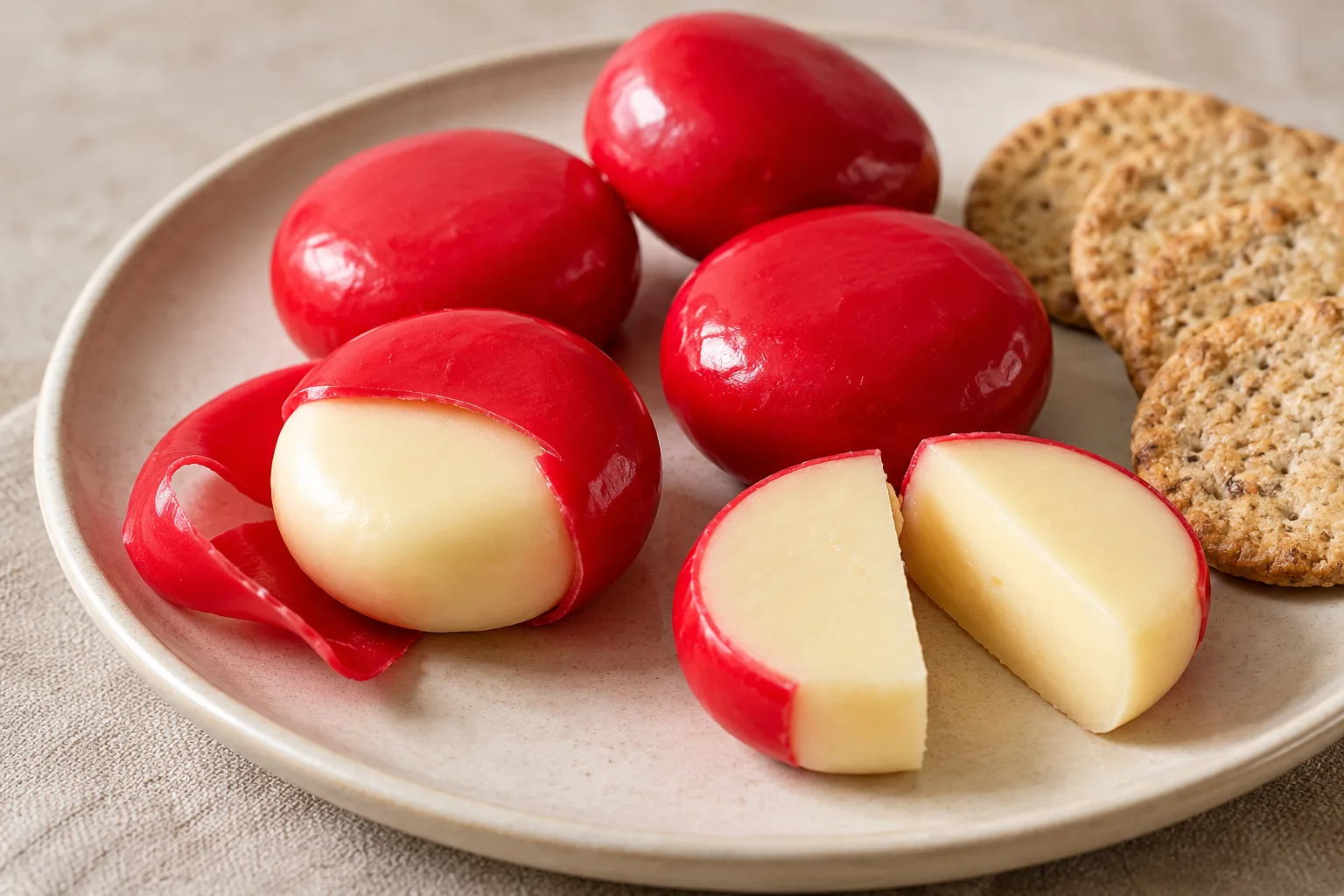
| Nutrient | One manufacturer-defined piece (20 g) | Per 100 g |
|---|---|---|
| Calories | 70 kcal | 350 kcal |
| Protein | 4.0 g | 20.0 g |
| Total fat | 5.0 g | 25.0 g |
| Saturated fat | 3.5 g | 17.5 g |
| Carbohydrate | 0.0 g | 0.0 g |
| Fiber | 0.0 g | 0.0 g |
| Total sugar | 0.0 g | 0.0 g |
| Added sugar | 0.0 g | 0.0 g |
| Sodium | 150 mg | 750 mg |
| Calcium | 140 mg | 700 mg |
| Iron | 0.0 mg | 0.0 mg |
| Potassium | 10 mg | 50 mg |
Babybel Original, US label; one 20-g piece.
This article uses the current US online label for Babybel Original, a 20-g piece. Reduced-fat, flavored and plant-based Babybel products are different foods and should be evaluated from their own labels.
What is in the Original product?
The manufacturer lists pasteurized cultured milk, salt and microbial enzymes, with milk as the declared allergen. The Original product contains milk, and its saturated fat and sodium still need checking alongside that short ingredient list. Babybel Original US nutrition label
The individually wrapped format can make portions easy to identify. It does not mean that several pieces have the same nutritional impact as one. Remove the wrapping and wax before eating, and prepare the food appropriately for the person being served.
The US Original label
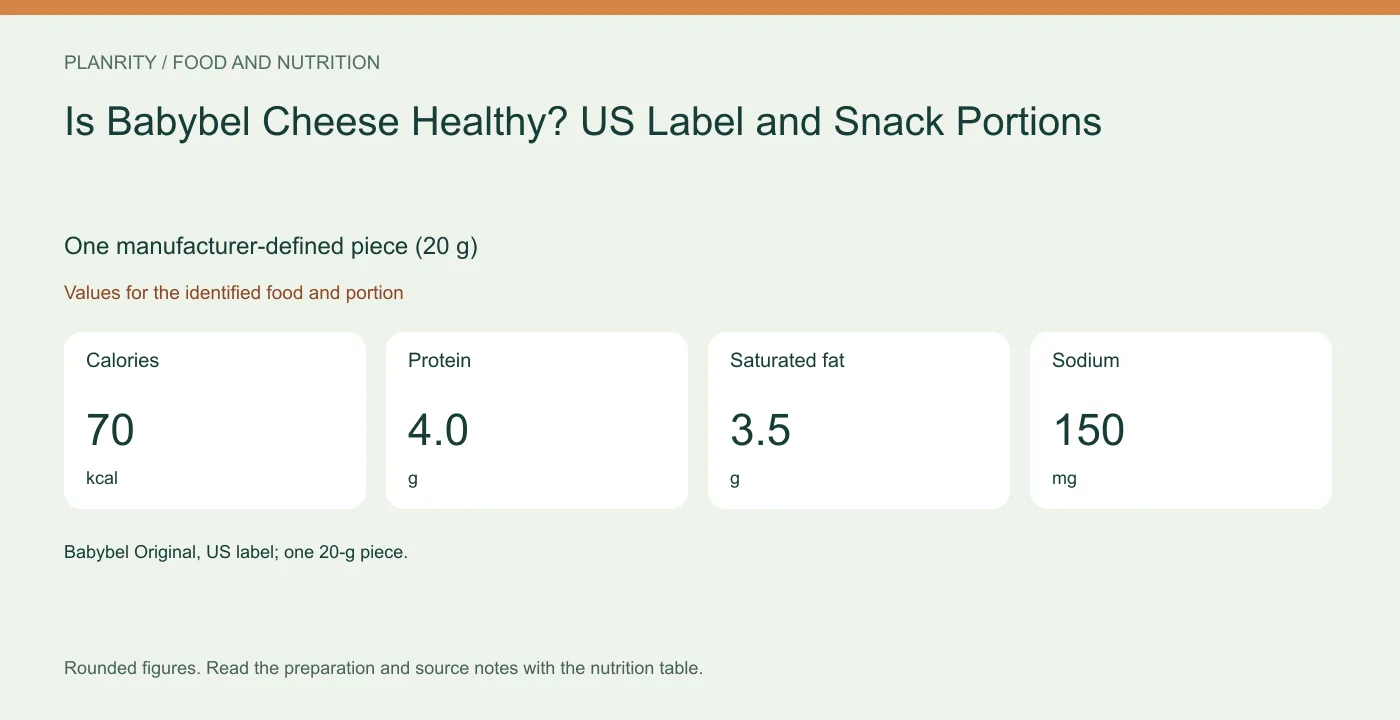
Source: Babybel Original, US label; one 20-g piece.
The verified panel lists 4 g protein per 20-g piece, not the higher amounts sometimes repeated in generic cheese articles. Its calcium contribution is also product-specific. Use the actual package if its formulation differs from the online panel.
Per-100-g figures are calculated from rounded label values. They help compare nutrient density, but the calculation cannot make a rounded label more precise. A listed zero is subject to labeling conventions and is not proof that no trace amount exists.
Compare equal weights and actual pieces
All rows below use the same 100-g weight.
| Food | Calories (kcal) | Protein (g) | Fat (g) | Saturated fat (g) | Fiber (g) | Sodium (mg) |
|---|---|---|---|---|---|---|
| Babybel Original, US label; one 20-g piece | 350 | 20.0 | 25.0 | 17.5 | 0.0 | 750 |
| The Laughing Cow Creamy Original Double Pack, US label; one 19-g wedge | 237 | 10.5 | 18.4 | 10.5 | 0.0 | 842 |
| Yogurt, Greek, plain, nonfat (Includes foods for USDA’s Food Distribution Program) | 59 | 10.2 | 0.4 | 0.1 | 0.0 | 36 |
Babybel and The Laughing Cow have different textures, formulations and serving sizes. A 20-g Babybel piece and a 19-g wedge are close in weight but not identical. The yogurt row is another dairy food with a different usual eating amount, included as an option rather than a direct substitute in every setting.
| Defined US label serving | Calories | Protein | Saturated fat | Sodium | Calcium |
|---|---|---|---|---|---|
| Babybel Original, 20 g | 70 | 4 g | 3.5 g | 150 mg | 140 mg |
| Laughing Cow Creamy Original, 19 g | 45 | 2 g | 2 g | 160 mg | 130 mg |
These figures show why “lower calorie” is not a complete ranking. One serving supplies more protein, while the other has a different fat profile and similar-sized calcium contribution. Choose the features that fit your snack. Babybel Original US nutrition label The Laughing Cow Creamy Original US label
What Babybel Original contributes
Protein: One piece supplies the amount in the panel. A piece contributes protein to a snack; a meal usually needs other foods and a larger total amount.
Calcium: One piece provides 140 mg, about 11% of the FDA’s 1,300-mg Daily Value used on labels for adults and children aged four and older. That helps put the contribution in context; it is a labeling benchmark rather than an individualized requirement. FDA Daily Values
Convenience: A wrapped piece is practical to portion and pack. Follow the package’s refrigeration instructions when packing the cheese for travel or lunch.
What to watch for
Saturated fat: The amount is meaningful for a small piece. If you are managing saturated fat, consider other cheese, butter and animal-fat sources in the day rather than focusing on this snack in isolation.
Sodium: Multiple pieces increase sodium proportionally. Crackers, deli meat and olives can add further sodium if they accompany the cheese.
No fiber: The reviewed panel lists no fiber. Fruit, vegetables or a suitable grain food can contribute different nutrients alongside it, depending on your needs.
Milk allergy: The Original product contains milk. Lactose-related tolerance and milk-protein allergy are different questions; do not treat a cheese’s fermentation or texture as proof that it is allergy-safe.
How much makes sense?
One piece is the manufacturer’s serving convention, not a universal recommendation. Two pieces double the listed per-piece amounts; whether that suits you depends on appetite, meal timing and dietary requirements. There is no source-backed rule here limiting everyone to a fixed number of pieces daily.
For a snack, consider what is missing as well as what is present. A piece with fruit offers a different combination from several pieces with salty crackers. Neither pairing should inherit a nutrition total without counting its actual ingredients and amounts.
If you need a larger protein-containing meal, a small cheese piece can be one component. The question is whether the complete meal supplies enough food and variety for you, rather than whether cheese alone earns a healthy label.
Compare other varieties carefully
A reduced-fat product may lower some fat values, but the exact change needs its own panel. A plant-based product may have different protein, calcium and allergen characteristics.
Packaging can change, and the same brand may sell different formulations in different countries. This comparison is explicitly US-specific. Match the product name, market and serving weight before using the figures.
Shopping checklist
- Select the exact Original or alternative variety you intend to eat.
- Match the US label and serving weight.
- Compare protein and calcium alongside saturated fat and sodium.
- Count all pieces consumed.
- Include crackers, meat or other accompaniments in snack totals.
- Check milk and any other relevant allergen information.
- Follow the actual package’s storage directions.
Use the format that fits the snack
A firm cheese piece can be useful when you want something eaten by hand, while a spreadable wedge fits a different purpose. If you need the food to provide most of a snack’s protein, compare the actual amount and consider whether another component is needed. If the purpose is a small flavor addition, protein may be less central to the choice. The best comparison begins with the role you want the product to play.
If several people are sharing a snack plate, keep the ingredient portions identifiable. This makes it easier to calculate the amount eaten and to avoid confusing a mixed plate’s nutrition with the cheese label alone.
Count pieces in the whole snack
Two Babybel Original pieces supply 140 calories, 8 g protein, 7 g saturated fat and 300 mg sodium. That may be the amount you want, but it is a different snack from one piece. Count the pieces first, then include crackers, deli meat or other accompaniments rather than assessing the cheese in isolation.
For a snack with more fiber, choose a suitable fruit, vegetable or grain food alongside. If more protein is your main goal, compare the amount in your full snack with another dairy or protein option. A plant-based Babybel has a different ingredient list and may have different protein and calcium amounts, so use its own panel. The Original’s convenient packaging is useful for portioning; it does not replace those nutrition and allergen checks.
What to take away
Babybel Original offers a simple, portioned way to add cheese, protein and calcium to a snack. Its saturated fat and sodium matter too, especially when you eat several pieces or add salty accompaniments. Choose the exact variety from its own label and pair it with foods that supply what the cheese lacks, such as fiber from fruit or vegetables. A small wrapped piece is convenient, but it is not a complete meal by itself.
Related food guides
Frequently asked questions
How much protein is in Babybel Original?
The reviewed US manufacturer label lists 4 grams per 20-gram piece. Other varieties or markets can differ. Check the package you have rather than applying a generic cheese value or assuming every Babybel product provides the same amount.
Is Babybel healthier than Laughing Cow?
They have different formulations and purposes. The reviewed Babybel serving has more protein and saturated fat, while the Laughing Cow serving is slightly smaller and spreadable. Compare the relevant nutrients and the actual amount you plan to eat rather than choosing a universal winner.
Does a low sugar value make it a complete snack?
Sugar is only one feature. Babybel contributes protein, calcium, fat and sodium, while the panel lists no fiber. Whether it is enough for your snack depends on appetite and other foods. A fruit or vegetable accompaniment changes the overall combination.
Can someone with a milk allergy eat it?
Babybel Original declares milk as an allergen. Do not assume fermentation or a low sugar value makes it suitable for a milk allergy. Follow individual allergy-management advice and inspect the exact label before choosing any alternative variety.
Sources
- Yogurt, Greek, plain, nonfat (Includes foods for USDA's Food Distribution Program); 170894, USDA
- Babybel Original US nutrition label, Babybel
- The Laughing Cow Creamy Original US label, The Laughing Cow
- How to Understand and Use the Nutrition Facts Label | FDA, FDA
- Sodium in Your Diet | FDA, FDA
- American Heart Association guidance on dietary fats, American Heart Association
- Daily Value on the Nutrition and Supplement Facts Labels, US Food and Drug Administration