Dairy and cheese
Is Laughing Cow Cheese Healthy? Compare US Wedges
Review The Laughing Cow Creamy Original US label and compare it with Babybel by weight. Assess calcium, protein, sodium, saturated fat and snack portions.
The short answer
Sometimes The Laughing Cow Creamy Original can be a convenient spread: one 19-g US wedge supplies 45 calories, 2 g protein and 130 mg calcium. It also adds 160 mg sodium and 2 g saturated fat. Count the number of wedges and the crackers or bread underneath them when choosing the whole snack.
| Nutrient | One manufacturer-defined wedge (19 g) | Per 100 g |
|---|---|---|
| Calories | 45 kcal | 237 kcal |
| Protein | 2.0 g | 10.5 g |
| Total fat | 3.5 g | 18.4 g |
| Saturated fat | 2.0 g | 10.5 g |
| Carbohydrate | 1.0 g | 5.3 g |
| Fiber | 0.0 g | 0.0 g |
| Total sugar | 1.0 g | 5.3 g |
| Added sugar | 0.0 g | 0.0 g |
| Sodium | 160 mg | 842 mg |
| Calcium | 130 mg | 684 mg |
| Iron | 0.1 mg | 0.5 mg |
| Potassium | 30 mg | 158 mg |
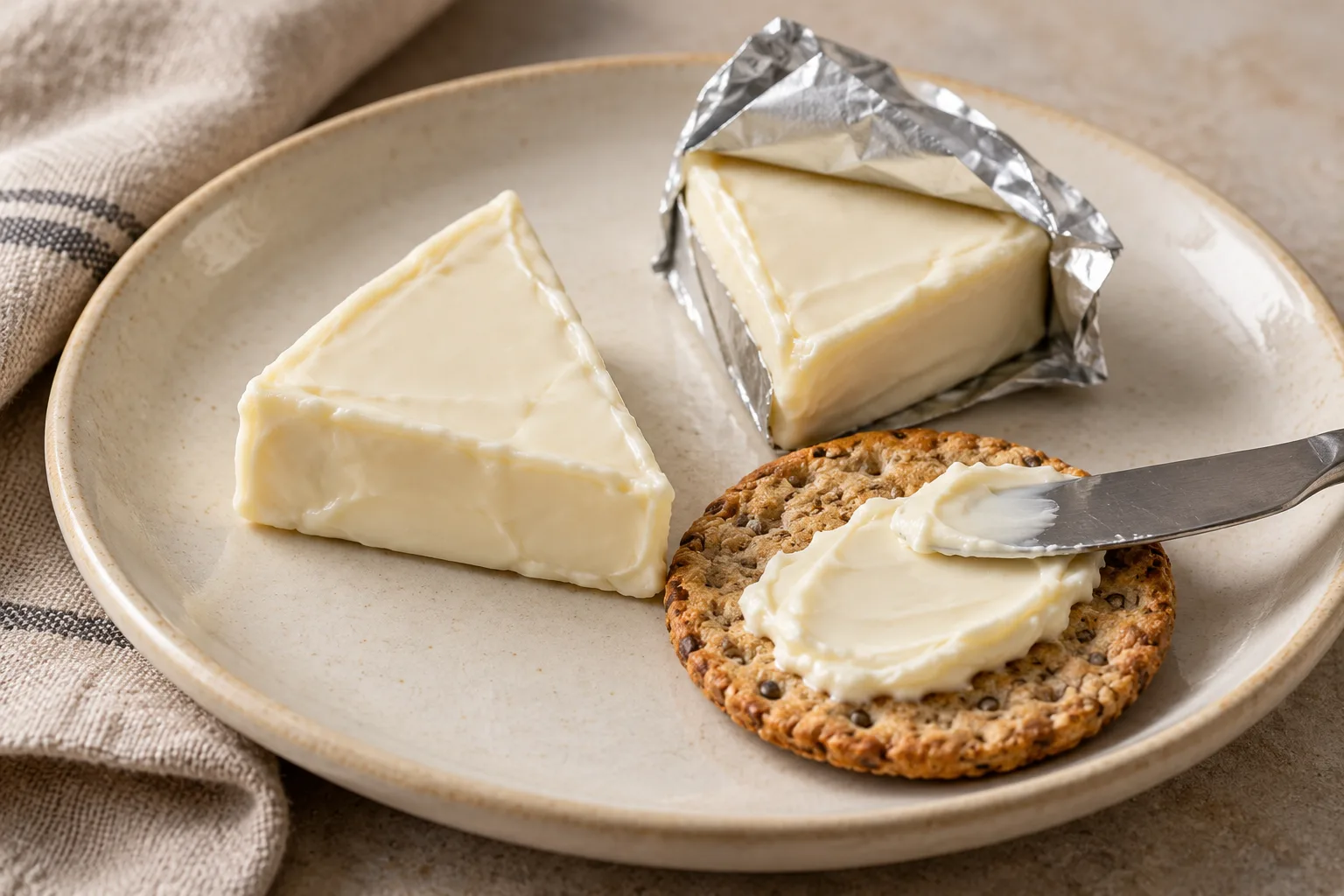
The Laughing Cow Creamy Original Double Pack, US label; one 19-g wedge.
The figures here describe the US Creamy Original Double Pack, with a 19-g wedge. Light, flavored, plant-based and non-US versions may have different formulations. Check the panel on each different variety.
What is in the reviewed wedge?
The manufacturer lists cheese, whey, milk protein concentrate, butter, water, skim milk and other ingredients, including salts used in the formulation and added vitamins. The product declares milk as an allergen. The ingredient list describes how the spread is made; the panel gives the quantities relevant to a serving. The Laughing Cow Creamy Original US label
Processing is not a sufficient reason to label a food harmful. The actual protein amount is 2 g per wedge. Use its actual composition rather than either marketing or a blanket judgment about processing.
The US Creamy Original panel
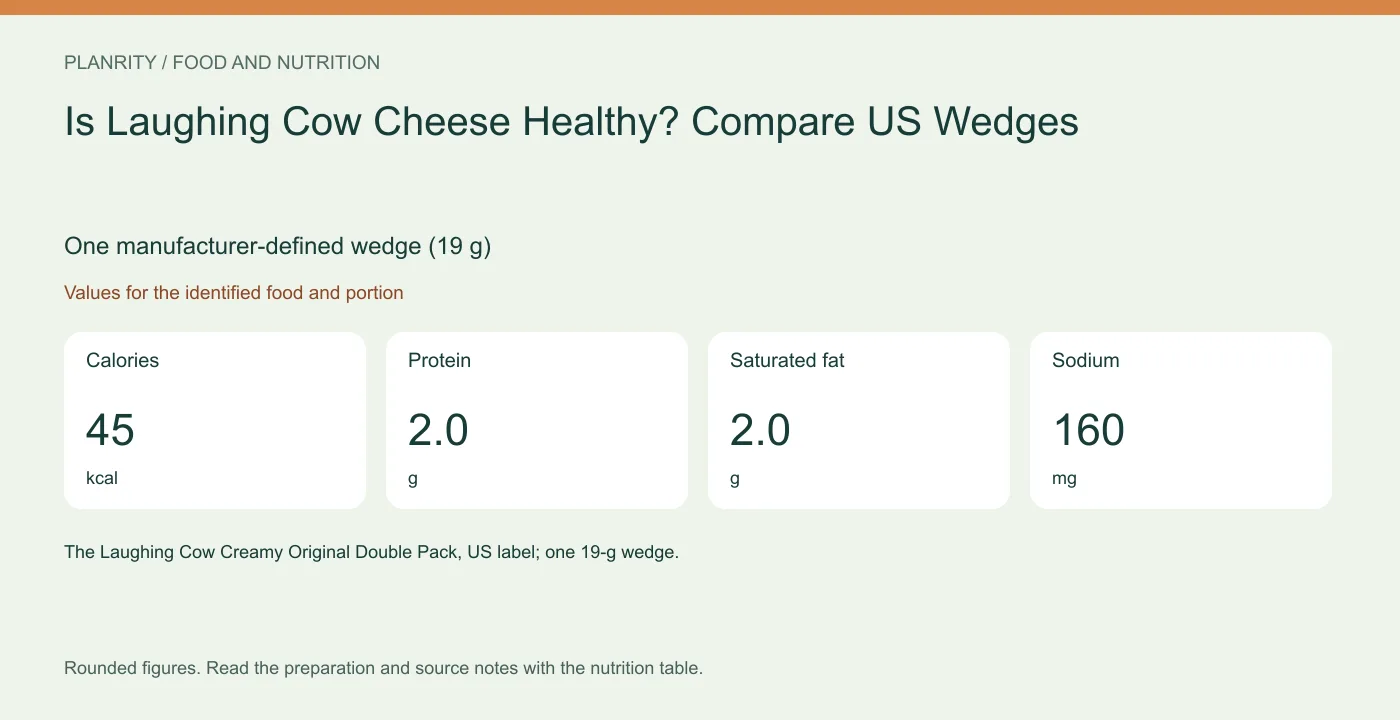
Source: The Laughing Cow Creamy Original Double Pack, US label; one 19-g wedge.
The current reviewed panel lists 45 calories and 2 g protein per 19-g wedge. Other versions can differ. Per-100-g figures are calculated from rounded label amounts, so the extra digits do not represent additional analytical precision.
The panel also reports calcium and vitamins A and D. Those fortifying nutrients contribute to the diet alongside the nutrients from the cheese itself.
Compare equal weights and individual servings
All rows below use the same 100-g weight.
| Food | Calories (kcal) | Protein (g) | Fat (g) | Saturated fat (g) | Fiber (g) | Sodium (mg) |
|---|---|---|---|---|---|---|
| The Laughing Cow Creamy Original Double Pack, US label; one 19-g wedge | 237 | 10.5 | 18.4 | 10.5 | 0.0 | 842 |
| Babybel Original, US label; one 20-g piece | 350 | 20.0 | 25.0 | 17.5 | 0.0 | 750 |
| Yogurt, Greek, plain, nonfat (Includes foods for USDA’s Food Distribution Program) | 59 | 10.2 | 0.4 | 0.1 | 0.0 | 36 |
The Laughing Cow wedge and Babybel piece are not identical serving weights. Babybel Original provides a firmer cheese format, while the reviewed wedge is designed to spread. Compare both the amount eaten and the role the product plays.
| US label serving | Calories | Protein | Saturated fat | Sodium | Calcium |
|---|---|---|---|---|---|
| Creamy Original wedge, 19 g | 45 | 2 g | 2 g | 160 mg | 130 mg |
| Babybel Original piece, 20 g | 70 | 4 g | 3.5 g | 150 mg | 140 mg |
The lower-calorie wedge has slightly more sodium per serving in this pair. The firmer cheese supplies more protein in its slightly larger serving. These are concrete trade-offs, not a universal winner. The Laughing Cow Creamy Original US label Babybel Original US nutrition label
What the wedge can do well
Convenient spreading: A defined wedge can be easy to use on bread, crackers or vegetables. This can be practical when you want a small amount of creamy flavor.
Calcium contribution: One wedge lists 130 mg calcium, or 10% of the FDA’s 1,300-mg Daily Value used on labels for adults and children aged four and older. Other foods contribute the rest of your intake; this benchmark is not an individualized requirement. FDA Daily Values
A clear starting portion: Individual wrapping identifies the amount in one wedge. Count each wedge you eat; choose the number according to the whole snack and your appetite.
What to watch for
Protein amount: One wedge supplies 2 g protein, a modest contribution to the snack. Add other food if you need more nourishment or a larger protein component.
Sodium: The wedge and salty crackers can both contribute. Count the combination rather than evaluating only the spread’s calories.
Saturated fat: The amount belongs in the full day’s pattern if this nutrient matters to you. A low calorie count does not mean zero saturated fat.
Milk allergy: The reviewed product contains milk. Do not confuse lactose-related tolerance with an absence of milk proteins.
No fiber in the panel: Vegetables, fruit or a suitable grain can add a different nutrient contribution alongside it. Their actual amounts determine the snack’s totals.
Build the snack you actually need
A wedge on cucumber slices differs from a wedge spread over a large bagel. The spread amount may be the same while the complete snack changes substantially. This is why a cheese-only table cannot describe every use.
If you use multiple wedges in cooking, count all of them and the other ingredients. A creamy sauce made with the product still needs a recipe calculation. Count the full recipe, even when each wedge is small.
For a quick comparison, two wedges contain twice the per-wedge label amounts. Whether that is an appropriate portion depends on the meal and your needs; there is no universal daily wedge limit established here.
Compare varieties rather than guessing
A reduced-fat or light product can have a different panel and serving weight. The magnitude of any change needs the current label. A flavored version may introduce different seasonings or allergens, while a plant-based product can differ in protein and fortification.
Use the exact market version. A website or package from another country may describe a different recipe. If you see conflicting calorie or nutrient figures, record the product name, country and weight before deciding which applies.
Storage and special dietary needs
Follow the actual package’s refrigeration instructions. When the package requires refrigeration, keep it cold in a lunch bag too, using an insulated container with an appropriate cold source.
People with strict sodium or other medical restrictions should use individual targets and verified package data. For allergy management, read ingredients and relevant cross-contact information rather than relying on a cheese category.
Shopping checklist
- Identify Creamy Original or the exact alternative variety.
- Match the US panel and wedge weight.
- Compare protein, calcium, sodium and saturated fat together.
- Count the number of wedges used.
- Include crackers, bread or sauce ingredients in the meal.
- Check milk and any other allergens.
- Follow storage directions on the actual package.
Read the spread and its base as separate ingredients
A defined wedge makes one part of the snack easy to count. The bread, crackers or vegetables still need their own portion information if you are calculating a total. Using a whole-grain base can change fiber, but its actual formulation and amount matter. Avoid giving the spread credit for nutrients supplied by its accompaniment, or blaming it for sodium that comes from another ingredient.
Compare the spread, then the base
Two Creamy Original wedges supply 90 calories, 4 g protein and 320 mg sodium. One Babybel Original piece supplies 70 calories, 4 g protein and 150 mg sodium. Those are practical portions with different weights and textures; the equal-weight table answers a separate density question. Choose the spread when you want spreadability, then compare the amount you would actually use.
Count the base as well. Several crackers, a large bagel and a slice of bread contribute different amounts of food even under the same thin cheese layer. If you use wedges to make a sauce, count all wedges and the rest of the recipe. A portioned wedge can make that easy, while the milk-allergen statement and refrigeration directions remain relevant regardless of how small the portion is.
What to take away
The Laughing Cow Creamy Original is useful when you want a portioned, spreadable cheese. One wedge contributes some protein and calcium, while sodium and saturated fat increase with each extra wedge. Compare it with Babybel by weight and by the portions you would eat, then include bread or crackers in the snack. Other varieties need their own labels. Spreadability and a low calorie count do not answer every nutritional question.
Related food guides
Frequently asked questions
How many calories are in the reviewed wedge?
The US Creamy Original Double Pack panel reviewed here lists 45 calories per 19-gram wedge. Different varieties, markets or revised formulations may differ. Check the package rather than assuming every Laughing Cow wedge has that value.
Is it lower in sodium than Babybel?
Not in the reviewed per-serving comparison: the wedge lists 160 milligrams and the 20-gram Babybel Original piece lists 150 milligrams. Serving weights differ slightly, so use the equal-weight table when comparing density.
Is a wedge a high-protein snack by itself?
The reviewed wedge supplies 2 grams of protein. That may be useful as part of a snack, but one wedge provides only a small part of a larger protein-containing meal. Consider your appetite and other foods rather than treating the cheese format as a protein guarantee.
Does processing make the product unhealthy?
Processing alone does not answer the nutrition question. Inspect the actual nutrients, ingredients, serving and dietary suitability. The product can fit some uses while contributing sodium and saturated fat; both observations can be true without a universal good-or-bad label.
Sources
- Yogurt, Greek, plain, nonfat (Includes foods for USDA's Food Distribution Program); 170894, USDA
- The Laughing Cow Creamy Original US label, The Laughing Cow
- Babybel Original US nutrition label, Babybel
- How to Understand and Use the Nutrition Facts Label | FDA, FDA
- Sodium in Your Diet | FDA, FDA
- American Heart Association guidance on dietary fats, American Heart Association
- Daily Value on the Nutrition and Supplement Facts Labels, US Food and Drug Administration