Breads and grains
Are Waffles Healthy? Batter, Portions and Toppings
Compare frozen and homemade waffle references and two calculated breakfasts. See how fruit, yogurt, syrup and butter change protein, sugar and portions.
The short answer
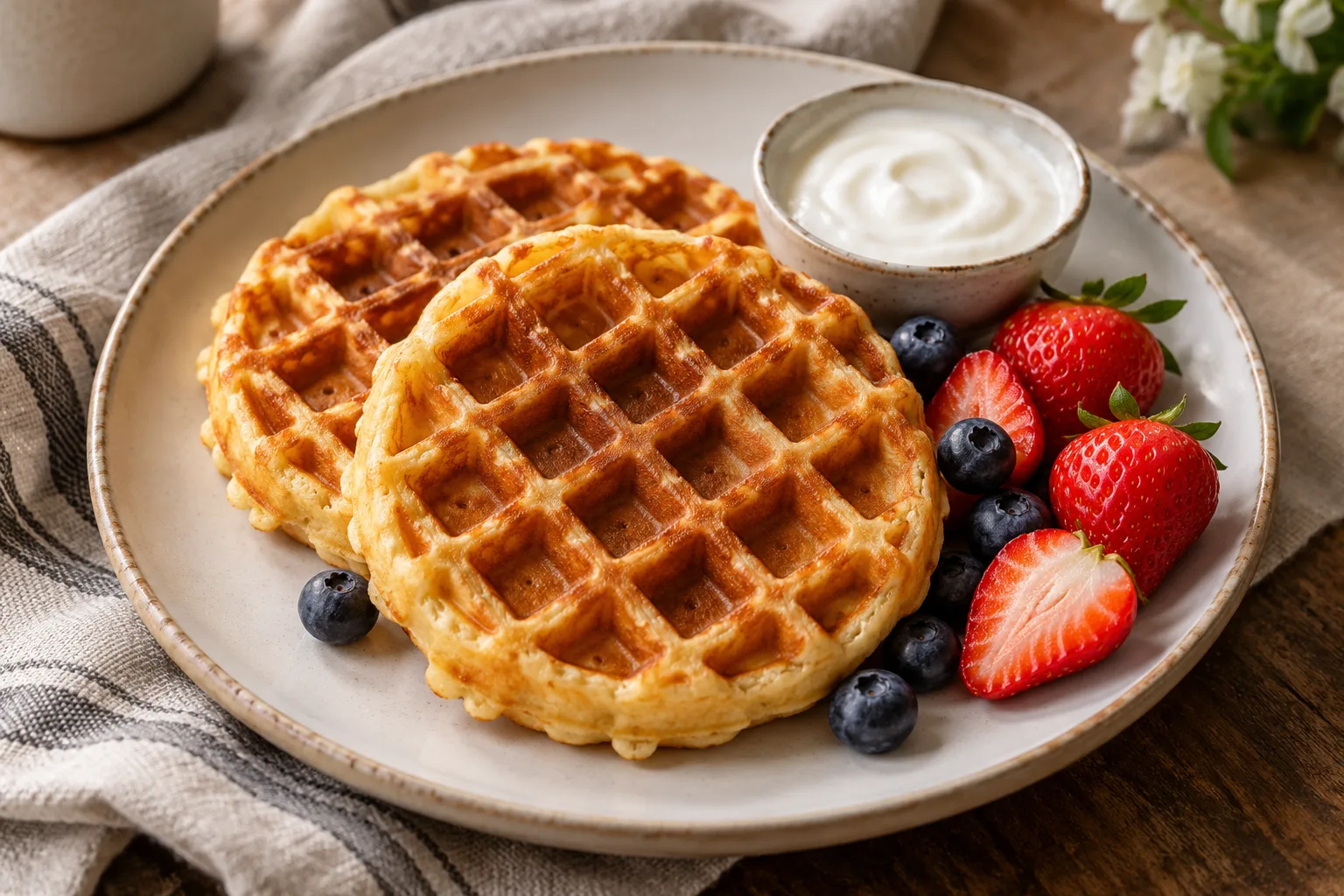
Sometimes Waffles can fit breakfast, but toppings and the rest of the meal determine how substantial it is. Two illustrative frozen waffles (70 g) supply about 200 calories and 4.5 g protein. Fruit and plain yogurt add different nutrients from syrup and butter; compare the complete breakfast rather than the waffle alone.
| Nutrient | Two illustrative 35-g waffles (70 g) | Per 100 g |
|---|---|---|
| Calories | 200 kcal | 285 kcal |
| Protein | 4.5 g | 6.5 g |
| Total fat | 6.8 g | 9.7 g |
| Saturated fat | 1.1 g | 1.5 g |
| Carbohydrate | 30.1 g | 43.0 g |
| Fiber | 1.5 g | 2.2 g |
| Total sugar | 3.4 g | 4.9 g |
| Sodium | 447 mg | 638 mg |
| Calcium | 216 mg | 308 mg |
| Iron | 3.9 mg | 5.6 mg |
| Potassium | 88 mg | 125 mg |
USDA FoodData Central, FDC 175038.
Instead of judging the waffle alone, consider whether the breakfast supplies enough food, protein and fiber for you. The calculations below show how changing toppings can create different meals using the same waffle amount.
What varies between waffles?
Flour, eggs, milk, oil, butter and sugar can all appear in batter. Some products use whole grains, added protein or different allergen substitutes. Belgian-style, small frozen and homemade iron-sized waffles can have very different weights.
“One waffle” is therefore not a reliable equal portion across products. The main example uses a weighed 70-g amount, described as two illustrative small waffles. Check your package’s actual piece weight rather than assuming every waffle is 35 g.
Plain frozen-waffle nutrition
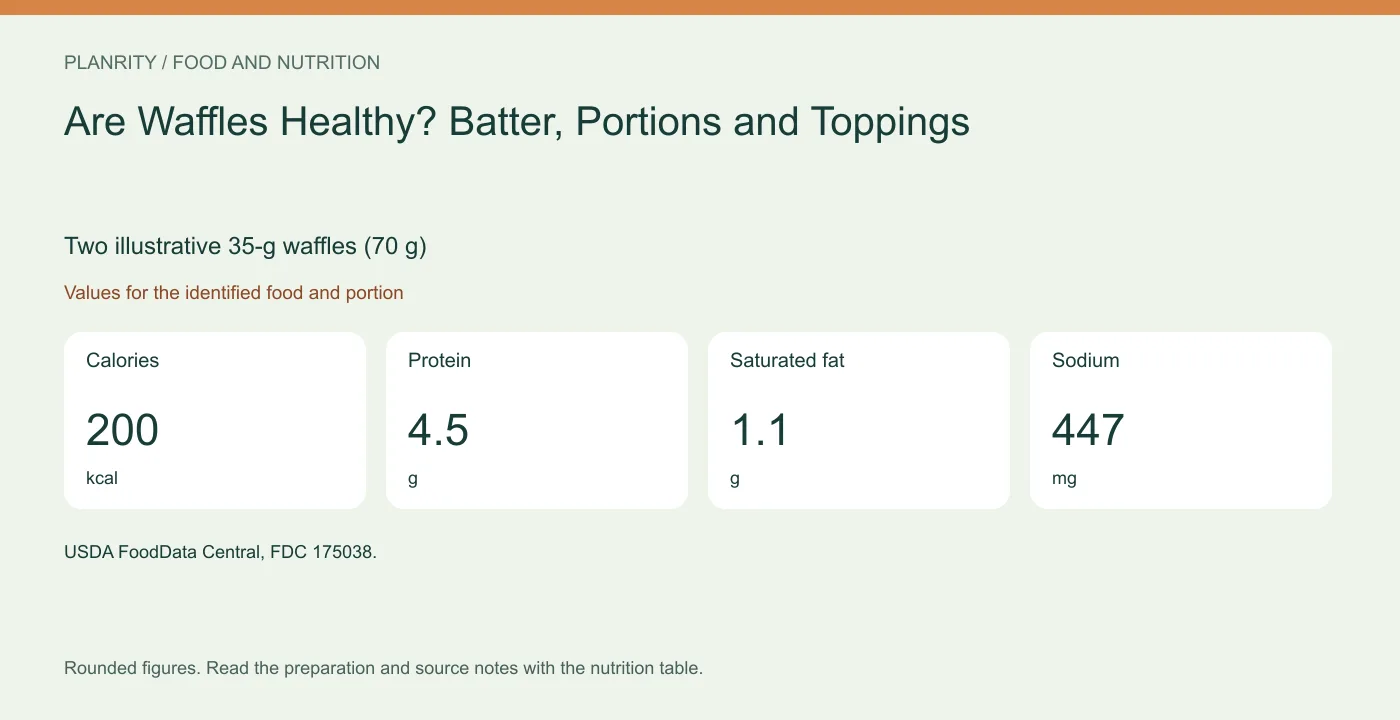
Source: USDA FoodData Central, FDC 175038.
The reference describes frozen waffles ready to heat. Toast them according to your package and use its stated serving for a different brand. Toasting removes some water, so a final cooked gram weight may differ from the starting weight even when no butter or oil is added. For the examples below, keep the original 70-g waffle allocation and count toppings separately.
Compare batter and breakfast formats
All rows below use the same 100-g weight.
| Food | Calories (kcal) | Protein (g) | Fat (g) | Saturated fat (g) | Sodium (mg) |
|---|---|---|---|---|---|
| Waffles, plain, frozen, ready-to-heat | 285 | 6.5 | 9.7 | 1.5 | 638 |
| Waffles, plain, prepared from recipe | 291 | 7.9 | 14.1 | 2.9 | 511 |
| Waffles, whole wheat, lowfat, frozen, ready-to-heat | 257 | 7.1 | 3.6 | 0.7 | 557 |
| Frozen waffles with strawberries and plain yogurt | 108 | 5.7 | 2.8 | 0.4 | 179 |
| Same waffles with maple syrup and butter | 326 | 3.8 | 14.7 | 6.7 | 437 |
The homemade row uses a different recipe from the frozen rows. Compare the batter ingredients and portion rather than assuming that making a waffle at home always lowers its fat or calories.
The whole-wheat frozen reference has its own formulation, including its low-fat description. Do not assume that every whole-grain waffle has those values. Compare the actual panel if fiber, sodium or another nutrient is the priority.
Ingredients for Frozen waffles with strawberries and plain yogurt
| Ingredient record | Grams |
|---|---|
| Waffles, plain, frozen, ready-to-heat; 175038 | 70 |
| Strawberries, raw; 167762 | 100 |
| Yogurt, Greek, plain, nonfat (Includes foods for USDA’s Food Distribution Program); 170894 | 100 |
| Nutrient | One calculated portion (270 g) | Per 100 g |
|---|---|---|
| Calories (kcal) | 290 | 108 |
| Protein (g) | 15.4 | 5.7 |
| Total fat (g) | 7.5 | 2.8 |
| Saturated fat (g) | 1.2 | 0.4 |
| Carbohydrate (g) | 41.4 | 15.3 |
| Fiber (g) | 3.5 | 1.3 |
| Total sugar (g) | 11.6 | 4.3 |
| Sodium (mg) | 484 | 179 |
| Calcium (mg) | 342 | 127 |
| Iron (mg) | 4.4 | 1.6 |
| Potassium (mg) | 382 | 141 |
This example uses plain nonfat Greek yogurt and unsweetened strawberries. The fruit contributes naturally occurring sugar, while the plain yogurt’s total sugar includes milk sugar. These are different from syrup or sugar added as a sweetener.
Ingredients for Same waffles with maple syrup and butter
| Ingredient record | Grams |
|---|---|
| Waffles, plain, frozen, ready-to-heat; 175038 | 70 |
| Syrups, maple; 169661 | 40 |
| Butter, salted; 173410 | 14 |
| Nutrient | One calculated portion (124 g) | Per 100 g |
|---|---|---|
| Calories (kcal) | 404 | 326 |
| Protein (g) | 4.7 | 3.8 |
| Total fat (g) | 18.2 | 14.7 |
| Saturated fat (g) | 8.3 | 6.7 |
| Carbohydrate (g) | 56.9 | 45.9 |
| Fiber (g) | 1.5 | 1.2 |
| Total sugar (g) | 27.6 | 22.3 |
| Sodium (mg) | 541 | 437 |
| Calcium (mg) | 260 | 209 |
| Iron (mg) | 4.0 | 3.2 |
| Potassium (mg) | 176 | 142 |
The same waffle amount is paired with weighed maple syrup and butter. Maple syrup used as a topping contributes added sugar to the meal, even though the ingredient is a naturally derived syrup. The syrup’s total sugar is not nutritionally exempt because it is “real maple.” Added Sugars on the Nutrition Facts Label | FDA
These combinations have different weights as well as different nutrients. Compare their full serving totals when planning breakfast. Per-100-g density helps describe concentration but does not replace the amount of food you eat.
What waffles can do well
A convenient grain component: Frozen waffles can be easy to prepare, while homemade batter offers ingredient control. Convenience and time matter when choosing a realistic breakfast.
A platform for other foods: Fruit, yogurt, nut butter or eggs can change the meal’s protein, fiber and volume. The right addition depends on preferences, allergies and appetite.
Flexible formulation: Whole-grain flour or a different batter may suit your needs. Substitutions should be evaluated from their own ingredients rather than assigned the original recipe’s nutrition.
What to watch for
Sodium can come from salt and leavening as well as savory toppings. Sweet breakfast foods can still contain substantial sodium. Check the panel instead of relying on taste.
Syrup, butter, whipped toppings and spreads can change the meal substantially. Measuring a usual topping once can make the amount easier to understand. It is not necessary to eliminate a topping you enjoy to make a thoughtful choice.
Protein and fiber vary by product. Individual appetite and meal context differ, and a product’s marketing cannot establish a universal response.
Dietary and practical considerations
Wheat, milk and egg are common batter ingredients. Nut toppings introduce additional allergens. A gluten-free waffle may have a different fiber or protein content rather than being nutritionally equivalent to a whole-wheat one.
Someone managing carbohydrate intake should count the waffle and toppings together. Fruit, yogurt and syrup contribute different foods but can all add carbohydrate. Use individual dietary advice where it applies rather than relying on a blanket “healthy topping” label.
For a homemade recipe, record the entire batter, the number of waffles and final cooked yield. Oil used on the iron belongs in the estimate if a material amount is retained. A scoop count alone is not a verified serving weight.
Breakfast checklist
- Check grams per waffle and number per label serving.
- Compare actual fiber, protein and sodium.
- Identify whether the record is frozen or toasted.
- Count syrup, butter and spreads separately.
- Add foods that complete the meal for your needs.
- Check allergens in batter and toppings.
- Treat homemade substitutions as a new calculation.
Choose toppings before the first pour
With the same 70-g waffle amount, the strawberry-and-plain-yogurt example comes to about 290 calories for the full breakfast. The syrup-and-butter version comes to about 404. The first combination also has more protein because of the yogurt. These are two complete ingredient combinations, so the difference includes all their toppings and serving weights.
Choose according to the breakfast you want. If you prefer syrup, measure the amount you enjoy and add other foods if you need more protein or produce. If you choose yogurt, check whether it is plain or sweetened and use its actual label. For a different waffle brand, keep toppings fixed while replacing the waffle contribution. That makes the comparison useful without treating every homemade, whole-grain or frozen waffle as nutritionally identical.
What to take away
Choose the waffle and toppings together. Fruit with plain yogurt provides a different breakfast from syrup with butter, even when the waffle amount stays unchanged. A whole-grain or protein claim still needs a serving weight and a label, and homemade batter has its own ingredients. For a useful comparison, keep one part of the meal fixed while changing another, then consider the full breakfast you will actually eat.
Related food guides
Frequently asked questions
Is maple syrup healthier than other added sugars?
Maple syrup used as a topping still contributes added sugar. Its origin does not remove that contribution. Compare the actual amount and the meal as a whole rather than treating “real maple” as a reason not to count it.
Are homemade waffles always better than frozen?
No. The ingredients and portions determine the result. A homemade batter can contain more butter or sugar, while a frozen product may offer convenience or a particular formulation. Compare recipes and panels rather than the place where the waffle was made.
Does fruit sugar count as added sugar?
Sugar naturally present in whole fruit is not added sugar. Sweetened fruit toppings or syrups may contain added sugars. Read ingredients and keep total sugar separate from added sugar when evaluating a topping or calculating a breakfast.
Why compare breakfast totals as well as equal weights?
Equal weights show nutrient density, while full servings describe what you actually eat. The fruit-and-yogurt example weighs more than the syrup-and-butter example. Neither comparison alone tells the whole story about the amount of food or its nutritional balance.
Sources
- Strawberries, raw; 167762, USDA
- Syrups, maple; 169661, USDA
- Yogurt, Greek, plain, nonfat (Includes foods for USDA's Food Distribution Program); 170894, USDA
- Butter, salted; 173410, USDA
- Waffles, whole wheat, lowfat, frozen, ready-to-heat; 174085, USDA
- Waffles, plain, frozen, ready-to-heat; 175038, USDA
- Waffles, plain, prepared from recipe; 175039, USDA
- How to Understand and Use the Nutrition Facts Label | FDA, FDA
- Added Sugars on the Nutrition Facts Label | FDA, FDA
- Sodium in Your Diet | FDA, FDA
- Selecting and Serving Produce Safely | FDA, FDA
- USDA FSIS: Leftovers and Food Safety, USDA