Breads and grains
Is Quiche Healthy? Crusted and Crustless Comparisons
Compare the same quiche filling with and without crust using weighed ingredients. Understand protein, saturated fat, yield limits and safe cooking.
The short answer
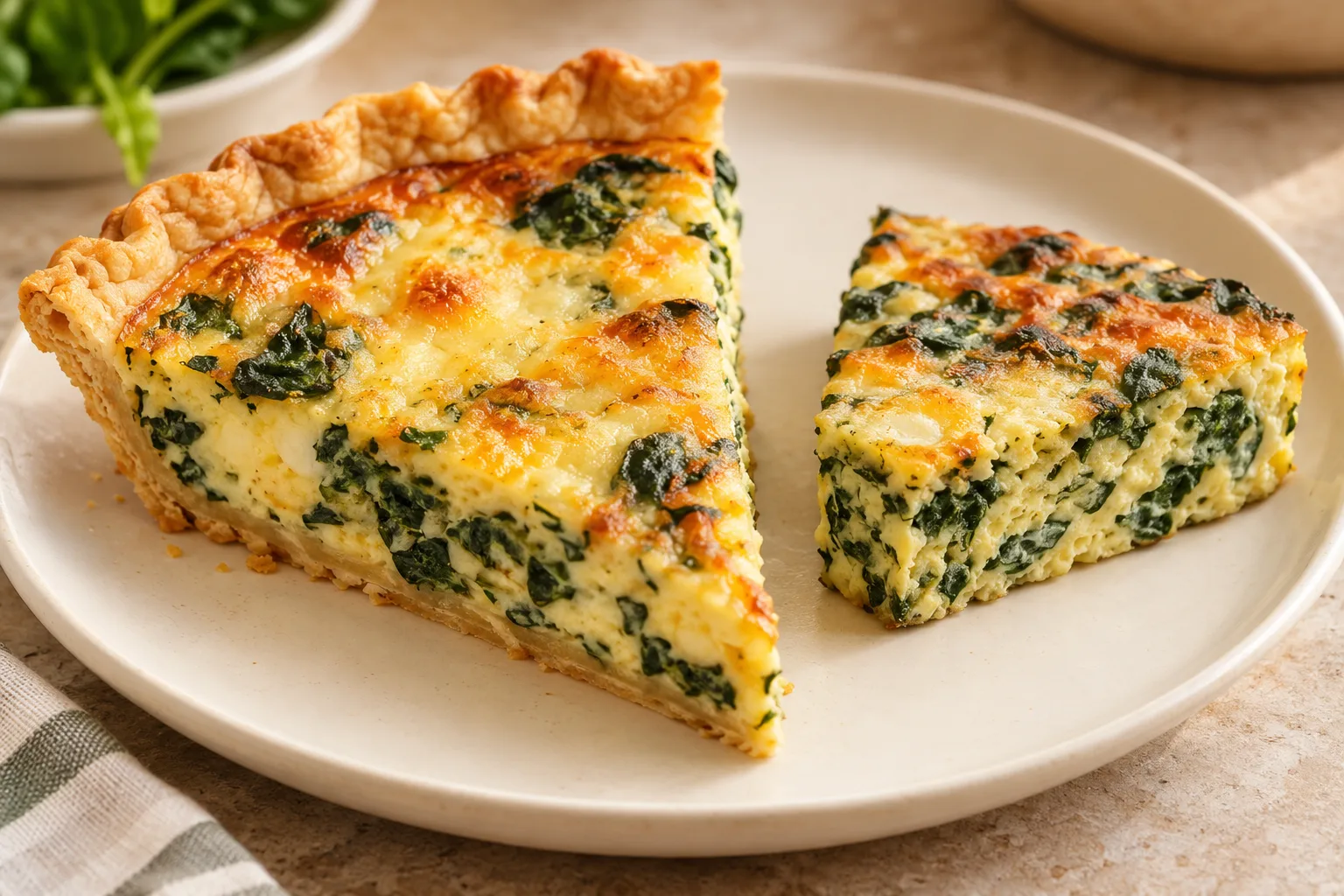
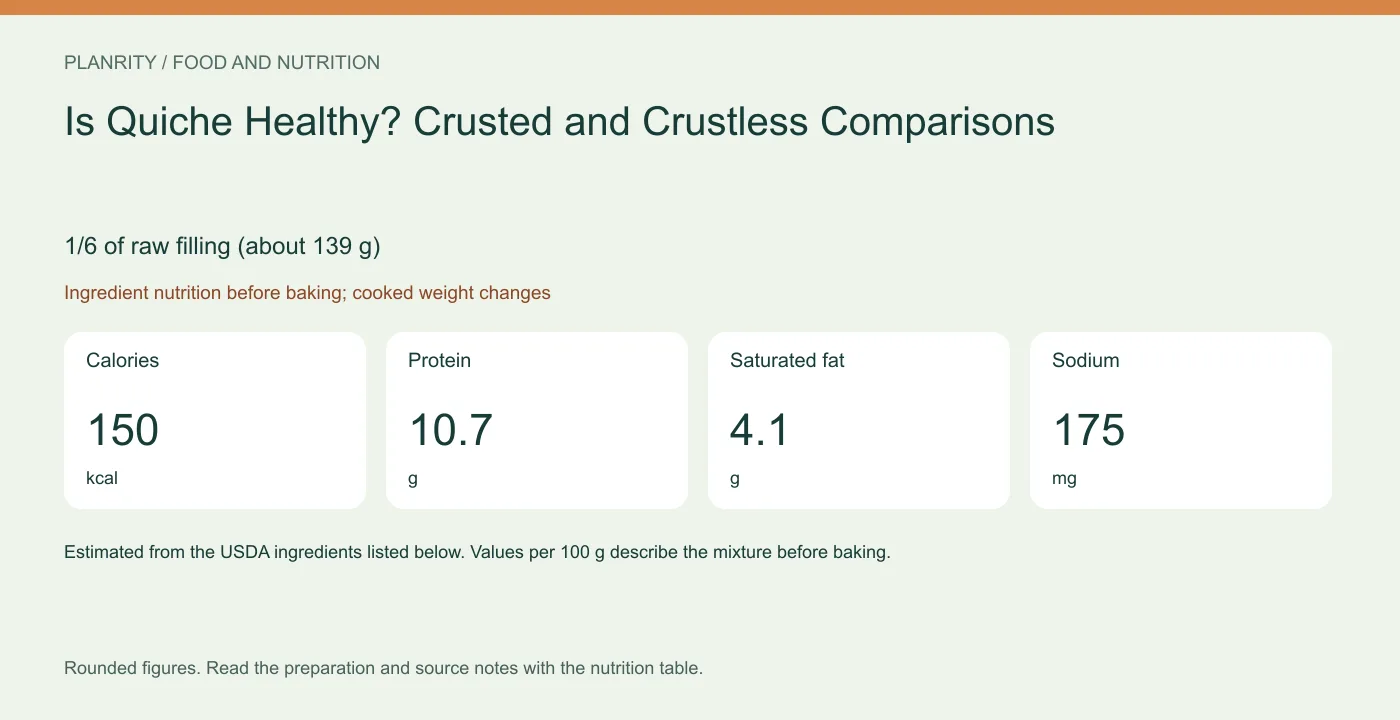
Sometimes Quiche can provide protein, while cheese, pastry and slice size determine its saturated fat and calories. One sixth of the crustless spinach recipe here is estimated at 150 calories and 10.7 g protein before cooking losses. Compare the same share of filling when deciding whether to add crust; a smaller crustless slice is a different comparison.
| Nutrient | 1/6 of raw filling (about 139 g) | Per 100 g |
|---|---|---|
| Calories | 150 kcal | 108 kcal |
| Protein | 10.7 g | 7.7 g |
| Total fat | 9.8 g | 7.1 g |
| Saturated fat | 4.1 g | 2.9 g |
| Carbohydrate | 4.8 g | 3.4 g |
| Fiber | 0.8 g | 0.6 g |
| Total sugar | 2.9 g | 2.1 g |
| Sodium | 175 mg | 126 mg |
| Calcium | 175 mg | 126 mg |
| Iron | 1.6 mg | 1.2 mg |
| Potassium | 292 mg | 210 mg |
Estimated from the USDA ingredients listed below. Values per 100 g describe the mixture before baking.
A fair comparison keeps the filling constant and changes one feature at a time. The two models below use the same egg, milk, cheese and vegetable filling, with a documented pastry addition in one version.
What a quiche contains
Quiche is a baked savory egg mixture, often containing milk or cream, cheese and other fillings, sometimes in pastry. Recipes vary in egg-to-dairy ratio, crust size and the amount of meat or vegetables.
Eggs contribute protein and fat, while cheese, milk, cream and pastry add their own nutrients. It would be inaccurate to say that all saturated fat comes from crust and cream or that eggs have no relevance to the complete profile.
Ingredients for Crustless spinach quiche ingredient estimate
This proposed filling uses six large eggs represented by 300 g edible raw egg, reduced-fat milk, cheddar, spinach, onion and measured oil. The number of eggs is approximate; use the gram amount to reproduce the calculation. Egg size and shell weight can vary.
For a proposed preparation, chop and soften the onion with the measured oil, then incorporate the spinach. Whisk the eggs and milk, mix in the cheese and vegetables, and transfer to a suitable baking dish. Bake at 375°F until the center reaches the appropriate safe endpoint; the setting is a method choice, not the safety test.
USDA lists 165°F for casseroles. This article uses that endpoint for the mixed baked dish. Check the center with a food thermometer rather than relying only on a set surface or browned edges. USDA safe minimum internal temperatures
Slice size after baking
The per-100-g figures describe the raw ingredient allocation before baking. The per-sixth values divide the full ingredient total evenly. Final cooked yield, water loss, food left in the dish and nutrient retention have not been measured.
Do not label the cooked slice as weighing 139.2 g merely because that is one sixth of the raw ingredient sum. Weigh the finished edible quiche before claiming a cooked slice weight.
Ingredients for Same filling with refrigerated pastry crust
| Nutrient | One sixth of raw ingredients (172.5 g) | Per 100 g of raw ingredients |
|---|---|---|
| Calories (kcal) | 299 | 173 |
| Protein (g) | 11.7 | 6.8 |
| Total fat (g) | 18.3 | 10.6 |
| Saturated fat (g) | 7.3 | 4.2 |
| Carbohydrate (g) | 21.8 | 12.6 |
| Fiber (g) | 1.4 | 0.8 |
| Sodium (mg) | 312 | 181 |
| Calcium (mg) | 178 | 103 |
| Iron (mg) | 1.9 | 1.1 |
| Potassium (mg) | 316 | 183 |
The crusted calculation adds 200 g refrigerated unbaked pastry to the same filling. It is a model, not a kitchen-tested pan-fitting instruction. A particular crust may need different dimensions or preparation, and its package instructions take precedence for its use.
Compare recipe states carefully
All rows below use the same 100-g weight.
| Food | Calories (kcal) | Protein (g) | Fat (g) | Saturated fat (g) | Fiber (g) | Sodium (mg) |
|---|---|---|---|---|---|---|
| Crustless spinach quiche ingredient estimate | 108 | 7.7 | 7.1 | 2.9 | 0.6 | 126 |
| Same filling with refrigerated pastry crust | 173 | 6.8 | 10.6 | 4.2 | 0.8 | 181 |
| Egg, whole, raw, fresh | 143 | 12.6 | 9.5 | 3.1 | 0.0 | 142 |
| Milk, reduced fat, fluid, 2% milkfat, with added vitamin A and vitamin D | 50 | 3.3 | 2.0 | 1.3 | 0.0 | 47 |
The two recipe rows use raw ingredient bases and are comparable as ingredient models. The egg and milk rows are individual ingredients, not complete meals. They help identify contributions without suggesting that a 100-g portion of milk is an equivalent quiche serving.
Adding crust increases the batch’s weight and changes both total nutrients and density. Compare each full sixth-portion total if that is how the quiches will be divided. Equal-weight density answers a separate question.
What quiche can contribute
Protein: Eggs, dairy and any additional protein ingredients contribute. The amount depends on the actual slice and recipe, so a universal protein figure for “a slice” is unreliable.
Vegetable additions: Spinach, onion, mushrooms or other vegetables can add variety. Count the vegetables per slice rather than the amount in the whole pie.
A make-ahead meal component: A baked dish can be divided into defined portions. That convenience works only alongside safe cooling, storage and reheating.
Trade-offs beyond the crust
Using milk rather than heavy cream changes the filling, but that is a separate substitution from removing pastry. To quantify both changes, build matched calculations rather than attributing every difference to the crust.
Cheese, bacon, sausage, smoked fish and seasoning can contribute sodium and saturated fat. A cheese-heavy crustless quiche can still supply substantial sodium and saturated fat. Count the ingredients actually used.
The recipe may provide little fiber unless there is enough vegetable or another fiber-containing ingredient. A side salad, beans or another food can contribute to the meal according to your preferences. Choose a slice and accompaniments that make a substantial enough meal for you.
Dietary considerations
This recipe contains egg and milk, and the crusted version contains wheat. A dairy-free milk alternative may differ in protein, fat and setting behavior. An egg-free dish needs a different formulation rather than a simple label change.
People with medically directed cholesterol, saturated-fat, sodium or other restrictions should use individualized advice and the complete recipe. Avoid a blanket statement that dietary cholesterol is irrelevant or that eggs are the sole nutritional issue.
Portion and storage
One sixth is a recipe division, not a prescribed intake. A smaller or larger slice changes nutrient intake, while sides change the meal. Weigh portions when precise calculation matters.
Cool and refrigerate leftovers promptly in suitable shallow portions. USDA advises using properly refrigerated leftovers within three to four days, and reheating leftovers to 165°F. USDA FSIS: Leftovers and Food Safety USDA safe minimum internal temperatures
Cooking checklist
- Record egg and dairy weights, not only package counts.
- Keep the filling constant for a crust-only comparison.
- Count cheese, meats, pastry and added fat.
- Check the center temperature with a thermometer.
- Measure cooked yield before reporting cooked density.
- Label substitutions as new calculations.
- Include sides when evaluating the meal.
Compare the same share of the filling
Use the same sixth of the filling to compare crust choices. Adding the listed 200-g pastry crust raises the ingredient estimate from about 150 to 299 calories per sixth. The difference is about 149 calories per portion, with additional fat and carbohydrate from the pastry. Comparing a smaller crustless slice with a larger crusted slice would change both the recipe and the amount eaten.
For serving, let the cooked dish cool enough to handle, then divide it into the intended number of portions. Its cooked gram weight will differ from the raw ingredient allocation. Keep accompaniments separate if calculating a meal: salad, bread and dressing add their own food amounts. If using another crust, follow its preparation directions and replace its nutrient contribution with the actual package values.
What to take away
Choose quiche by its filling, pastry and the slice you plan to serve. The crustless estimate offers protein, but cheese and eggs still contribute saturated fat. To isolate the crust’s effect, compare the same share of the same filling in both versions. Weigh the cooled cooked batch if you need density per 100 g, and follow the safe casserole endpoint. A salad or other accompaniment can complete the meal without changing the quiche’s own figures.
Related food guides
Frequently asked questions
Is crustless quiche always low in saturated fat?
No. Cheese, cream, eggs and other ingredients still contribute according to the recipe. Removing pastry changes one component. Compare the complete formulation rather than assuming crustless means low in every nutrient you are managing.
Are the calculated slice weights cooked weights?
No. They divide the raw ingredient sum by six. Baking changes weight and may change retained nutrients. A final cooked batch weight is required before reporting precise cooked slice weights or cooked per-100-gram values.
Can I replace milk with any plant drink?
Different drinks have different protein, fat and ingredients, and the custard may set differently. Use an appropriate tested recipe when making a substantial substitution, and recalculate with the actual product. The original nutrition estimate does not necessarily apply.
What temperature is used for this mixed baked dish?
The article follows USDA’s 165°F casserole endpoint. Check the center with a food thermometer. An oven setting or a browned surface does not tell you the internal temperature, and reheated leftovers also need the applicable safe endpoint.
Sources
- Pie crust, refrigerated, regular, unbaked; 167932, USDA
- Spinach, raw; 168462, USDA
- Onions, raw; 170000, USDA
- Milk, reduced fat, fluid, 2% milkfat, with added vitamin A and vitamin D; 171267, USDA
- Egg, whole, raw, fresh; 171287, USDA
- Oil, olive, salad or cooking; 171413, USDA
- Cheese, cheddar (Includes foods for USDA's Food Distribution Program); 173414, USDA
- USDA safe minimum internal temperatures, USDA
- USDA FSIS: Leftovers and Food Safety, USDA
- How to Understand and Use the Nutrition Facts Label | FDA, FDA
- Sodium in Your Diet | FDA, FDA
- American Heart Association guidance on dietary fats, American Heart Association