Sauces and condiments
Is Pico de Gallo Healthy? Recipe, Sodium and Portions
See a measured pico de gallo recipe and compare equal dip weights. Understand sodium additions, vegetable portions, food safety and the complete snack.
The short answer
Yes Pico de gallo is a light vegetable topping when made and stored safely, with salt added to suit your needs. One eighth of the no-added-salt recipe here—about 71 g—supplies roughly 16 calories and 4 mg sodium. Salt and the chips served alongside it can change the snack much more than the vegetables do.
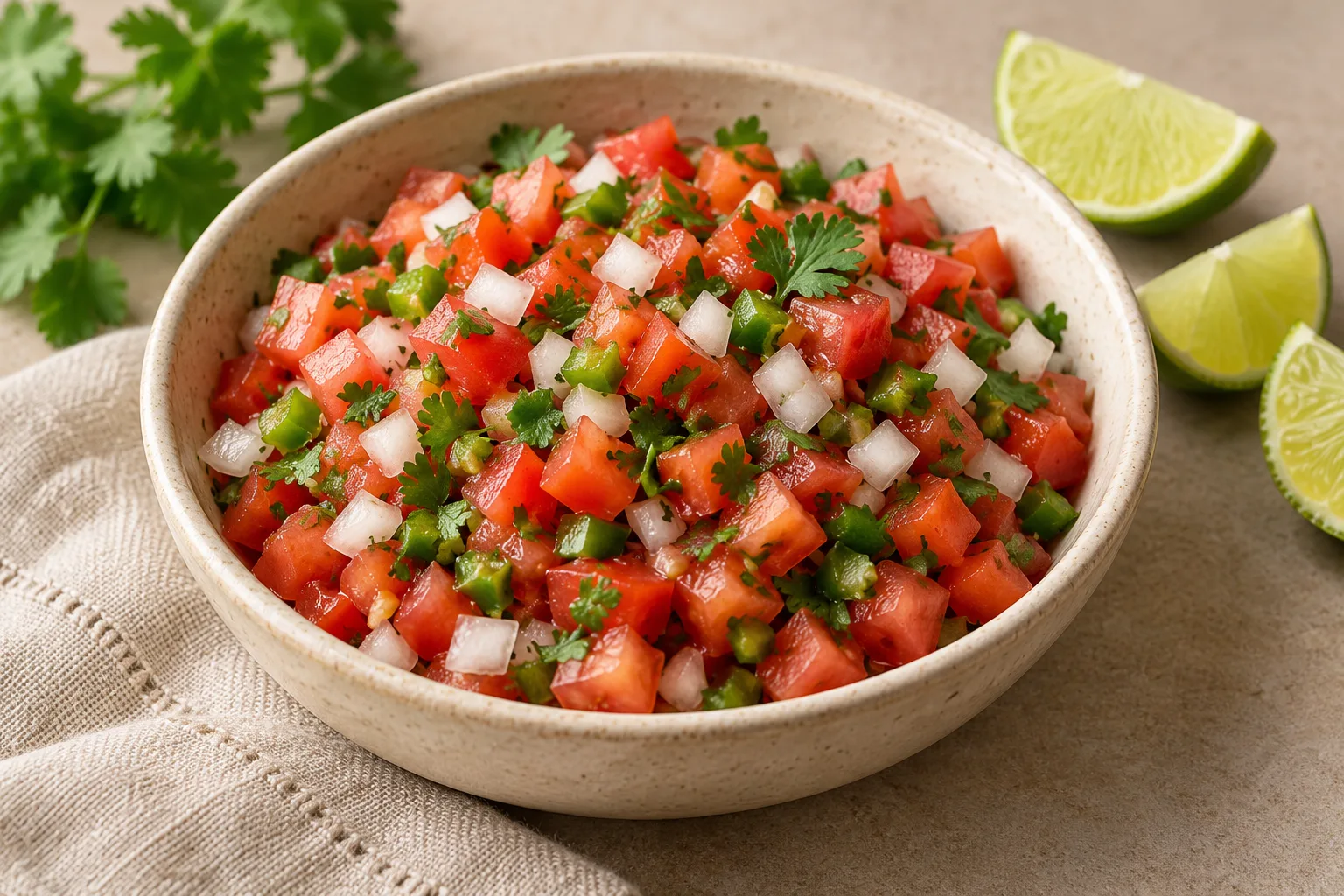
| Nutrient | 1/8 of recipe (about 71 g) | Per 100 g |
|---|---|---|
| Calories | 16 kcal | 23 kcal |
| Protein | 0.6 g | 0.9 g |
| Total fat | 0.1 g | 0.2 g |
| Saturated fat | 0.0 g | 0.0 g |
| Carbohydrate | 3.7 g | 5.3 g |
| Fiber | 0.9 g | 1.3 g |
| Total sugar | 2.0 g | 2.9 g |
| Sodium | 4 mg | 5 mg |
| Calcium | 10 mg | 14 mg |
| Iron | 0.2 mg | 0.3 mg |
| Potassium | 155 mg | 218 mg |
Estimated from the USDA ingredients listed below. Ingredient weights and portions are stated in the recipe.
Use pico as a topping for beans, fish or eggs, or as a fresh dip alongside chips. Its tomato, onion, chili and lime bring flavor without added oil in this version. The amount of salt and the foods served with it determine the finished snack.
What is in pico de gallo?
Pico de gallo commonly combines chopped tomato, onion, chili, cilantro and lime juice. Ingredients and ratios vary by household and region. Salt is optional in the recipe below, while some commercial or restaurant preparations include it.
Its fresh, chopped texture differs from many cooked or blended salsas. Fresh and cooked salsas both provide nutrients; compare their ingredients and added salt. The actual recipe determines the comparison.
Ingredients for Pico de gallo, no added salt
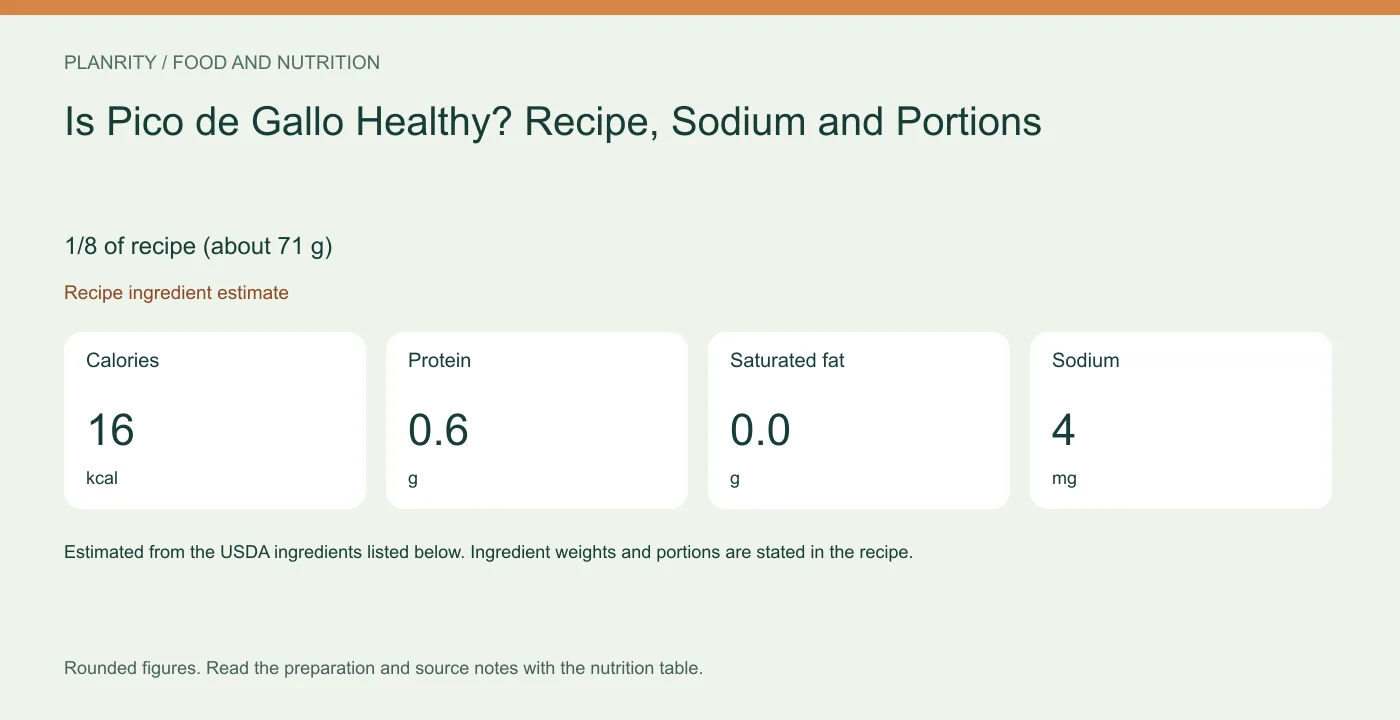
| Ingredient record | Grams |
|---|---|
| Tomatoes, red, ripe, raw, year round average; 170457 | 400 |
| Onions, raw; 170000 | 100 |
| Lime juice, raw; 168156 | 40 |
| Coriander (cilantro) leaves, raw; 169997 | 10 |
| Peppers, jalapeno, raw; 168576 | 20 |
Wash the produce under running water, then cut the tomato, onion and chili with clean equipment. Chop the cilantro and combine all ingredients with the measured lime juice. Retain the juices if using this calculation. Divide the 570-g batch into eight portions of 71.25 g. Selecting and Serving Produce Safely | FDA
The exact yield is an ingredient-sum model, not a weighed kitchen test. Discarding tomato liquid, leaving food in the bowl or changing the vegetable ratio changes the amount and potentially the composition eaten. Weigh your completed batch if you need a more precise serving calculation.
Nutrition and portion size
The portion is a recipe convention, not a universal cup measure or official recommendation. Chopping size and how tightly a cup is filled affect volume conversions. A gram weight is more reproducible for calculation.
Equal-weight dip comparisons
All rows below use the same 100-g weight.
| Food | Calories (kcal) | Protein (g) | Fat (g) | Saturated fat (g) | Fiber (g) | Sodium (mg) |
|---|---|---|---|---|---|---|
| Pico de gallo, no added salt | 23 | 0.9 | 0.2 | 0.0 | 1.3 | 5 |
| Sauce, salsa, ready-to-serve | 29 | 1.5 | 0.2 | 0.0 | 1.9 | 711 |
| Avocados, raw, all commercial varieties | 160 | 2.0 | 14.7 | 2.1 | 6.7 | 7 |
| Yogurt, Greek, plain, nonfat (Includes foods for USDA’s Food Distribution Program) | 59 | 10.2 | 0.4 | 0.1 | 0.0 | 36 |
The avocado row is plain avocado, not a measured guacamole recipe. The yogurt row is plain nonfat Greek yogurt, not a seasoned yogurt dip. They show different ingredient profiles rather than proving that one finished dip is universally better.
Pico is lower in energy density than avocado in these examples, while avocado contributes more fat and fiber. Yogurt contributes a different protein profile. A lower calorie figure is one feature, not a complete ranking of usefulness or nutritional value.
Make salt additions explicit
Using the USDA salt record, 2 g table salt adds about 775 mg sodium to the batch, or about 97 mg per eighth-batch portion. The new batch weight becomes 572 g if all ingredients are retained. The arithmetic is 38,758 mg per 100 g × 2 ÷ 100, then divided by eight. Salt, table; 173468
This addition is distinct from the small amount of sodium naturally present in the unsalted ingredients. It does not mean every restaurant serving contains the calculated amount. Use the actual recipe or panel for a commercial product.
What pico contributes
Vegetables and flavor: Tomato, onion and chili add produce in the amount actually consumed. A small garnish supplies less produce than a substantial vegetable side.
A low-fat topping option: The recipe includes no added oil. That can be useful when you want acidity and texture without a rich sauce, but other dips can contribute useful nutrients too.
Control of seasoning: A home recipe lets you choose salt and chili levels. The benefit comes from the defined choices, not from the word homemade.
Avoid exaggerated ingredient claims
Tomatoes, onions and herbs contribute nutrients as well as flavor. One eighth of this recipe contains about 0.9 g fiber, so it adds a modest amount rather than replacing a larger vegetable or bean serving. The amount you eat matters more than a list of nutrients found somewhere in the ingredients.
The same caution applies to vitamin language. Use the actual nutrient calculation before calling a small condiment serving a major source. It is more useful to describe its role in the meal accurately than to attach a health promise to every ingredient.
What you serve with it matters
Pico over fish, eggs, beans or a grain bowl is a different meal from pico with a large chip basket. The topping’s low energy density does not remove nutrients from the foods underneath it.
For chips, weigh the chip portion and add the dip amount. For a meal topping, count the protein, starch, cooking fats and other sauces separately. A condiment-only table is not an estimate for the nutrition of the whole plate.
Handling and dietary considerations
Fresh-cut produce is perishable. Use clean surfaces, refrigerate appropriately and follow safe handling. Lime flavor is not proof that the mixture is sufficiently acidified for shelf-stable storage. Do not treat an improvised fresh recipe as a validated canning process. Selecting and Serving Produce Safely | FDA
Someone managing sodium should distinguish a no-added-salt recipe from salted commercial salsa. People sensitive to chili or particular ingredients can adjust the recipe according to tolerance. Individual symptoms and medical dietary restrictions require more specific advice than a generic healthy-food label.
There is no official universal frequency for eating pico established here. Use an amount that fits the meal, and choose other vegetables too when variety and adequate intake are the goals.
Preparation checklist
- Wash and handle produce safely.
- Weigh ingredients in the state used for calculation.
- Record whether juices are retained or discarded.
- Count any salt or oil added.
- Compare finished dips only when their recipes are identified.
- Include chips or meal components in total nutrition.
- Refrigerate fresh mixtures rather than assuming lime preserves them.
Measure the addition that changes the dip
Taste the vegetables before adding salt, then measure the addition to the whole bowl. Two grams of table salt adds about 775 mg sodium to this eight-portion batch, or about 97 mg per portion. That is a much larger change than small adjustments in cilantro or lime. The no-added-salt version stays lower, but the choice can reflect the meal and any individual sodium target.
Keep the juices if you want to use the stated batch weights. Draining liquid changes the finished weight and may remove some dissolved nutrients. Adding avocado changes the recipe too, with more fat and fiber from that ingredient. For a chip snack, weigh the chips separately; for a meal topping, count the protein, starch and other sauces. A low-sodium topping does not remove salt already in the food beneath it.
What to take away
Pico de gallo is an easy way to add vegetables and flavor with few calories. The no-added-salt recipe is also low in sodium; the salt you add and the foods served with it determine the finished snack. Keep the ingredient weights if you want to reproduce the estimate, retain the juices for that calculation, and refrigerate the chopped mixture safely. A fresh topping works best as part of a meal, not as a substitute for its other components.
Related food guides
Frequently asked questions
Is pico de gallo always lower in sodium than salsa?
No. The recipe contains no added salt, while commercial and restaurant recipes may include it. Compare the actual formulation or panel. Fresh versus cooked texture alone does not show which recipe contains less sodium.
Does lime juice make it shelf-stable?
No. This fresh mixture needs refrigeration. Acidic flavor does not prove a validated preservation process. Handle it as a perishable fresh mixture and use approved canning guidance for any separate preservation project.
Is plain avocado the same as guacamole?
No. Guacamole may include salt, lime, vegetables or other ingredients. The table identifies plain avocado; salt, lime and other guacamole ingredients need counting separately. Use a measured guacamole recipe or current panel for a direct dip comparison.
Can pico replace the vegetables in a meal?
It contributes vegetables in the quantity eaten, but a small garnish is not necessarily a substantial vegetable portion. Consider the full meal and add other vegetables according to your needs rather than assigning a large contribution to a few spoonfuls.
Sources
- Lime juice, raw; 168156, USDA
- Peppers, jalapeno, raw; 168576, USDA
- Coriander (cilantro) leaves, raw; 169997, USDA
- Onions, raw; 170000, USDA
- Tomatoes, red, ripe, raw, year round average; 170457, USDA
- Yogurt, Greek, plain, nonfat (Includes foods for USDA's Food Distribution Program); 170894, USDA
- Avocados, raw, all commercial varieties; 171705, USDA
- Salt, table; 173468, USDA
- Sauce, salsa, ready-to-serve; 174524, USDA
- Selecting and Serving Produce Safely | FDA, FDA
- How to Understand and Use the Nutrition Facts Label | FDA, FDA
- Sodium in Your Diet | FDA, FDA
- Selecting and Serving Fresh and Frozen Seafood Safely | FDA, FDA
- USDA FSIS: Leftovers and Food Safety, USDA