Beans and legumes
Which Beans Are Healthiest? Compare Cooked Legumes
Compare cooked beans, lentils, chickpeas and edamame at equal weights. Choose by protein, fiber, sodium, convenience and transparent ranking criteria.
The short answer
For fiber, cooked unsalted black beans are a strong choice at 8.7 g per 100 g. For protein, the prepared edamame reference leads this comparison at 11.9 g per 100 g. Lentils and chickpeas offer other useful combinations, so choose the nutrient you need and the bean that works in your meal.
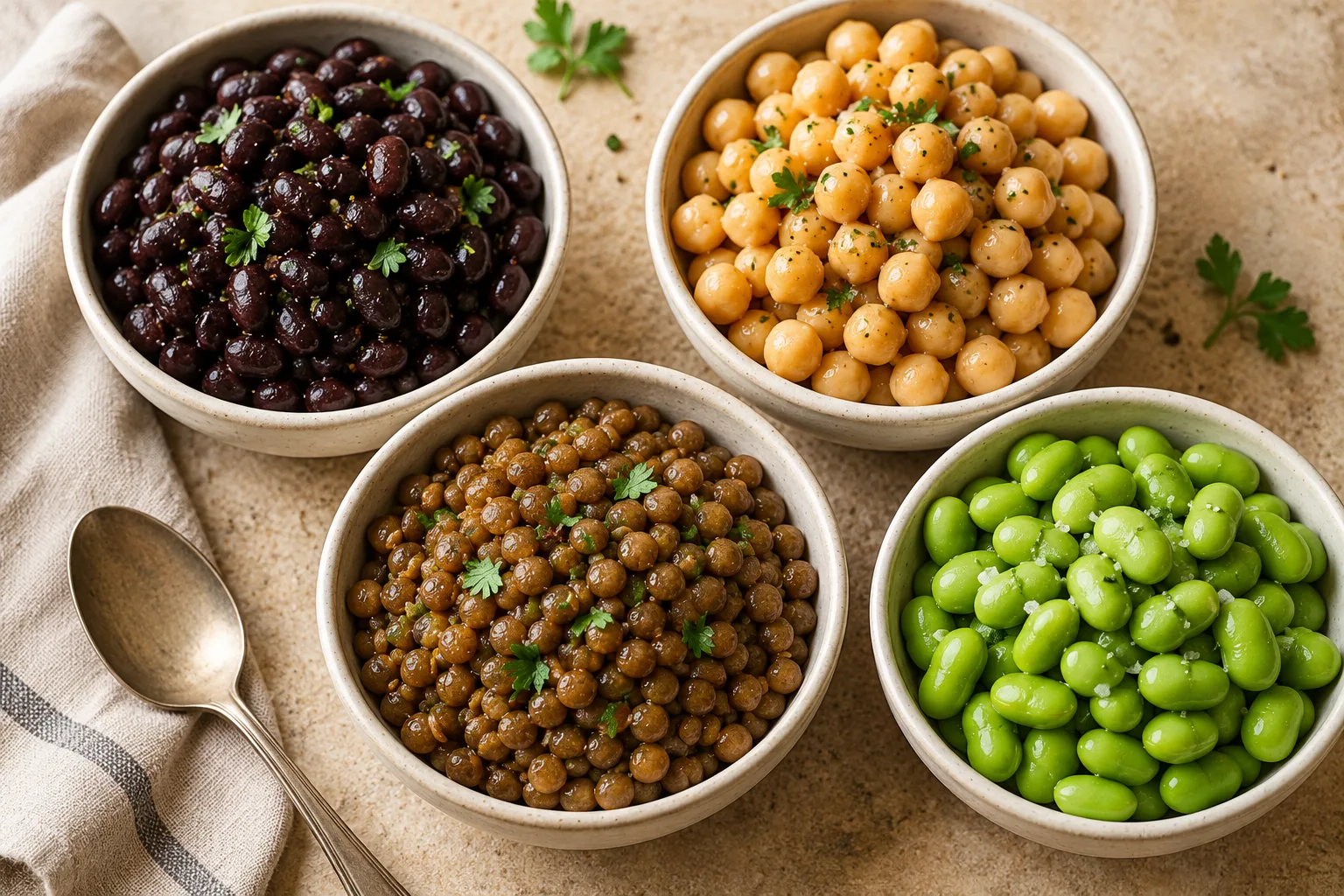
| Nutrient | Approximately half a cup; weighed example (86 g) | Per 100 g |
|---|---|---|
| Calories | 114 kcal | 132 kcal |
| Protein | 7.6 g | 8.9 g |
| Total fat | 0.5 g | 0.5 g |
| Saturated fat | 0.1 g | 0.1 g |
| Carbohydrate | 20.4 g | 23.7 g |
| Fiber | 7.5 g | 8.7 g |
| Total sugar | 0.3 g | 0.3 g |
| Sodium | 1 mg | 1 mg |
| Calcium | 23 mg | 27 mg |
| Iron | 1.8 mg | 2.1 mg |
| Potassium | 305 mg | 355 mg |
USDA FoodData Central, FDC 173735.
Choose the legume for the job: black beans for a fiber-rich bowl, edamame for more protein by weight, or lentils and chickpeas for the texture your recipe needs. The table compares cooked edible portions, so dry seeds and cooking water do not distort the ranking.
Define the category and cooking state
Beans, lentils and chickpeas are legumes, while edamame is immature soybean. They can all serve useful roles, but their composition and culinary uses differ. This is a practical comparison across common legumes rather than a strict botanical ranking of beans alone.
Dry seeds and cooked legumes have very different water contents. Do not use a dry-food protein value to describe a cooked serving. Canned products also need a clear basis: solids and liquid, drained solids, or drained and rinsed food.
A defined black-bean portion
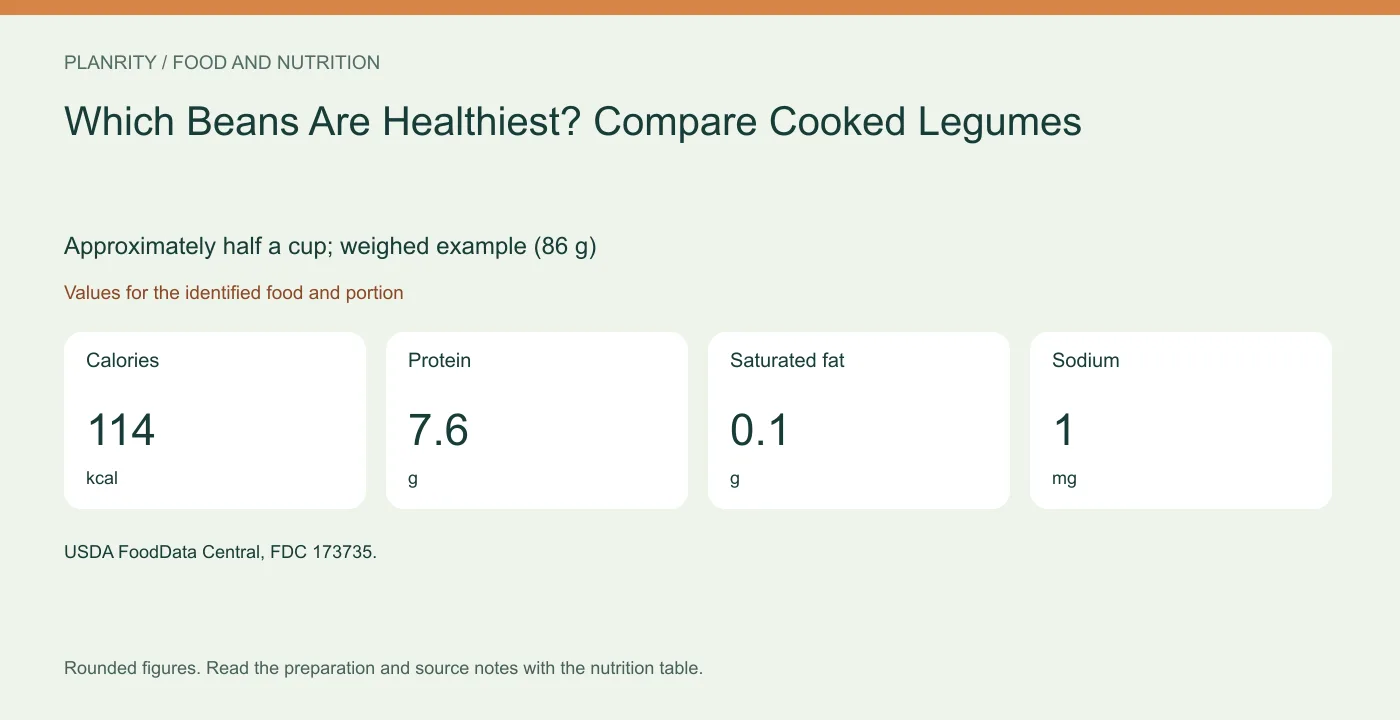
Source: USDA FoodData Central, FDC 173735.
The 86-g portion is a weighed example approximating a half cup of cooked black beans. Other legumes have different cup weights, so their equal-weight comparison below is separate from customary household measures.
The record specifies boiling without salt. A canned or seasoned product can have more sodium and additional ingredients. Use the canned or seasoned product’s label for sodium.
Equal cooked-weight comparison
All rows below use the same 100-g weight.
| Food | Calories (kcal) | Protein (g) | Fat (g) | Saturated fat (g) | Fiber (g) | Sodium (mg) |
|---|---|---|---|---|---|---|
| Beans, black, mature seeds, cooked, boiled, without salt | 132 | 8.9 | 0.5 | 0.1 | 8.7 | 1 |
| Lentils, mature seeds, cooked, boiled, without salt | 116 | 9.0 | 0.4 | 0.1 | 7.9 | 2 |
| Chickpeas (garbanzo beans, bengal gram), mature seeds, cooked, boiled, without salt | 164 | 8.9 | 2.6 | 0.3 | 7.6 | 7 |
| Beans, kidney, red, mature seeds, cooked, boiled, without salt | 127 | 8.7 | 0.5 | 0.1 | 7.4 | 2 |
| Edamame, frozen, prepared | 121 | 11.9 | 5.2 | 0.6 | 5.2 | 6 |
All rows use prepared edible foods. The dry-seed legumes are cooked without added salt in their specified records; the edamame is a prepared frozen-food record. These remain different foods, but the common weight makes their nutrient density easier to assess.
Choose the criterion before naming a winner
Protein per equal weight: In this set, prepared edamame has the most protein per 100 g. That does not make the other legumes poor protein choices, and a larger amount of another food can still supply useful protein.
Fiber per equal weight: Black beans lead the identified rows on this measure. A fiber-focused ranking therefore need not match a protein-focused ranking.
Protein per calorie: Divide protein grams by calories and multiply by 100 to calculate grams per 100 calories. For the records shown, edamame provides about 9.8 g per 100 calories, lentils 7.8 g, and black beans 6.7 g. Edamame leads this particular comparison; lentils still supply useful protein with a different texture and cooking role.
Convenience and use: Lentils can be useful in soups, chickpeas in salads or patties, black beans in bowls, and edamame as a prepared vegetable-style protein component. Taste, preparation time and availability can reasonably guide the choice.
Choose the criterion that matters for your meal rather than expecting one legume to lead on every nutrient. A different shortlist or a specific medical dietary requirement could produce another answer.
What these foods can contribute
Plant protein: Each food contributes protein in a defined amount. A varied eating pattern can use several legumes rather than relying on a single alleged champion.
Fiber: The table shows substantial differences worth considering. Increase amounts according to tolerance rather than assuming that the highest possible fiber amount is best for every person at every meal.
Minerals: Legumes can contribute iron and other minerals. NIH notes that absorption of plant-source iron differs from that of animal-source iron and can be supported by foods containing vitamin C. Pairing legumes with suitable produce is an option, not a promise to treat an iron deficiency. NIH iron fact sheet
Canned versus home-cooked
Canned legumes can be convenient, while cooking from dry gives control over added salt. Compare actual panels and drained weights. A no-salt-added canned product is not the same as a regular salted can, and a home recipe can still contain substantial salt.
Rinsing can change what is eaten, but do not assume a fixed sodium reduction for every product. Some USDA records distinguish drained from drained-and-rinsed chickpeas; use the matching record when available. Do not apply the result from one method to all beans without evidence.
If the cooking liquid is consumed in a soup, it remains part of the recipe. A drained-solids record cannot represent the whole pot without including its liquid and other ingredients.
Gas and individual tolerance
Some people experience gas or discomfort with legumes. Tolerance depends on the food, portion and individual. Start with an amount that suits you if you already know legumes cause symptoms, and seek appropriate advice for persistent problems.
Try preparation steps you tolerate, recognizing that rinsing or soaking may not resolve digestive symptoms. A food’s nutritional advantages do not mean every person must tolerate it in a large portion.
Cook kidney beans safely
Raw or undercooked kidney beans contain a lectin that can cause illness. FDA advises soaking for at least five hours, discarding that water and boiling in fresh water for at least 30 minutes. Properly canned kidney beans are a different product from raw dry beans. Do not rely on low-temperature slow cooking alone for raw kidney beans. FDA: Natural Toxins in Food.
Follow the actual product’s instructions and safe handling practices. For leftovers, refrigerate promptly and reheat appropriately. A nutritious ingredient still requires a safe preparation process. USDA FSIS: Leftovers and Food Safety
Shopping and meal checklist
- Compare cooked foods at equal edible weights.
- State whether the priority is protein, fiber, sodium or convenience.
- Match dry, cooked, drained or rinsed preparation states.
- Read labels for salt and other additions.
- Count cooking liquid when it is eaten.
- Use safe kidney-bean preparation guidance.
- Rotate options you enjoy rather than chasing one universal winner.
Make the ranking useful at the table
Choose a legume you enjoy and can prepare reliably. A small difference in a comparison table may matter less than whether the food works in the meals you cook regularly. The numerical criteria help explain trade-offs; they do not require everyone to replace a familiar bean with the highest-ranked row.
Choose a bean for the recipe
For a fiber-focused meal, 100 g cooked black beans supplies 8.7 g fiber compared with 5.2 g in the prepared edamame reference. For protein, the order reverses: edamame supplies 11.9 g compared with 8.9 g in black beans. Those are two useful priorities, with no need to turn the result into a claim that one food wins every comparison.
Choose the texture that works in the dish. Chickpeas hold their shape in a salad, while cooked lentils or beans can suit soups and purees. Use the corresponding cooked weight rather than a dry scoop for the nutrition estimate. With canned products, check whether the stated serving is drained and compare sodium on that can. If you eat the liquid in soup, include it and the other ingredients in the recipe.
What to take away
Choose beans according to the nutrient and recipe you care about. Black beans lead this set on fiber, while edamame supplies more protein per cooked gram; lentils, chickpeas and kidney beans are useful alternatives. Use cooked edible weights for a fair comparison and check sodium on canned products. A bean you enjoy and can use regularly is often more useful than a narrow ranking based on one nutrient.
Related food guides
Frequently asked questions
Are lentils always the healthiest choice?
No. The answer depends on the criterion. In the selected cooked records, edamame leads protein per equal weight and per calorie, while black beans lead fiber per equal weight. Lentils remain a useful option without needing to win every measure.
Are canned beans less nutritious than dried beans?
Compare canned beans with cooked beans, not dry seeds. Canned products can be useful and convenient, while salt and other ingredients vary. Match drained state and label serving, and use the actual product when sodium matters.
Does rinsing remove a fixed percentage of sodium?
A universal percentage is not established for every product and method. Rinsing can change the food, but use a matching drained-and-rinsed record or a verified product-specific analysis when available. Do not assume all brands or legumes respond identically.
Can raw kidney beans be prepared only in a slow cooker?
Do not rely on low-temperature slow cooking alone. FDA advises soaking dry kidney beans, discarding the water and boiling in fresh water for the specified time. Properly canned beans have already undergone a different process and should be handled according to their label.
Sources
- Edamame, frozen, prepared; 168411, USDA
- Lentils, mature seeds, cooked, boiled, without salt; 172421, USDA
- Beans, black, mature seeds, cooked, boiled, without salt; 173735, USDA
- Chickpeas (garbanzo beans, bengal gram), mature seeds, cooked, boiled, without salt; 173757, USDA
- Beans, kidney, red, mature seeds, cooked, boiled, without salt; 175194, USDA
- NIH iron fact sheet, NIH Office of Dietary Supplements
- How to Understand and Use the Nutrition Facts Label | FDA, FDA
- Sodium in Your Diet | FDA, FDA
- Selecting and Serving Produce Safely | FDA, FDA
- USDA FSIS: Leftovers and Food Safety, USDA
- FDA: Natural Toxins in Food, US Food and Drug Administration