Cuisines and takeaway
Are Falafels Healthy? Chickpeas, Oil and Meal Portions
Assess falafel with defined portions and transparent chickpea-patty calculations. Compare oil scenarios, check sauces and avoid unsupported frying claims.
The short answer
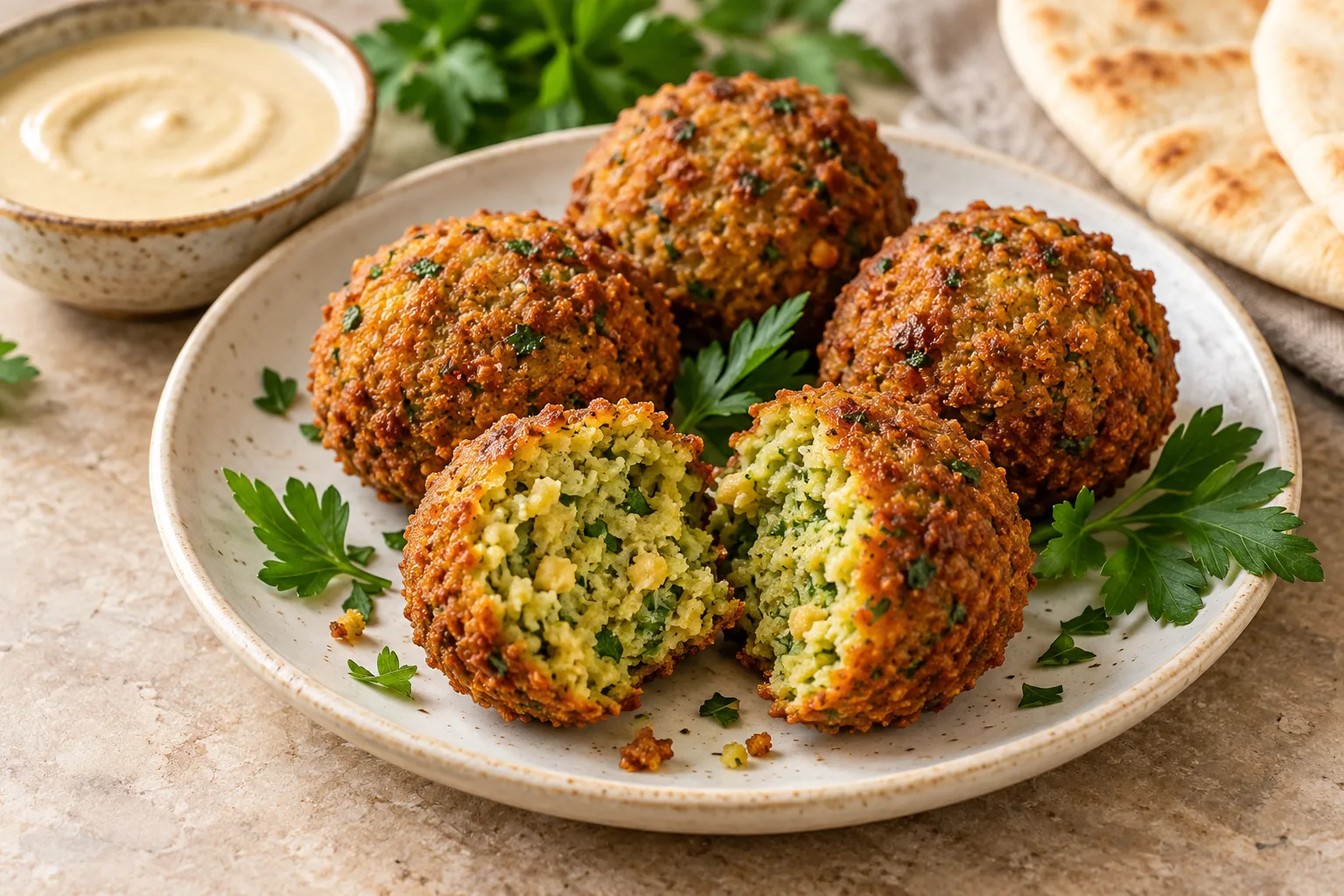
Sometimes Falafel offers a legume-based meal component, but frying oil can make the portion calorie-dense. One 85-g portion of USDA’s prepared-falafel reference contains about 437 calories and 7 g protein. Recipes vary widely, so choose the actual portion and cooking method rather than assuming every chickpea patty has the same nutrition.
| Nutrient | Small weighed falafel portion (85 g) | Per 100 g |
|---|---|---|
| Calories | 437 kcal | 514 kcal |
| Protein | 7.0 g | 8.3 g |
| Total fat | 35.0 g | 41.2 g |
| Saturated fat | 4.6 g | 5.4 g |
| Carbohydrate | 24.6 g | 29.0 g |
| Fiber | 4.1 g | 4.8 g |
| Total sugar | 3.8 g | 4.5 g |
| Sodium | 424 mg | 499 mg |
| Calcium | 73 mg | 86 mg |
| Iron | 2.0 mg | 2.3 mg |
| Potassium | 220 mg | 259 mg |
USDA FoodData Central, FDC 2707408.
Chickpeas provide a useful base, while the cooking oil, pita and sauce can change the meal substantially. The comparisons below show prepared falafel alongside a weighed chickpea-patty example, so you can see which ingredients account for the difference.
What is in falafel?
Falafel is commonly made from chickpeas, fava beans or a combination, with herbs, onion, garlic and spices. Traditional methods often use soaked dried legumes rather than canned cooked chickpeas. That distinction affects texture and the recipe’s ingredient basis.
The calculated patties below use cooked chickpeas. They are a proposed home-style chickpea preparation, not a claim to reproduce every traditional falafel. A soaked-legume recipe requires its own drained weight and yield calculation.
Prepared falafel nutrition
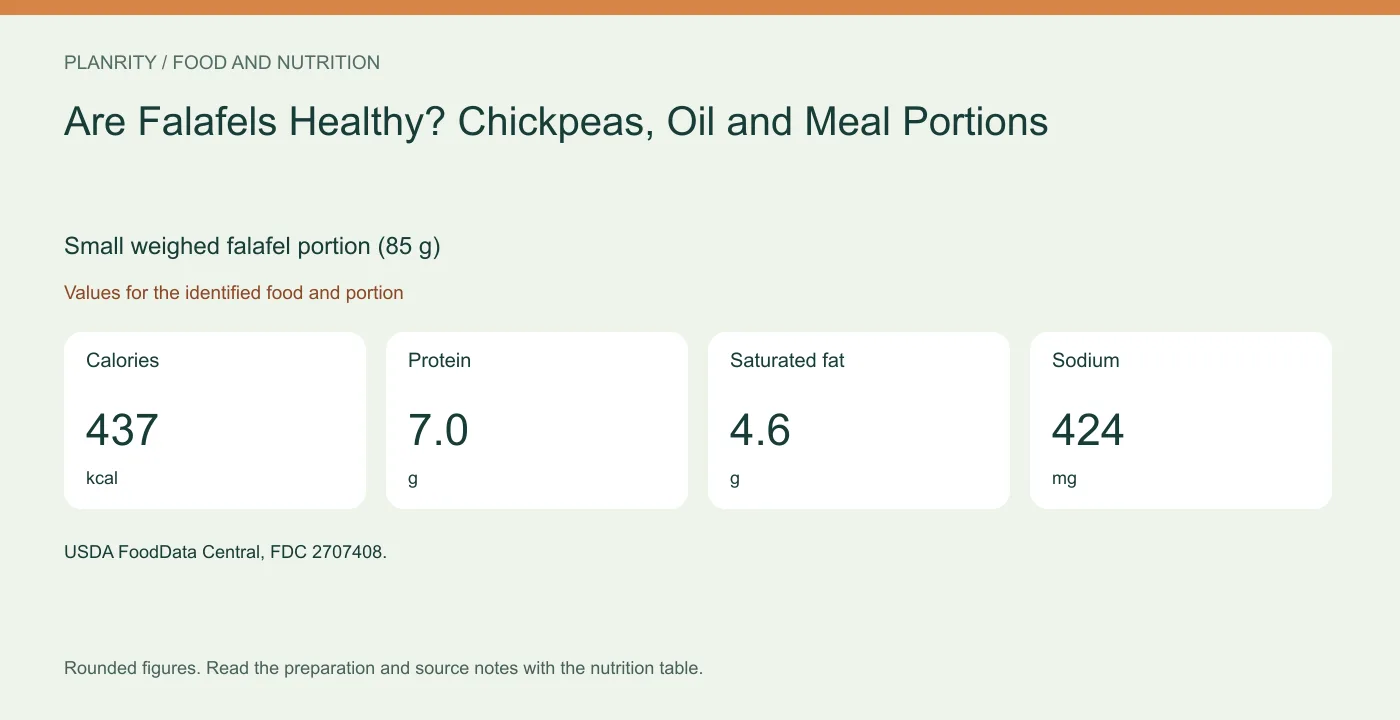
Source: USDA FoodData Central, FDC 2707408.
The 85-g portion is a weighed example. It is not a universal count of balls or patties. Their size varies, and a restaurant sandwich may contain a different amount as well as bread, sauces and vegetables.
Compare the evidence categories
All rows below use the same 100-g weight.
| Food | Calories (kcal) | Protein (g) | Fat (g) | Saturated fat (g) | Sodium (mg) |
|---|---|---|---|---|---|
| Falafel | 514 | 8.3 | 41.2 | 5.4 | 499 |
| Falafel, home-prepared | 333 | 13.3 | 17.8 | 2.4 | 294 |
| Chickpea patty ingredient estimate, 10 g oil | 152 | 7.2 | 4.0 | 0.5 | 157 |
| Same chickpea mixture, 30 g retained oil scenario | 180 | 6.9 | 7.5 | 1.0 | 151 |
The prepared-food rows describe different falafel recipes. The chickpea-patty examples below use weighed ingredients; their values describe the mixture before baking.
Ingredients for Chickpea patty ingredient estimate, 10 g oil
| Nutrient | One calculated portion (130 g) | Per 100 g |
|---|---|---|
| Calories (kcal) | 198 | 152 |
| Protein (g) | 9.3 | 7.2 |
| Total fat (g) | 5.1 | 4.0 |
| Saturated fat (g) | 0.6 | 0.5 |
| Carbohydrate (g) | 30.1 | 23.2 |
| Fiber (g) | 8.1 | 6.2 |
| Total sugar (g) | 5.7 | 4.4 |
| Sodium (mg) | 204 | 157 |
| Calcium (mg) | 61 | 47 |
| Iron (mg) | 3.1 | 2.4 |
| Potassium (mg) | 354 | 273 |
For a proposed baked method, mash or process the chickpeas with the chopped onion, cilantro, garlic and salt. Divide into similar patties and distribute the measured oil over the tray and patties. Bake on a lined tray until heated through and set, turning if needed. This formulation and its final texture have not been kitchen-tested.
What a documented oil change can show
The second scenario retains the same chickpeas, onion, cilantro, garlic and salt, but changes oil from 10 g to 30 g. The ingredient basis becomes 540 g, divided into four 135-g allocations before cooking.
| One quarter of the ingredient batch | Calories | Fat |
|---|---|---|
| 10 g oil in whole batch | 198 | 5.1 g |
| 30 g oil in whole batch | 242 | 10.1 g |
This second calculation adds 20 g more retained oil across the same four-portion mixture. It isolates an ingredient change. It compares two known oil amounts; actual deep-frying absorption varies with the recipe and method.
To compare real baked and fried versions, begin with a matched mixture, measure final cooked yields and use a defensible method for oil uptake. Spattering, oil left on utensils and changes in moisture make a pan-only oil estimate uncertain.
What falafel can offer
Legume ingredients: Chickpeas or fava beans can contribute plant protein and other nutrients. Their contribution in a serving depends on the recipe and portion.
Meal flexibility: Falafel can be served with vegetables, in a pita or as part of a plate. Different formats can suit different appetites without requiring one format to be universally best.
Flavor from herbs and spices: These ingredients can make a legume dish appealing.
What changes a falafel meal?
Bread, tahini, yogurt sauces, pickles and cooking oil all count. A salad plate with substantial tahini can have a different fat profile from a pita with a smaller sauce portion. “Salad” and “wrap” are meal formats, not numerical nutrition categories.
Plant-based foods can contain saturated fat, depending on the ingredients and oil. Check the prepared product’s saturated fat and sodium as well as its legume ingredients.
If you want a complete meal, consider how much protein the serving supplies, the vegetables present and the starch amount. Removing the pita may change calories and carbohydrate, but it may also leave the meal smaller than you need. Choose according to the whole meal rather than a rule that bread must be avoided.
Allergies and tolerance
Tahini contains sesame, pita usually contains wheat, and some sauces contain milk. A falafel mixture may include a binder or other ingredients. Confirm vegan or allergen suitability from the actual recipe rather than the dish’s name.
Legumes can cause digestive discomfort for some people. Individual tolerance varies, so a smaller initial amount may be practical if you already know this is an issue for you. Persistent or significant symptoms need appropriate advice rather than a promise that everyone will adapt.
Buying and cooking checklist
- Identify the legumes and whether their weights are dry, soaked or cooked.
- Compare the edible portion, not a universal ball count.
- Check the actual oil and salt amounts.
- Distinguish a calculated scenario from a measured preparation.
- Include bread, sauce and pickles in meal totals.
- Read allergen information for sesame, wheat and dairy additions.
- Weigh the final cooked batch if precise density is needed.
What a cooking experiment found
Fikry and colleagues studied frozen market falafel using air-frying without added oil and deep-frying in oil. Their selected conditions were 178°C (about 352°F) for 11 minutes and 180°C (356°F) for 7 minutes, respectively. These are experimental conditions for their product, not universal household cooking instructions. Fikry et al., Foods 2021: falafel air-frying experiment, DOI 10.3390/foods10112567
| Experimental method | Reported fat-concentration change from starting product |
|---|---|
| Selected air-frying condition | About 45% lower |
| Deep-fat frying | 32.8% higher |
The authors measured fat on a dry-weight basis. These percentages are not grams of fat per 100 g of edible falafel and cannot be substituted into the nutrition table. The result applies to those experimental conditions. Oven baking, another recipe or a calorie comparison requires different measurements. Fikry et al., Foods 2021: falafel air-frying experiment, DOI 10.3390/foods10112567
A published baked method to cook from
Colorado State University Extension provides a complete baked recipe reviewed in October 2025. It uses drained canned chickpeas, whole-wheat flour, herbs, baking powder and seasonings, then bakes small patties at 375°F for 15 minutes per side with cooking spray. Its reported serving is five patties: 135 calories, 6.7 g protein, 2.1 g fat and 592.7 mg sodium. Those values belong to that recipe, not to the separate model above. Colorado State University Extension: Baked Falafel, reviewed October 2025
The extension recipe does not publish a cooked gram yield or measured spray uptake. Use its published per-serving figures; without a cooked gram yield, they cannot provide an equal-weight comparison with fried falafel. Use the linked complete method for cooking; use the two ingredient models to understand an isolated change in retained oil. A direct cooked comparison still needs matched measured batches.
Decide whether you need a recipe or a comparison
For a home dinner, choose a complete recipe you can follow rather than trying to turn an oil calculation into a frying method. The linked CSU Extension recipe includes ingredients that help the patties hold together, a cooking temperature and turning instructions. Its nutrient figures belong to that recipe and serving count, which lacks a published cooked gram yield.
For meal planning, decide whether the falafel is going into pita, onto salad or beside another grain. Count tahini, yogurt sauce, pickles and oil-rich dressings separately. A salad plate can still contain a substantial amount of fat from dressing, while a pita can be a useful part of a larger meal. Choose the combination you enjoy, with enough total food for your appetite; the legume name is only one part of that decision.
What to take away
Falafel can provide a legume-based part of a meal, with a substantial difference between a lightly oiled patty and some fried preparations. Choose a complete recipe or a labeled product, then count pita, tahini and other additions separately. The cooking experiment supports a specific air-frying result, not a universal fat reduction for every baked recipe. Use the published baked method for cooking and the ingredient examples for understanding the role of oil.
Related food guides
Frequently asked questions
Does baking cut falafel fat in half?
There is no universal reduction established here. The amount depends on the starting mixture, oil used, oil retained and cooked yield. The calculation shows a defined oil change rather than claiming a measured percentage for every baked or fried version.
Is falafel always vegan?
Traditional ingredients are often plant-based, but recipes, binders and sauces vary. Check the actual mixture and accompaniments. A yogurt sauce is different from tahini, and shared preparation may also matter for individual dietary needs.
Are canned chickpeas equivalent to soaked dried chickpeas?
They are different ingredient states with different moisture and texture. A recipe designed for one may not work identically with the other. Use the appropriate drained or cooked weight and nutrition record rather than substituting the same volume without recalculation.
Does a chickpea base make every falafel high in fiber?
Chickpeas contribute fiber, but the portion and recipe determine how much you eat. The prepared reference here supplies about 4.1 grams in 85 grams. Compare the actual serving and count pita, vegetables and sauces separately when planning the meal.
Sources
- Garlic, raw; 169230, USDA
- Coriander (cilantro) leaves, raw; 169997, USDA
- Onions, raw; 170000, USDA
- Oil, olive, salad or cooking; 171413, USDA
- Falafel, home-prepared; 172455, USDA
- Salt, table; 173468, USDA
- Chickpeas (garbanzo beans, bengal gram), mature seeds, cooked, boiled, without salt; 173757, USDA
- Falafel; 2707408, USDA
- How to Understand and Use the Nutrition Facts Label | FDA, FDA
- Sodium in Your Diet | FDA, FDA
- Selecting and Serving Produce Safely | FDA, FDA
- USDA FSIS: Leftovers and Food Safety, USDA
- USDA safe minimum internal temperatures, USDA
- Colorado State University Extension: Baked Falafel, reviewed October 2025, Colorado State University Extension
- Fikry et al., Foods 2021: falafel air-frying experiment, DOI 10.3390/foods10112567, Foods / MDPI