Cuisines and takeaway
Is Fried Rice Healthy? Ingredients, Portions and Safety
Explore fried rice with defined ingredients, measured oil and sauce. Compare calculated bowls, understand sodium, and handle cooked rice safely at home.
The short answer
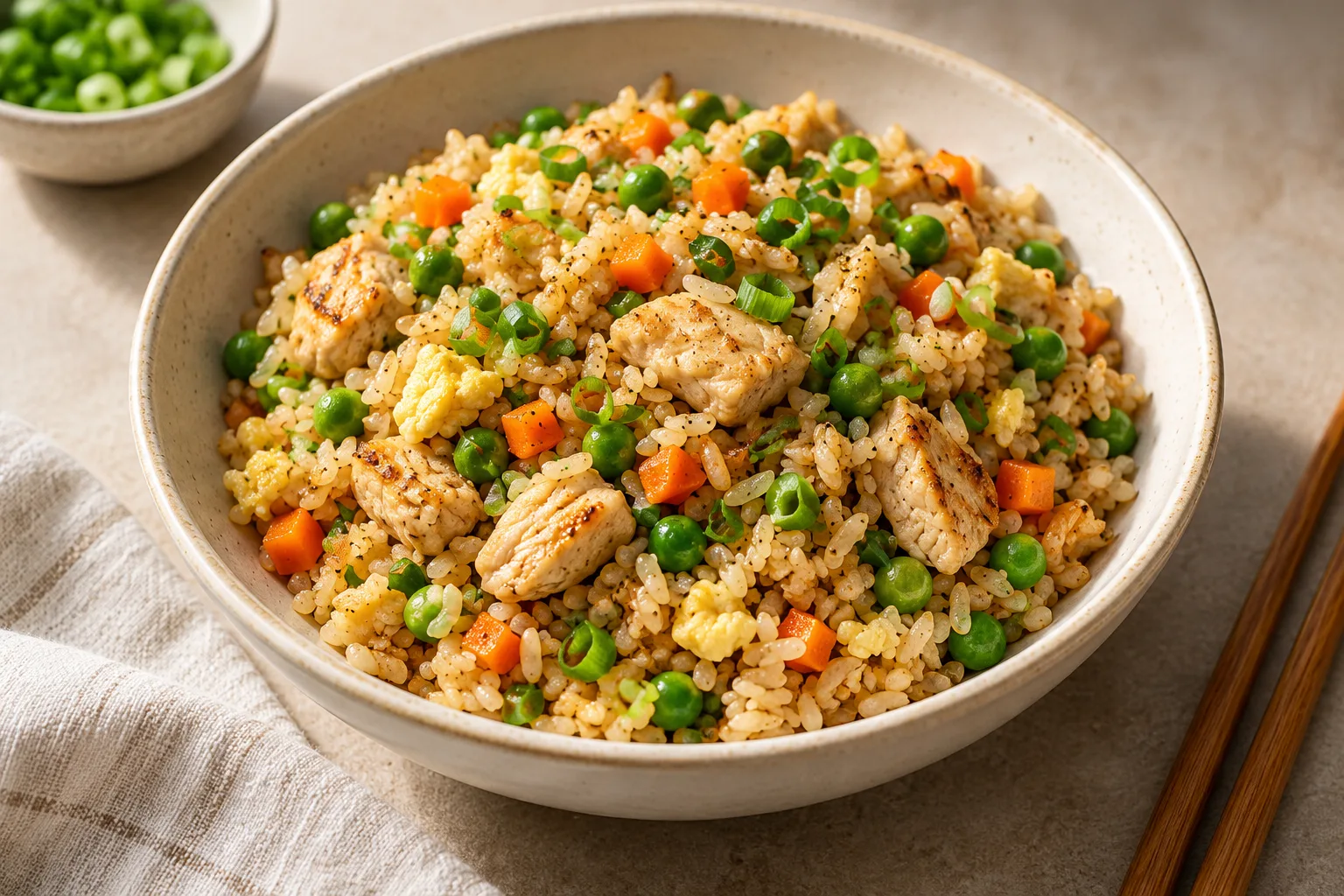
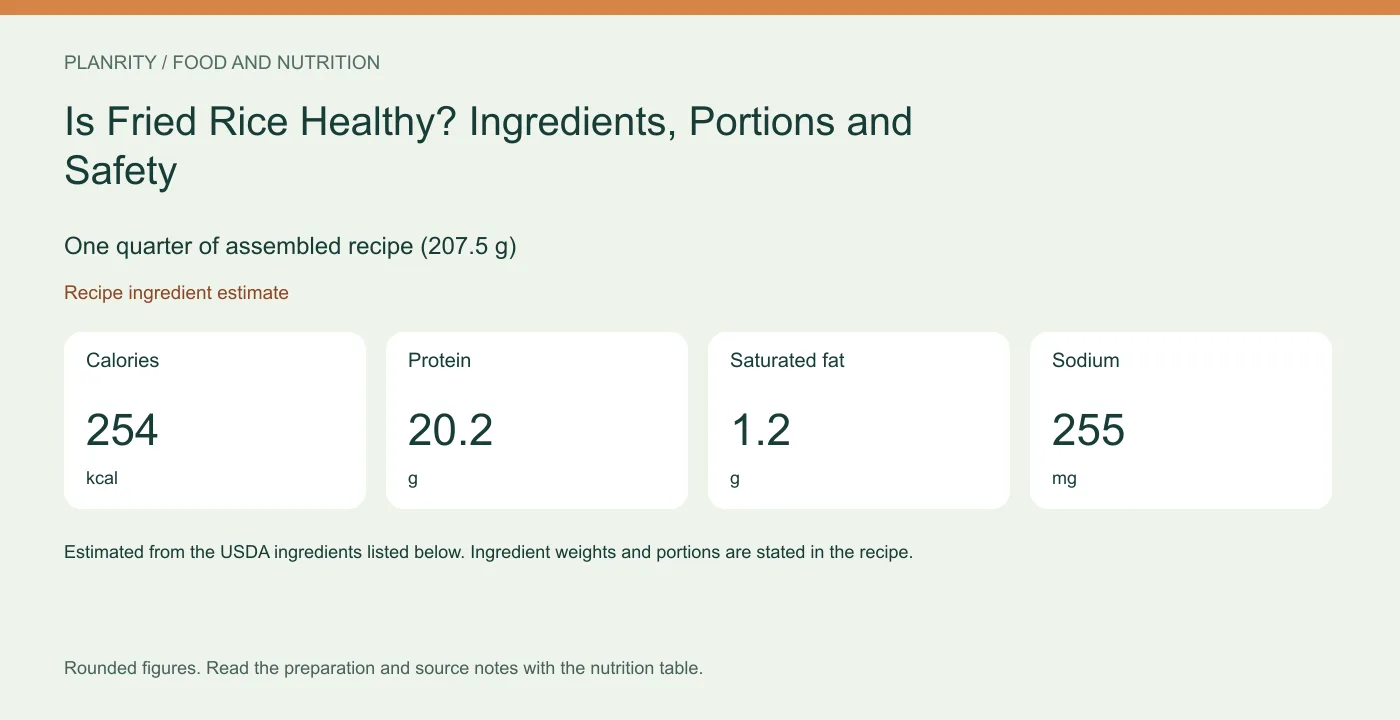
Yes Fried rice can make a balanced meal when it includes enough protein and vegetables and a measured amount of oil and sauce. The home example here allocates about 254 calories and 20.2 g protein to one quarter of the batch. Safe rice cooling and refrigeration matter just as much as the ingredients.
| Nutrient | One quarter of assembled recipe (207.5 g) | Per 100 g |
|---|---|---|
| Calories | 254 kcal | 123 kcal |
| Protein | 20.2 g | 9.8 g |
| Total fat | 5.5 g | 2.6 g |
| Saturated fat | 1.2 g | 0.6 g |
| Carbohydrate | 30.9 g | 14.9 g |
| Fiber | 3.2 g | 1.5 g |
| Total sugar | 2.4 g | 1.2 g |
| Sodium | 255 mg | 123 mg |
| Calcium | 24 mg | 11 mg |
| Iron | 1.6 mg | 0.8 mg |
| Potassium | 311 mg | 150 mg |
Estimated from the USDA ingredients listed below. Ingredient weights and portions are stated in the recipe.
There is no reliable universal nutrition value for “restaurant fried rice.” A measured home example is more useful than an unsupported range that assumes all kitchens use the same recipe. The calculation below identifies every material ingredient.
What goes into the dish?
Rice is usually stir-fried with a combination of vegetables, egg, meat, seafood or tofu, plus oil and seasonings. The choices vary by cooking tradition and preference. Brown rice is an option, not a requirement for the dish to fit a balanced diet.
White rice can provide a useful starch component. Brown rice supplies more fiber in the identified cooked records. Neither choice tells you how much oil or sodium was added later, so the grain decision should not stand in for evaluating the recipe.
Ingredients for Assembled brown-rice, chicken and vegetable bowl
This example begins with cooked rice, cooked chicken and cooked vegetables. Heat the measured oil, add the components, and distribute the measured sauce across the batch. Reheat previously cooked ingredients to 165°F, checking with a food thermometer. The per-100-g estimate uses the combined ingredient weight. Moisture lost during stir-frying changes the finished weight and its calorie density.
The four portions are a recipe convention, not an official meal size. A portion can be served with other food or enlarged according to appetite. If you change the portion count, divide the same batch totals by the new count.
What the estimate includes
All listed oil and sauce are assumed retained. The figures exclude egg, extra salt, sesame oil and garnishes. If you use those ingredients, add their contributions. A different sauce or an extra tablespoon of oil changes the batch, even if the rice amount stays the same.
Isolate the soy-sauce change
All rows below use the same 100-g weight.
| Food | Calories (kcal) | Protein (g) | Fat (g) | Saturated fat (g) | Fiber (g) | Sodium (mg) |
|---|---|---|---|---|---|---|
| Assembled brown-rice, chicken and vegetable bowl | 123 | 9.8 | 2.6 | 0.6 | 1.5 | 123 |
| Same bowl with regular soy sauce | 123 | 9.7 | 2.6 | 0.6 | 1.5 | 169 |
| Rice, fried, meatless | 174 | 3.8 | 3.2 | 0.5 | 1.1 | 361 |
| Rice, white, long-grain, regular, enriched, cooked | 130 | 2.7 | 0.3 | 0.1 | 0.4 | 1 |
The two calculated bowls differ only in the soy sauce record. That isolates a useful sodium trade-off without pretending that a different restaurant meal has been measured. The FNDDS fried-rice entry is a separate prepared-food reference, and plain white rice is a starch reference rather than an equivalent complete meal.
Ingredients for Same bowl with regular soy sauce
| Nutrient | One calculated portion (207.5 g) | Per 100 g |
|---|---|---|
| Calories (kcal) | 254 | 123 |
| Protein (g) | 20.2 | 9.7 |
| Total fat (g) | 5.5 | 2.6 |
| Saturated fat (g) | 1.2 | 0.6 |
| Carbohydrate (g) | 30.9 | 14.9 |
| Fiber (g) | 3.2 | 1.5 |
| Total sugar (g) | 2.4 | 1.2 |
| Sodium (mg) | 350 | 169 |
| Calcium (mg) | 24 | 11 |
| Iron (mg) | 1.6 | 0.8 |
| Potassium (mg) | 315 | 152 |
Reduced-sodium soy sauce is still a sodium source. “Reduced” compares it with another formulation; it does not mean sodium-free. Use the panel for the sauce you own because brands and serving weights vary.
What a balanced version contributes
Protein: Chicken supplies protein in this example. Egg, tofu or another food can play that role in a different recipe, but each substitution needs its own calculation.
Vegetables: The peas and carrots add a defined amount, not an unspecified handful. More vegetables change volume and nutrient density, though they do not erase the rice or oil already present.
Control of additions: Measuring oil and sauce makes a batch easier to reproduce. A nonstick pan can help with technique, but the amount used should still be recorded rather than assumed minimal.
Food safety is part of the recipe
Cooked rice needs prompt cooling and refrigeration. Bacillus cereus is a relevant rice hazard. Discard rice that was held improperly instead of trying to make it safe by reheating. FDA discusses this organism in its foodborne-pathogen guidance. FDA Bad Bug Book.
USDA advises refrigerating leftovers promptly, using shallow containers, and using refrigerated leftovers within three to four days. Reheat leftovers to 165°F. Do not leave a large pot of rice on the counter for extended cooling before refrigeration. USDA FSIS: Leftovers and Food Safety USDA safe minimum internal temperatures
“Day-old rice” is a texture preference, not permission to keep rice at room temperature overnight. The relevant feature is properly stored cooked rice. Freshly cooked rice can also be used; the texture may be different, but safety should determine storage decisions.
Ordering and portion decisions
When ordering, ask whether fried rice is a side or the main dish and whether a stated serving includes the protein. A meatless side may need a separate protein food. An entrée with chicken may already include one.
Ask about the serving weight and sauce instead of estimating them from the box size or the rice’s color. If a restaurant discloses nutrition, match the listed size and additions. Otherwise, describe the uncertainty rather than assigning exact sodium figures.
Preparation checklist
- Use cooked ingredients with a known safe storage history.
- Measure rice, vegetables and protein in the state used for calculation.
- Weigh or measure oil before adding it.
- Count every sauce and any added salt.
- Choose a grain and vegetable balance you enjoy.
- Reheat thoroughly and check the food temperature.
- Cool and refrigerate any remaining batch promptly.
Plan the rice before the stir-fry
The reduced-sodium sauce version allocates about 255 mg sodium per quarter-batch portion. Changing only to the regular soy sauce brings that to about 350 mg, a difference of roughly 95 mg. That is a specific recipe change you can reproduce; a larger pour of reduced-sodium sauce could undo the saving.
Set out the measured sauce and oil before the pan heats. Use cooked rice and protein that were stored safely, and add the weighed vegetables. After stir-frying, divide the whole batch into four portions. That keeps each share tied to the ingredients even if some water evaporates. If the meal needs to be larger, increase the component you want deliberately and count it, rather than filling a bigger bowl and assigning it the original portion’s nutrition.
What to take away
Make fried rice a meal by including protein and vegetables, then measure the sauce and oil that season the batch. The home example shows that a useful protein portion does not require a large sauce pour. Rice handled safely before cooking remains essential: refrigeration and reheating are separate tasks. At a restaurant, use that restaurant’s serving information rather than assigning these home figures to an unknown takeout container.
Related food guides
Frequently asked questions
Is brown fried rice always healthier?
Brown rice supplies more fiber than the identified cooked white-rice reference, but oil, sauce, protein and portion still matter. A brown-rice dish can contain more sodium than a white-rice dish depending on the recipe. Compare the complete preparation.
Can I use rice left on the counter overnight?
Do not treat room-temperature overnight storage as a recipe step. Use rice that has been handled and refrigerated safely. Reheating is not a reliable way to rescue rice that was stored unsafely, even if it is steaming hot afterward.
Does reduced-sodium soy sauce remove the sodium concern?
No. It can lower sodium compared with another sauce at the same amount, but it still contributes sodium. Count the actual quantity used and any other salty ingredients. A large pour can offset a lower concentration.
Are these exact cooked nutrition values?
No. They are calculated from weighed cooked ingredients and assumed retention of sauce and oil. Final stir-fried yield has not been measured. Per-portion estimates are useful for the stated inputs, but a final cooked-density claim needs additional yield verification.
Sources
- Rice, white, long-grain, regular, enriched, cooked; 168878, USDA
- Rice, brown, long-grain, cooked (Includes foods for USDA's Food Distribution Program); 169704, USDA
- Peas and carrots, frozen, cooked, boiled, drained, without salt; 170018, USDA
- Oil, olive, salad or cooking; 171413, USDA
- Chicken, broilers or fryers, breast, meat only, cooked, roasted; 171477, USDA
- Soy sauce made from soy and wheat (shoyu), low sodium; 172473, USDA
- Soy sauce made from soy and wheat (shoyu); 174277, USDA
- Rice, fried, meatless; 2708951, USDA
- USDA FSIS: Leftovers and Food Safety, USDA
- USDA safe minimum internal temperatures, USDA
- How to Understand and Use the Nutrition Facts Label | FDA, FDA
- Sodium in Your Diet | FDA, FDA
- Selecting and Serving Produce Safely | FDA, FDA
- FDA Bad Bug Book, US Food and Drug Administration