Meats and seafood
Is Chorizo Healthy? Fresh and Cured Types Compared
Learn how fresh and cured chorizo differ, compare identified nutrition records, and assess portions, sodium, saturated fat and safe cooking requirements.
The short answer
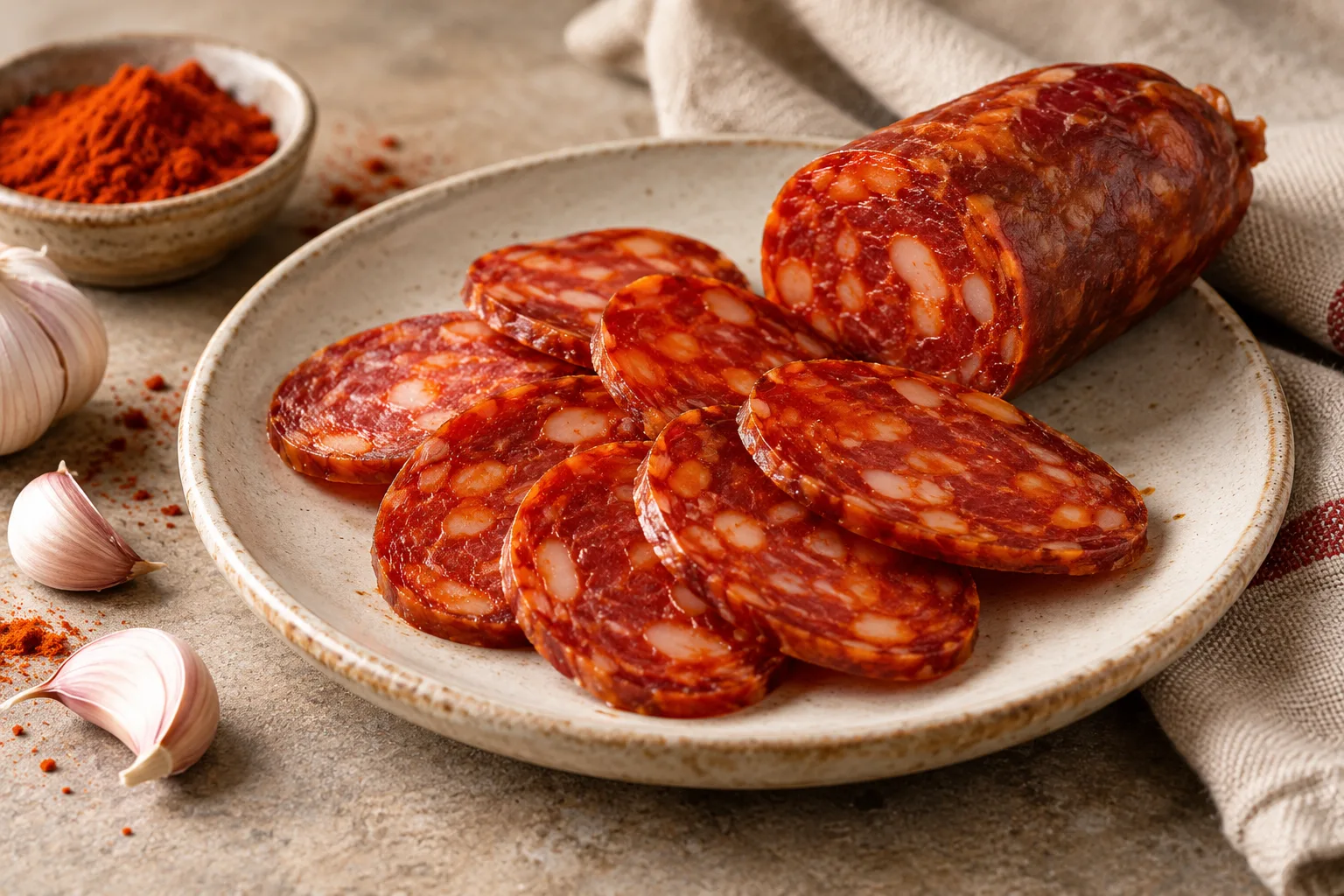
Sometimes Chorizo works better as a flavorful addition than as a food to choose for low sodium. One ounce (28 g) of Palacios Original cured chorizo supplies 140 calories, 8 g protein and 470 mg sodium. An equal 28-g amount of Johnsonville chorizo after cooking supplies 90 calories and 200 mg sodium, showing why the exact product matters.
| Nutrient | Manufacturer-defined 1-oz cured sausage serving (28 g) | Per 100 g |
|---|---|---|
| Calories | 140 kcal | 500 kcal |
| Protein | 8.0 g | 28.6 g |
| Total fat | 12.0 g | 42.9 g |
| Saturated fat | 4.0 g | 14.3 g |
| Carbohydrate | 0.0 g | 0.0 g |
| Fiber | 0.0 g | 0.0 g |
| Total sugar | 0.0 g | 0.0 g |
| Added sugar | 0.0 g | 0.0 g |
| Sodium | 470 mg | 1679 mg |
| Calcium | 6 mg | 21 mg |
| Iron | 0.1 mg | 0.2 mg |
| Potassium | 0 mg | 0 mg |
Palacios Original Chorizo 7.9 oz; ready-to-eat cured sausage, 28-g serving.
A small amount used to season beans or vegetables plays a different role from several large links served as the main protein. The practical question is how the product and portion fit the complete meal.
Fresh versus cured chorizo
Fresh Mexican-style chorizo is commonly a seasoned raw sausage that needs cooking. Ingredients can include pork, beef or other proteins, fat, vinegar, chili and spices. A turkey or plant-based version has its own formulation and should not inherit the nutrition of pork chorizo.
Spanish-style chorizo is often cured and may be sold ready to eat, but some products still require cooking. The package must identify whether it is ready to eat. Read the actual storage and cooking label, and distinguish a dry-cured sausage from a fresh link.
Paprika and chili contribute flavor but do not counterbalance the amount of salt or saturated fat in a sausage. Check sodium and saturated fat on artisanal products too.
Nutrition for a defined prepared example
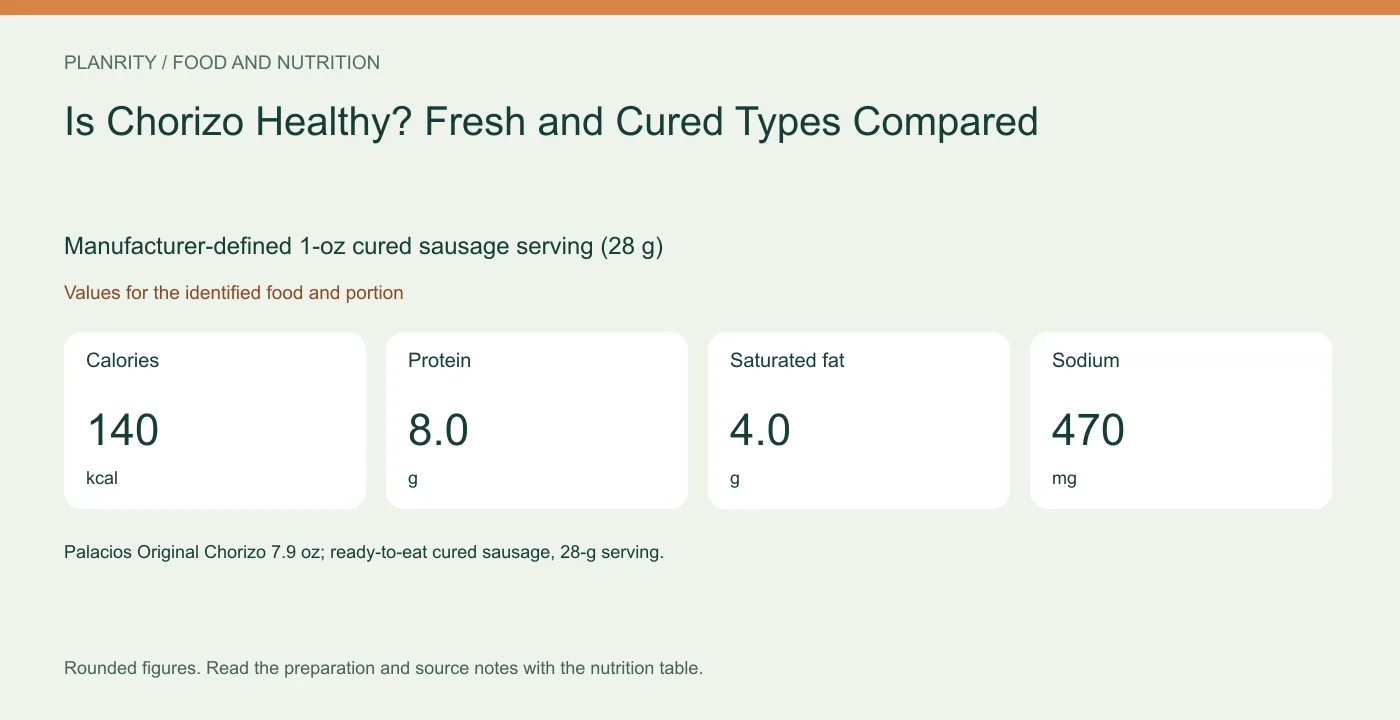
Source: Palacios Original Chorizo 7.9 oz; ready-to-eat cured sausage, 28-g serving.
The main table uses Palacios Original ready-to-eat cured chorizo. Its 28-g amount is the manufacturer’s serving, not an official recommendation. Johnsonville’s fresh sausage label instead describes a 56-g cooked portion. Halving that panel gives an equal 28-g cooked amount for comparison. Palacios: Original Chorizo 7.9 oz, ready-to-eat label Johnsonville: Chorizo Ground Sausage, cooked-portion label
Fresh and cured chorizo compared
All rows below use the same 100-g weight.
| Food | Calories (kcal) | Protein (g) | Fat (g) | Saturated fat (g) | Sodium (mg) |
|---|---|---|---|---|---|
| Johnsonville Chorizo Ground Sausage; 56-g COOKED portion | 321 | 16.1 | 26.8 | 8.9 | 714 |
| Palacios Original Chorizo 7.9 oz; ready-to-eat cured sausage, 28-g serving | 500 | 28.6 | 42.9 | 14.3 | 1679 |
Both rows describe the named products in edible states: Johnsonville after cooking and Palacios as sold ready to eat. They show different formulations as well as different curing methods; two products cannot establish a universal difference between national styles.
| Named product, equal 28-g edible amount | Calories | Protein | Saturated fat | Sodium |
|---|---|---|---|---|
| Johnsonville Chorizo, cooked | 90 | 4.5 g | 2.5 g | 200 mg |
| Palacios Original, cured and ready to eat | 140 | 8 g | 4 g | 470 mg |
The Palacios portion has 270 mg more sodium in this pair. Johnsonville lists less than 1 g each of fiber, total sugar and added sugar per 56-g cooked serving. The label gives bounds rather than exact quantities for those nutrients. A different package or formulation needs its own calculation. Johnsonville: Chorizo Ground Sausage, cooked-portion label Palacios: Original Chorizo 7.9 oz, ready-to-eat label
What chorizo contributes
Protein: A serving provides protein, although a small seasoning portion supplies less than a full meal portion. Check the amount rather than assuming the strong flavor implies a large protein contribution.
Concentrated flavor: A modest amount can season a larger pot of beans, vegetables or rice. This can make it practical to use less sausage while keeping a flavor you enjoy.
Ingredient flexibility: A homemade mixture lets you choose the meat and seasoning. A homemade fresh mixture has a different texture and composition from cured sausage; count all its ingredients.
Nutritional and safety concerns
Sodium: Sausage seasoning and curing can contribute salt. Serving it with cheese, salty tortillas, pickles or sauces adds other sodium sources. Count the complete combination if sodium management is important.
Saturated fat: A concentrated meat-and-fat mixture can contribute a meaningful amount in a small serving. Draining visible fat may change the amount eaten, but do not claim a fixed reduction without a measured yield and analysis.
Processing: WHO/IARC distinguishes processed meat from unprocessed red meat. Processed meat has been classified as carcinogenic to humans based on sufficient evidence; the classification describes evidence strength rather than making every exposure equally risky. Do not equate a hazard category with the size of an individual’s risk. Carcinogenicity of red and processed meat
Uncertain readiness: Curing, color and spice are not evidence that a fresh sausage is safe to eat uncooked. Follow the package instructions. Raw pork or beef sausage belongs in the ground-meat category, while poultry sausage needs the poultry endpoint. USDA safe minimum internal temperatures
Cooking and portion guidance
During pregnancy or with weakened immunity, CDC advises heating deli meats and fermented or dry sausages to 165°F or until steaming hot before eating. That precaution also applies to a product sold ready to eat. CDC pregnancy food-safety guidance and CDC guidance for weakened immunity.
USDA lists 160°F for ground meats and 165°F for ground poultry. Use the guidance for the actual ingredients and product. For a mixed sausage, follow the package’s validated instructions or the more protective applicable guidance rather than using the color of the filling. USDA safe minimum internal temperatures
For meal planning, consider using the illustrated small portion to flavor beans, then add vegetables and an appropriate starch. This is a practical example, not a universal prescribed amount. If chorizo is the main protein, evaluate the larger portion using the product’s current panel.
There is no source-backed rule here that chorizo is safe or optimal a fixed number of times per week. Overall eating patterns, preferences and individual needs matter. People with a clinician-directed sodium or fat restriction should use their actual target and product figures.
Shopping checklist
- Identify whether the sausage is raw, cooked or dry-cured.
- Read the meat ingredients rather than relying on the style name.
- Compare sodium and saturated fat at equal gram weights.
- Check the package’s storage and cooking instructions.
- Include tortillas, cheese and sauces in meal calculations.
- Use a thermometer for raw sausage.
- Keep a measured portion in mind when adding sausage to a larger dish.
Compare the amount used in a larger recipe
When a small sausage portion seasons a pot of beans, calculate the whole pot and divide by the portions actually served. Do not assign the entire sausage package to each bowl, or assume that a little sausage supplies the protein of a full meat portion. The beans, liquid and other ingredients remain part of the meal.
A useful recipe note records whether rendered fat is retained in the dish or discarded. If it is used to cook the vegetables, it has not disappeared from the meal. If some is discarded, the amount and composition need a defensible estimate before subtracting nutrients. Clear preparation notes are more useful than a vague instruction to drain well. Record any additional meat or cheese too, because the sausage name does not describe those ingredients. Keep the portion count consistent when comparing two versions of the same dish.
Use the seasoning portion deliberately
Consider the amount needed for the dish before comparing labels. Two ounces of the Palacios cured product is twice its 28-g serving: 280 calories, 16 g protein and 940 mg sodium. Johnsonville’s 56-g cooked serving supplies 180 calories, 9 g protein and 400 mg sodium. Those are equal edible weights, with quite different sodium and protein contributions.
For a pot of beans, a weighed smaller amount of chorizo can distribute flavor through several portions. Count salt in the beans, cheese and tortillas as well. For fresh sausage, cook it before serving and use the endpoint for its meat ingredients. Ready-to-eat cured slices follow their own storage instructions. Keeping those products distinct helps with both meal planning and safe preparation.
What to take away
Use the chorizo you enjoy in a portion that gives the dish enough flavor. The named cured sausage contributes more sodium per ounce than the cooked fresh example, but that pair is not a ranking of every Spanish- or Mexican-style product. Read whether yours needs cooking, compare edible weights, and count cheese, tortillas and sauces. A small addition to beans can serve a different purpose from several links as the main protein.
Related food guides
Frequently asked questions
Can Spanish chorizo be eaten without cooking?
Some dry-cured products are ready to eat, while other Spanish-style products require cooking. The style name alone is insufficient. Follow the actual label, including refrigeration and handling instructions, and do not apply ready-to-eat instructions to a fresh raw sausage.
Is turkey chorizo automatically healthier?
No. A turkey formulation may differ in fat, but salt, added oils and portion still matter. Compare current labels for specific products at equal weights. Plain ground turkey is a useful ingredient reference but is not a nutritional measurement of turkey chorizo.
Does draining the fat remove most calories?
Draining can remove some fat, but the amount depends on the recipe, cooking method and what is discarded. It does not justify a universal percentage reduction. A reliable calculation needs measured cooked yield and an appropriate method for accounting for the discarded fat.
Is a small amount useful in a bean dish?
It can contribute flavor while beans provide much of the meal’s bulk. Count the actual chorizo amount and the other seasonings, particularly salt. This is a meal-building option rather than a claim that adding chorizo improves every bean dish nutritionally.
Sources
- Carcinogenicity of red and processed meat, World Health Organization
- USDA safe minimum internal temperatures, USDA
- How to Understand and Use the Nutrition Facts Label | FDA, FDA
- Sodium in Your Diet | FDA, FDA
- USDA FSIS: Leftovers and Food Safety, USDA
- Johnsonville: Chorizo Ground Sausage, cooked-portion label, Johnsonville
- Palacios: Original Chorizo 7.9 oz, ready-to-eat label, Palacios
- CDC: Safer Food Choices for Pregnant Women, CDC
- CDC: Safer Food Choices for People With Weakened Immune Systems, CDC