Meats and seafood
Healthy Turkey Meatballs: Recipe, Nutrition and Safety
Make turkey meatballs with weighed ingredients and safe poultry cooking guidance. See transparent nutrition estimates, serving yield and meal ideas.
The short answer
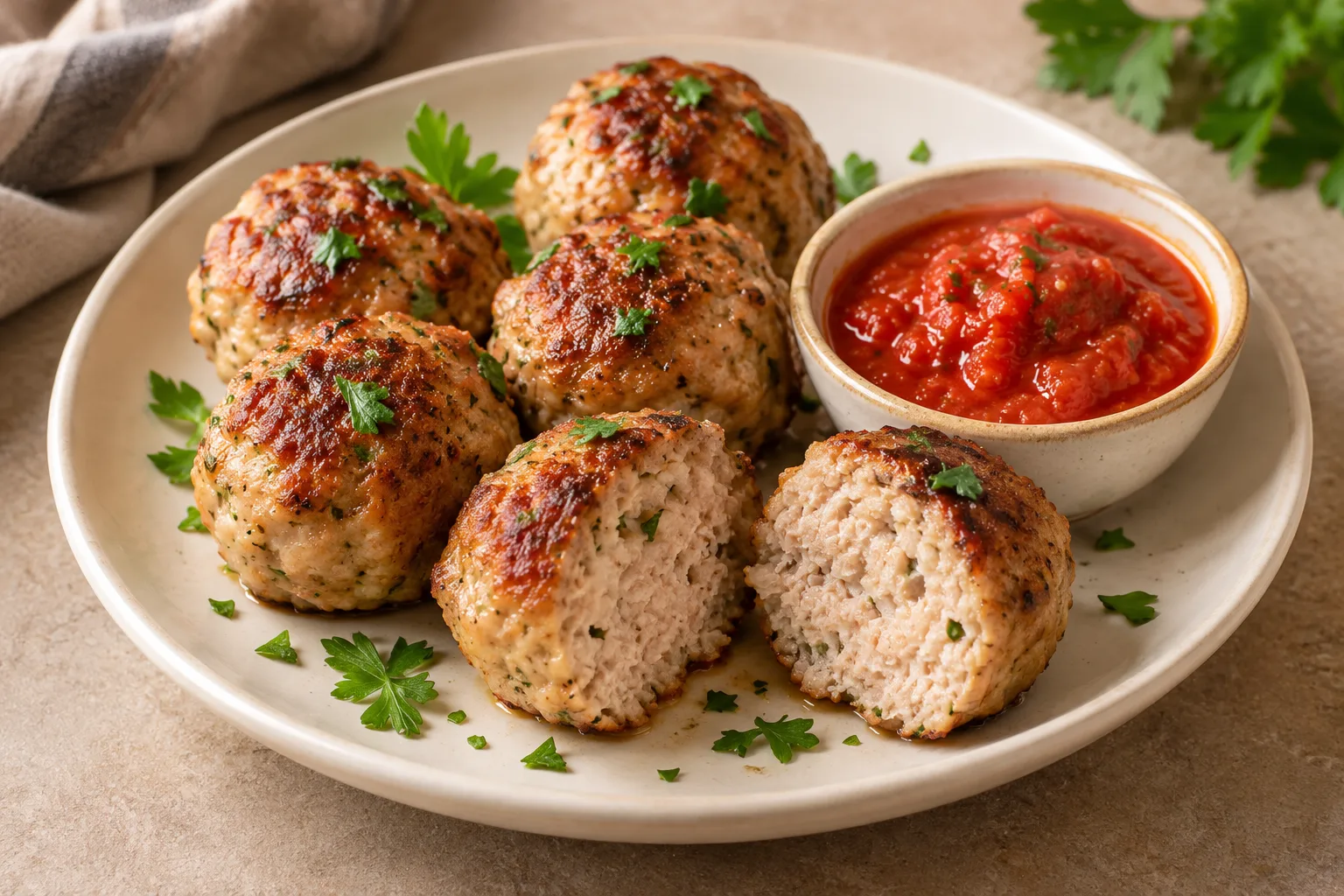
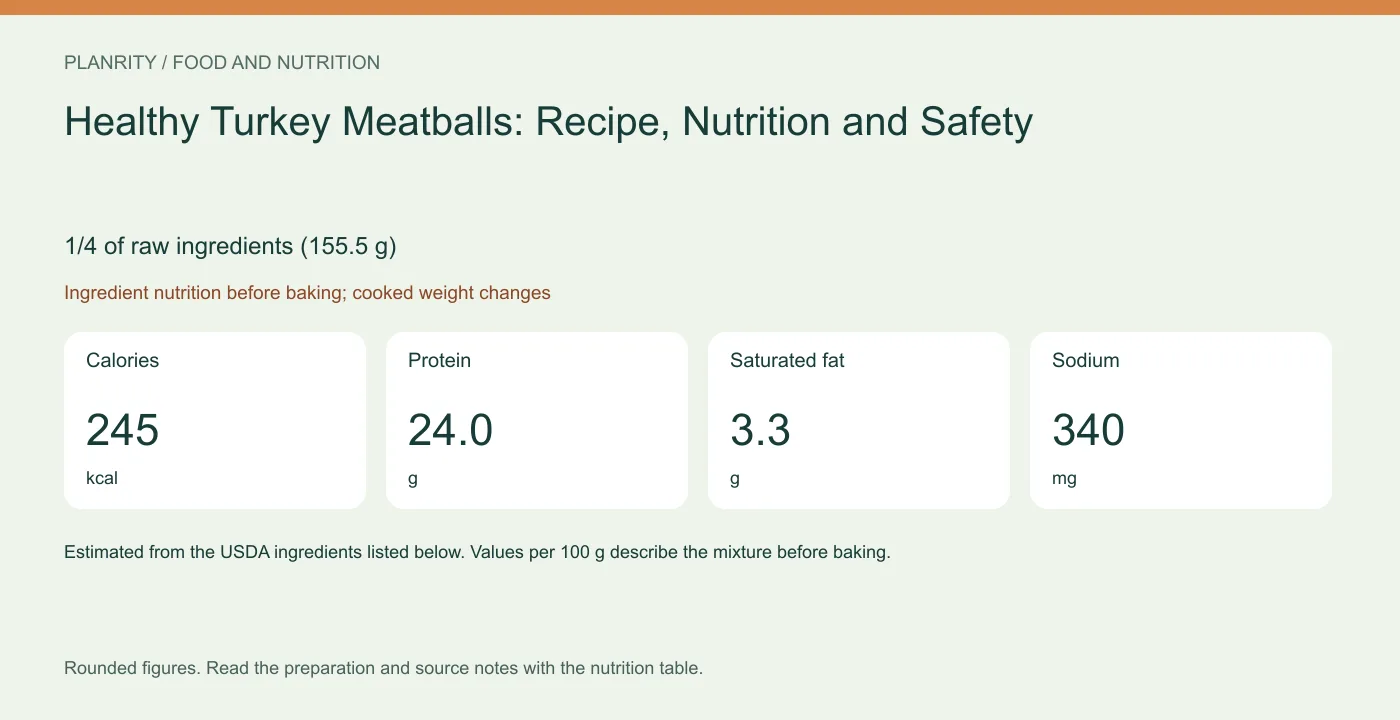
Yes These turkey meatballs offer an estimated 24 g protein and 245 calories per four-meatball portion when the listed ingredients are divided into 16 balls. The recipe uses 93%-lean ground turkey and measured oil. Cook the centers to 165°F; the nutrition is an ingredient estimate, and final cooked weights and drippings will change the result.
| Nutrient | 1/4 of raw ingredients (155.5 g) | Per 100 g |
|---|---|---|
| Calories | 245 kcal | 158 kcal |
| Protein | 24.0 g | 15.4 g |
| Total fat | 13.5 g | 8.7 g |
| Saturated fat | 3.3 g | 2.1 g |
| Carbohydrate | 6.9 g | 4.5 g |
| Fiber | 0.6 g | 0.4 g |
| Total sugar | 1.3 g | 0.8 g |
| Sodium | 340 mg | 218 mg |
| Calcium | 52 mg | 33 mg |
| Iron | 2.0 mg | 1.3 mg |
| Potassium | 300 mg | 193 mg |
Estimated from the USDA ingredients listed below. Values per 100 g describe the mixture before baking.
The recipe below is a proposed home preparation with transparent ingredient calculations. It has not been kitchen-tested. Its nutrition describes the ingredients allocated to each portion, while the final cooked weight and nutrient losses remain unmeasured.
Choose the turkey before choosing the label
A lean beef blend can contain less fat than a fattier turkey blend. Packages vary in the proportions of light and dark meat, skin and fat. This recipe uses a 93%-lean, 7%-fat raw turkey USDA record. A fat-free blend or an 85%-lean blend would change the calculation and potentially the texture.
The bread in this version is soft white bread, not dry breadcrumbs. Substituting an equal volume of dry crumbs can change both weight and texture. Use the listed gram weight if you want to reproduce the calculation.
Ingredients for 16 turkey meatballs
Divide the mixture into 16 equal meatballs, making four portions of four meatballs. The calculated raw mixture totals 622 g, or about 39 g per raw meatball. These are forming targets; cooked meatballs will lose some weight. Do not label a cooked portion as weighing 155.5 g unless you actually measure it.
Preparation steps
- Heat the oven to 400°F and line a rimmed tray. This is an oven setting for the proposed method, not the safety endpoint.
- Finely chop the onion and garlic. Break the weighed soft bread into small crumbs.
- Mix the egg, bread, onion, garlic and salt, then gently incorporate the turkey.
- Divide into 16 similar-sized balls and place them with space between each one.
- Use the measured oil to coat the tray or meatballs; do not add an uncounted pour.
- Bake until the center of the meatballs reaches 165°F, checking several pieces with a food thermometer. Time varies with size and oven performance, so temperature determines completion. USDA safe minimum internal temperatures
- Transfer cooked meatballs with clean utensils. Divide into four portions or weigh the finished batch before calculating your own cooked serving weights.
Do not taste the raw mixture. If adjusting seasoning, cook a small sample to the safe endpoint before tasting it. A browned surface or the disappearance of pink color is not a substitute for a thermometer.
How to portion the cooked meatballs
The per-100-g column describes the raw ingredient mixture. The per-portion figures allocate one quarter of all ingredients to a meal portion. They assume all oil is retained and do not deduct unmeasured drippings. That is a transparent starting estimate, not a laboratory measurement of the cooked food.
To improve the estimate, weigh the cooked batch and record any discarded fat or liquid using an appropriate nutrient-calculation method. Simply dividing ingredient totals by a smaller cooked weight can estimate concentration, but it does not prove that all nutrients survived cooking unchanged.
Compare without giving turkey an automatic advantage
All rows below use the same 100-g weight.
| Food | Calories (kcal) | Protein (g) | Fat (g) | Saturated fat (g) | Fiber (g) | Sodium (mg) |
|---|---|---|---|---|---|---|
| Turkey meatball ingredient estimate | 158 | 15.4 | 8.7 | 2.1 | 0.4 | 218 |
| Turkey, ground, 93% lean, 7% fat, pan-broiled crumbles | 213 | 27.1 | 11.6 | 3.0 | 0.0 | 90 |
| Beef, ground, 95% lean meat / 5% fat, patty, cooked, pan-broiled | 164 | 25.8 | 5.9 | 2.6 | 0.0 | 71 |
These rows have different preparation states: raw meatball mixture, cooked ground turkey and cooked lean beef. They illustrate why an animal-name ranking is insufficient, not a matched test of finished meatballs. For a recipe comparison, keep the egg, bread, vegetables, oil, seasoning, portion count and yield method the same, changing only the specified meat.
What this approach does well
Defined protein ingredient: The turkey blend is identified, so the calculation does not rely on an unspecified “lean turkey” assumption.
Measured additions: Oil, bread and salt are included. Small additions can matter across a batch, and including them makes the estimate reproducible.
Flexible meal use: Meatballs can accompany pasta, a grain bowl or vegetables. The recipe does not need to carry every nutrient requirement on its own.
Limits and practical adjustments
Sodium: The measured salt contributes sodium, and jarred sauce or Parmesan adds more. A no-added-salt tomato sauce is a different ingredient from a salty commercial sauce. Use its actual panel when calculating the meal.
Fiber: This meatball recipe supplies little fiber. Choose a side such as vegetables, beans or a suitable grain rather than assuming the small onion amount closes that gap.
Allergens: This formulation contains egg and wheat. Any milk in the bread depends on the product. A gluten-free or egg-free substitution needs its own ingredient and texture assessment.
Yield uncertainty: Meatball count is a practical portion tool, but only when the pieces are formed consistently. A restaurant’s four meatballs may be a different total weight from this recipe’s four.
For a softer texture, handle the mixture gently and avoid compressing it heavily. If you change the binder or add grated vegetables, record their gram weights. Added moisture changes cooking time and final weight, so recalculate the changed recipe before using its cooked density.
Serving, cooling and storage
Four meatballs are the recipe’s portion convention, not a universal intake recommendation. Adjust the complete plate to your appetite and dietary needs. Count sauce, pasta, bread and cheese separately if you track nutrition.
Refrigerate leftovers promptly in shallow containers. USDA advises using refrigerated leftovers within three to four days; freeze portions for longer storage. Reheated leftovers should reach 165°F. These storage rules depend on proper handling and refrigeration, not merely on counting days. USDA FSIS: Leftovers and Food Safety USDA safe minimum internal temperatures
Cooking checklist
- Confirm the turkey blend and package condition.
- Weigh ingredients rather than guessing bread or oil amounts.
- Form similar-sized pieces for more even cooking.
- Check the center temperature of several meatballs.
- Keep utensils used on raw turkey separate from serving utensils.
- Include sides and sauce in any meal calculation.
- Record the cooked batch weight if precise cooked nutrition is needed.
Make portions repeatable
For repeatable portions, form 16 balls from the listed mixture and divide the cooked batch into four groups. The raw forming target is about 39 g per ball. A scoop can help with size, but use a thermometer in several centers to confirm 165°F. Size and oven performance affect the time; a browned surface alone cannot confirm that temperature.
Keep sauce separate when weighing the finished meatballs. Adding sauce makes a serving heavier without adding more turkey, so a cooked gram weight becomes hard to interpret if the components are mixed first. If you change the turkey’s leanness, use a different record and expect the texture to change too. Serve vegetables, beans or a starch alongside according to the meal you want; the meatballs’ modest fiber contribution is a useful reason to plan those accompaniments.
What to take away
Start with the stated turkey blend, weigh the ingredients and form evenly sized meatballs. Four balls allocate a useful protein portion, while vegetables, beans or another accompaniment can add fiber to the meal. The 165°F center temperature is the cooking endpoint. Treat the nutrition as an ingredient estimate, keep sauce separate when measuring servings, and weigh a finished batch if you need its cooked portion size. Ingredient swaps need their own calculation.
Related food guides
Frequently asked questions
What temperature should turkey meatballs reach?
The center must reach 165°F according to USDA poultry guidance. Check several meatballs because size and oven position can affect cooking. The oven setting and a browned surface do not tell you that the center has reached the safe endpoint.
Are the nutrition figures for cooked meatballs?
They are ingredient-based estimates allocated across four portions. Per-100-g figures describe the raw mixture because cooked yield and drippings have not been measured. They should not be relabeled as an exact cooked-food analysis.
Can I use a leaner turkey blend?
Yes, but the nutrition and texture will change. Use the actual package or an appropriate USDA record and recalculate the recipe. A very lean blend may need a different moisture strategy; any added ingredient should be recorded.
Can I make the recipe gluten-free?
A suitable gluten-free binder may work, but this formulation has not been tested with substitutions. Check all ingredient labels and cross-contact needs, and recalculate using the replacement’s gram weight and nutrition. Use the replacement ingredient’s figures for the changed recipe.
Sources
- Garlic, raw; 169230, USDA
- Onions, raw; 170000, USDA
- Egg, whole, raw, fresh; 171287, USDA
- Oil, olive, salad or cooking; 171413, USDA
- Beef, ground, 95% lean meat / 5% fat, patty, cooked, pan-broiled; 171792, USDA
- Turkey, ground, 93% lean, 7% fat, raw; 172850, USDA
- Turkey, ground, 93% lean, 7% fat, pan-broiled crumbles; 172851, USDA
- Salt, table; 173468, USDA
- Bread, white, commercially prepared (includes soft bread crumbs); 174924, USDA
- USDA safe minimum internal temperatures, USDA
- USDA FSIS: Leftovers and Food Safety, USDA
- How to Understand and Use the Nutrition Facts Label | FDA, FDA
- Sodium in Your Diet | FDA, FDA
- Selecting and Serving Produce Safely | FDA, FDA