Breads and grains
Is Ciabatta Bread Healthy? Portions, Fiber and Fillings
Is ciabatta bread healthy? Compare two La Brea rolls, whole and half portions, fiber and sodium, with a chicken filling and practical sandwich choices.
The short answer
Sometimes Ciabatta can work well as sandwich bread when you choose the roll and portion deliberately. La Brea Bakery’s listed 85 g Take & Bake roll has 250 calories and 450 mg sodium. Its larger 4.5 oz food-service roll lists 370 calories and 900 mg sodium for the whole roll. Both are ciabatta, but they are different products with different portions and recipes.
| Nutrient | La Brea Take & Bake Ciabatta: one 85 g roll |
|---|---|
| Calories | 250 kcal |
| Protein | 7 g |
| Fiber | 1 g |
| Sodium | 450 mg |
| Total fat | 4.5 g |
Currently linked manufacturer panel for the 85 g retail roll; the 4.5 oz food-service roll has its own half/whole columns.
Ciabatta can work well as sandwich bread when you choose the roll and portion deliberately. La Brea Bakery’s listed 85 g Take & Bake roll has 250 calories and 450 mg sodium. Its larger 4.5 oz food-service roll lists 370 calories and 900 mg sodium for the whole roll. Both are ciabatta, but they are different products with different portions and recipes.
Choose the bread you enjoy, then compare its amount, fiber and sodium with a realistic alternative. A rustic crust does not identify whole-grain content. The filling and the roll together determine the sandwich.
Two ciabatta rolls, three portion choices
The manufacturer’s Take & Bake Ciabatta Rolls page links a one-roll, 85 g panel. The separate 4.5 oz food-service roll has a dual-column label for half and whole rolls.
| Named product and amount | Calories | Protein | Fiber | Sodium |
|---|---|---|---|---|
| Take & Bake, one 85 g roll | 250 | 7 g | 1 g | 450 mg |
| Food-service roll, half, 64 g | 180 | 5 g | 1 g | 450 mg |
| Food-service roll, whole | 370 | 11 g | 3 g | 900 mg |
The smaller whole retail roll has the same listed sodium as half the larger food-service roll. That illustrates why “smaller” and “lower sodium” are not interchangeable without looking at the product. Calories and protein differ as well.
Use the actual whole-roll column for the larger roll. Twice its rounded 180-calorie half-roll value is 360, but the printed whole-roll figure is 370. Protein and fiber also have separate rounded amounts; the manufacturer’s whole column is the better match when eating the whole roll.
The Take & Bake image uses an older label design that remains linked from the manufacturer page. Check the package you buy for updates. Its 85 g roll should not inherit the larger roll’s panel merely because both have an open, chewy crumb.
At a café, ask whether the sandwich uses a whole roll and whether a displayed nutrition value includes the filling. Two halves of a finished sandwich can also have unequal filling amounts even when the bread is cut evenly.
The ingredient list matters more than the crust color
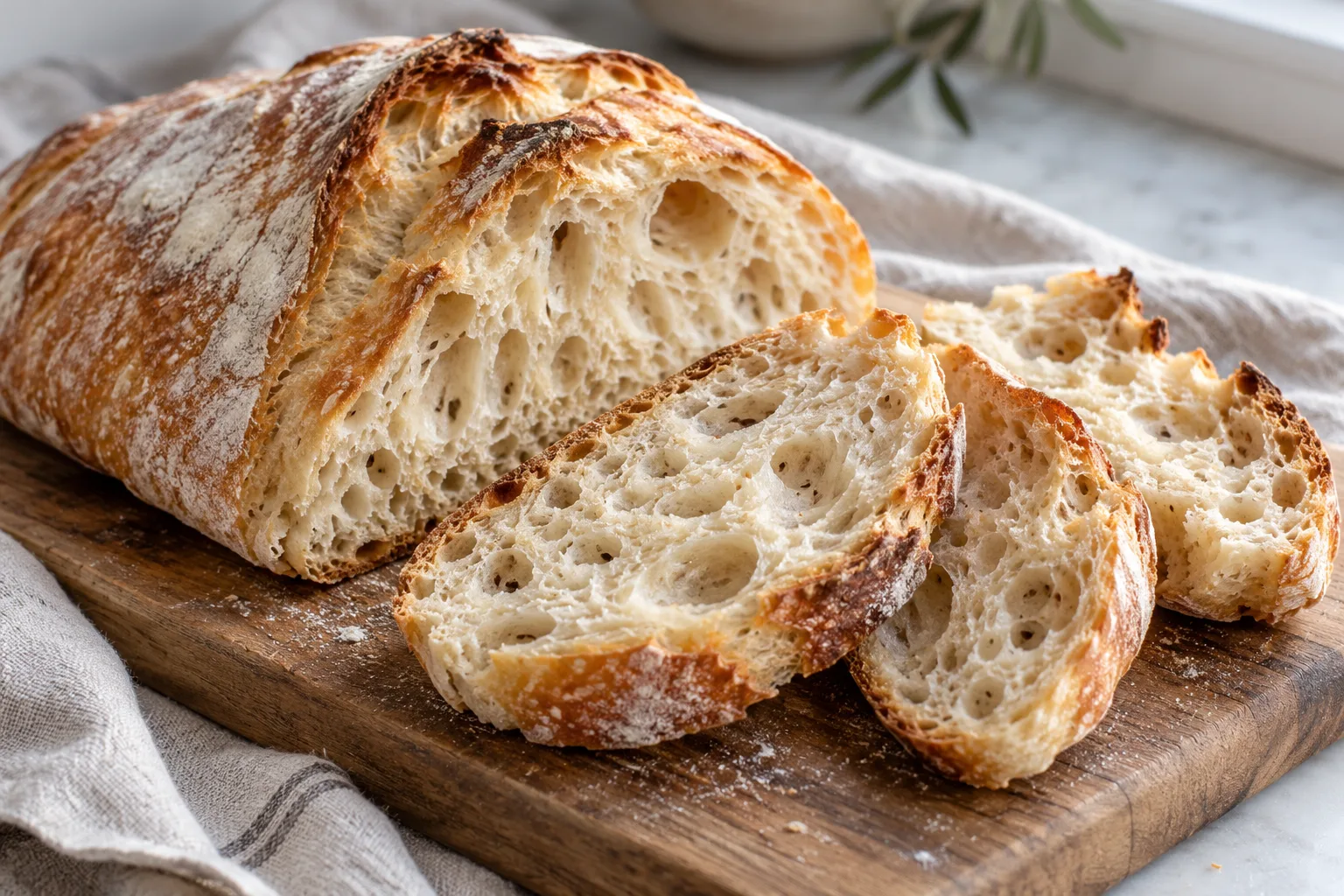
The larger food-service roll lists enriched wheat flour, water and sour culture, with smaller amounts including olive oil, salt, semolina and wheat germ. The Take & Bake list also starts with enriched wheat flour, but includes organic canola oil and a smaller-listed whole-wheat flour ingredient. Neither the germ in the first list nor a whole-wheat ingredient later in the second makes the main flour whole wheat.
When whole grains are your aim, look for a product that identifies whole-wheat or other whole-grain flour rather than relying on a dark crust, flour dusting or an artisan description. The FDA’s label guide is useful for pairing that ingredient check with the fiber amount per serving.
You may still prefer ciabatta for a particular sandwich. Bread choice does not need to be reduced to “good” and “bad.” The relevant question is whether the bread portion and the finished meal suit your needs. If you want more fiber, choose it deliberately through the bread or another food rather than assuming a chewy texture guarantees it.
Planrity’s pita comparison covers a similar issue: bread format and flour type are separate decisions. A pocket, roll or sliced loaf can be made in several formulations, and each can come in very different sizes.
Compare equal weights before comparing sandwiches
The USDA commercial whole-wheat bread reference, FDC 172688, has about 161 calories, 3.8 g fiber and 291 mg sodium per 64 g. That weight matches this ciabatta label’s half-roll serving. It is a generic reference, not a claim that all sliced whole-wheat loaves share those values.
At that equal weight, the named ciabatta half roll lists 180 calories, 1 g fiber and 450 mg sodium. The differences are worth seeing, especially for someone comparing fiber or sodium. Comparing a whole large roll with a single thin slice would exaggerate the role of bread type because the food amounts differ too.
The USDA commercial white-bread reference, FDC 174924, supplies about 170 calories, 1.7 g fiber and 314 mg sodium per 64 g. These comparisons do not establish a universal bread ranking. They show how both recipe and portion can matter, and why a current package label is useful even when a food seems familiar.
If your bread’s serving is 45 g and you eat 90 g, double its panel. If the deli uses a roll without a label, ask whether it has nutrition information or can identify the bakery product. Estimating from a matched product is more defensible than using a precise number for an unidentified roll.
The filling can change the purpose of the meal
A roll can hold a modest vegetable filling, a substantial chicken portion or several salty deli ingredients. Those sandwiches have different protein, fiber, energy and sodium even when the bread is identical. Start with the bread amount, then add ingredients one at a time.
For example, 56 g of plain cooked roasted chicken contributes about 92 calories and 17.4 g protein, using USDA FDC 171477. Add it to the featured half roll and the two-ingredient base is approximately 272 calories, 22.4 g protein and 491 mg sodium. Sauces, vegetables and cheese are excluded from that calculation.
Use the whole roll with the same chicken amount and the base is approximately 462 calories and 941 mg sodium. The change comes from more bread, not more chicken. That can be useful to notice if a larger sandwich leaves you eating much more bread while the protein filling barely changes.
Cheese and pesto add another layer. The provolone guide uses weighed cheese portions, while the pesto guide discusses sauce quantities. You can use both foods, but count the amount you actually spread or layer rather than assuming fillings disappear inside a “healthy sandwich.”
Sodium is easy to overlook in plain-looking bread
The whole ciabatta roll’s 900 mg sodium is about 39% of the FDA’s 2,300 mg Daily Value. It can therefore contribute substantially before a salty filling is added. Bread need not taste strongly salty to make a useful contribution to the meal total.
The FDA’s sodium guide recommends comparing products using their labels. When reducing sodium is the goal, a smaller roll or another identified bread may make more difference than removing a little lettuce or choosing a different crust color.
At a café, you can ask for half the bread or eat part of a large roll if that suits your appetite. At home, choose a roll size that fits the filling rather than using the largest available as the default. You do not need to remove all bread to make a meaningful portion change.
What to check at the bakery or supermarket
First identify the weight of one roll or your usual portion. Next compare fiber and sodium at that amount. Then consider the sandwich filling, any accompanying soup or chips, and whether the meal needs another component such as fruit or vegetables.
The featured roll contains wheat and is made in a facility handling several other allergens. A sour culture or long fermentation description does not make ordinary wheat ciabatta appropriate for a wheat allergy or establish that it is gluten-free. The FDA’s allergy-label advice supports checking the current product and asking about unpackaged bakery foods.
Choose ciabatta when you enjoy it, with a portion and filling that make sense for the meal. The most useful improvement is often simply knowing whether you are eating half a roll or a full one—and using the correct nutrition column for that choice.
Frequently asked questions
Is ciabatta healthier than white sandwich bread?
There is no universal answer. Compare equal weights for calories, fiber and sodium, then consider the finished sandwich. Half the identified 4.5 oz food-service roll has 180 calories, 1 g fiber and 450 mg sodium per 64 g. A generic white-bread reference differs, but your actual bakery roll and packaged loaf may have other values. Rustic appearance is not a nutrition standard.
Does ciabatta contain whole grains?
Some versions may, but the featured roll lists enriched wheat flour as its main flour. Wheat germ or sour culture in the ingredients does not establish that the bread is whole grain. Look for whole-grain ingredients and check fiber on the actual panel if that is your buying priority. The word ciabatta describes a bread style, not a fixed whole-grain recipe.
Why does half the roll show 180 calories and the whole roll 370?
Nutrition panels use rounding, and this manufacturer supplies separate columns. Use the printed 370-calorie whole-roll figure for the whole product rather than doubling the rounded half-roll number. The same issue affects protein and fiber. If a package has a whole-container column, it is generally more useful for that amount than multiplying already rounded serving figures.
Sources
- La Brea Bakery: Ciabatta roll, 4.5 oz, La Brea Bakery
- La Brea Bakery: Ciabatta roll: half-roll and whole-roll nutrition, La Brea Bakery
- FDA: How to Understand and Use the Nutrition Facts Label, FDA
- FDA: Sodium in Your Diet, FDA
- FDA: Have Food Allergies? Read the Label, FDA
- USDA FoodData Central: Chicken, broilers or fryers, breast, meat only, cooked, roasted (FDC 171477), USDA FoodData Central
- USDA FoodData Central: Bread, whole-wheat, commercially prepared (FDC 172688), USDA FoodData Central
- USDA FoodData Central: Bread, white, commercially prepared (includes soft bread crumbs) (FDC 174924), USDA FoodData Central
- La Brea Bakery: Take & Bake Ciabatta Rolls, La Brea Bakery
- La Brea Bakery: Take & Bake Ciabatta roll nutrition image, La Brea Bakery