Snacks
Are Banana Chips Healthy? Compare Chips, Dried and Fresh
Are banana chips healthy? Compare Bare’s oil-free baked chips, fat-rich USDA chips and fresh banana for sugar, fat, fiber and realistic snack portions.
The short answer
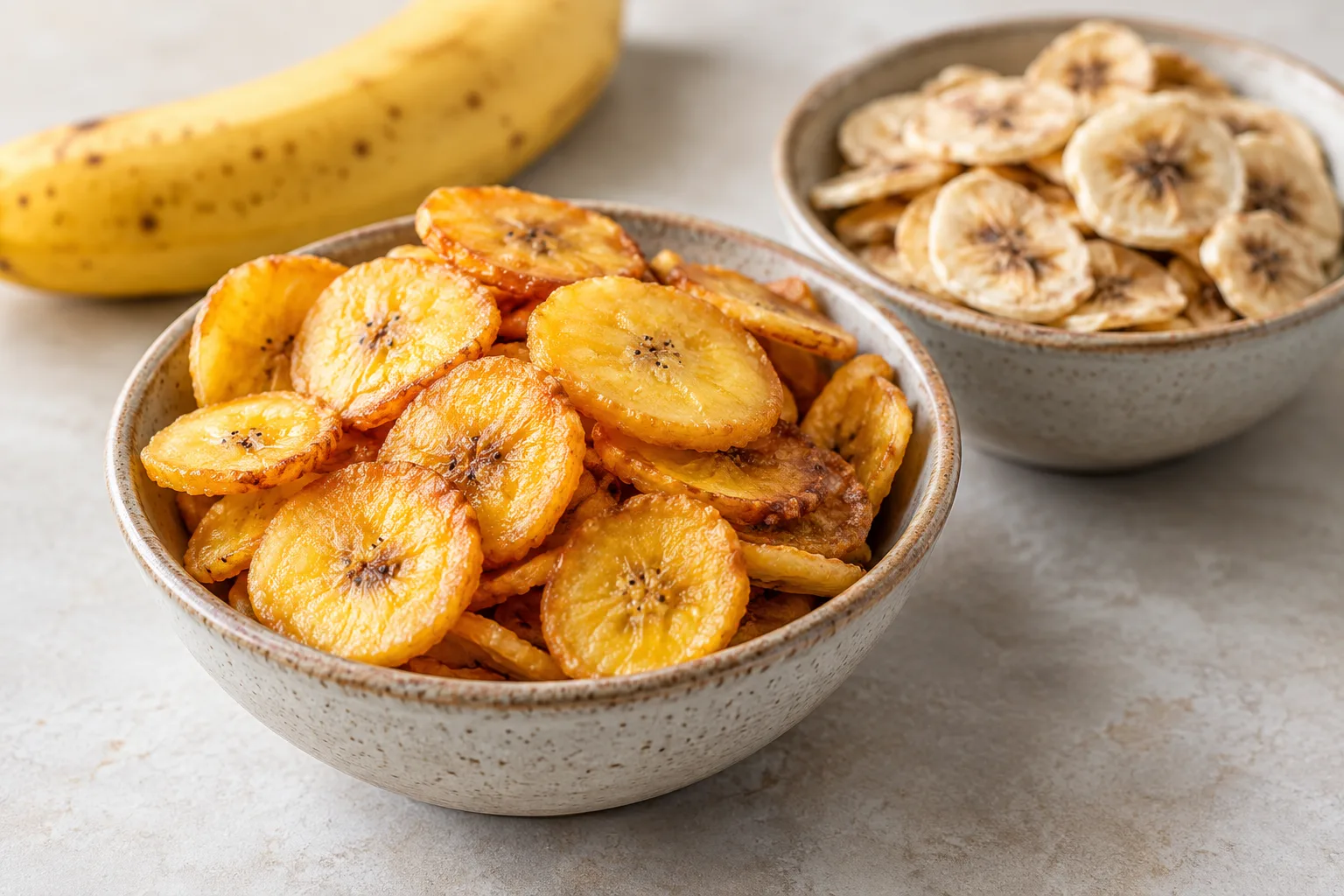
Sometimes Oil-free baked banana chips and oil-rich banana chips deserve different answers. Bare Simply Banana Chips lists 110 calories, 0 g fat and 0 g added sugar per 28 g. The USDA’s fat-rich banana-chip reference has about 145 calories and 8.1 g saturated fat at that weight. Identify the product before treating every crisp banana slice as the same snack.
| Nutrient | Bare Simply Banana Chips: about 1/3 cup, 28 g |
|---|---|
| Calories | 110 kcal |
| Protein | 1 g |
| Fiber | 3 g |
| Total fat | 0 g |
| Total sugar | 18 g |
| Added sugar | 0 g |
Official SmartLabel UPC 013971040005; single banana ingredient. The fat-rich generic USDA chips elsewhere in the article are a different reference.
Oil-free baked banana chips and oil-rich banana chips deserve different answers. Bare Simply Banana Chips lists 110 calories, 0 g fat and 0 g added sugar per 28 g. The USDA’s fat-rich banana-chip reference has about 145 calories and 8.1 g saturated fat at that weight. Identify the product before treating every crisp banana slice as the same snack.
Check whether the product is baked, dried or oil-containing, then read the ingredients and portion. A crisp slice made only from banana can differ substantially from a sweetened, oil-rich chip even when both are sold as banana snacks.
Three banana foods, compared at the same weight
The table uses separate USDA SR Legacy records: banana chips, FDC 168849, raw bananas, FDC 173944, and dehydrated banana or banana powder, FDC 173945. These are reference foods, not current panels for every commercial bag.
| Per 100 g | Banana chips | Dehydrated banana reference | Fresh banana |
|---|---|---|---|
| Calories | 519 | 346 | 89 |
| Total fat | 33.6 g | 1.8 g | 0.3 g |
| Saturated fat | 29.0 g | 0.7 g | 0.1 g |
| Fiber | 7.7 g | 9.9 g | 2.6 g |
| Total sugar | 35.3 g | 47.3 g | 12.2 g |
Drying removes water, which concentrates the remaining food by weight. The chip reference also has much more fat than either of the other entries. Its composition should not be transferred to an air-dried product whose actual ingredient list and label differ.
The dehydrated entry includes banana powder in its description. It is useful for showing how concentrated banana differs from an oily chip, but it is not a tested description of every soft dried banana slice. If you buy a particular chewy product, use that package rather than assigning it the generic powder reference.
Now compare portions someone might actually eat
Equal-weight tables help explain composition. They do not mean most people eat 100 g of each food at one sitting. A separate portion comparison makes the buying decision more practical.
| Example portion | Calories | Fiber | Total sugar | Saturated fat |
|---|---|---|---|---|
| Banana chips, weighed 28 g | 145 | 2.2 g | 9.9 g | 8.1 g |
| Dehydrated banana reference, 28 g | 97 | 2.8 g | 13.2 g | 0.2 g |
| Medium fresh banana, 118 g edible part | 105 | 3.1 g | 14.4 g | 0.1 g |
The fresh banana has more total sugar than the small fat-rich chip-reference portion in this comparison, yet fewer calories, more fiber and far less saturated fat. The separate oil-free Bare example below has another profile. That is why “choose the one with the least sugar” can lead to an incomplete decision. Weight, water content, oil and portion all affect the result.
A 56 g chip portion doubles the 28 g estimate to approximately 291 calories and 16.2 g saturated fat. That saturated fat amount is about 81% of the FDA’s 20 g Daily Value. The figure belongs to this fat-rich USDA reference; a different oil or manufacturing method may produce a different panel.
A baked product shows why the ingredient list matters
The Bare Simply Banana Chips SmartLabel, UPC 013971040005, identifies a 2.7 oz bag and an approximately 1/3-cup, 28 g serving. Its ingredient section lists bananas. The manufacturer’s baking explanation says the banana chips are baked without added oil or sugar.
| Equal 28 g | Bare Simply Banana label | USDA fat-rich chip reference |
|---|---|---|
| Calories | 110 | 145 |
| Total fat | 0 g | 9.4 g |
| Saturated fat | 0 g | 8.1 g |
| Fiber | 3 g | 2.2 g |
| Total sugar | 18 g | 9.9 g |
| Added sugar | 0 g | Not specified in the reference |
The oil-free product has more total sugar at the same weight, yet less energy and far less fat. That does not make its sugar added sugar: the Bare panel lists zero added sugar. This comparison is a good reason to read several columns rather than choosing the smallest total-sugar number alone.
The USDA chip entry is a generic reference, not a laboratory test of Bare or a competing brand. Its missing added-sugar value is left unspecified instead of invented. The manufacturer’s listed panel has an information date of February 2023; check the actual bag for a changed formula or serving before using these numbers.
The FDA’s added-sugars guide explains the distinction. Total sugar includes sugar already present in fruit. Added sugar is a separate part of that total when processing adds sweeteners. Planrity’s cane-sugar guide covers why changing the sweetener name does not remove an addition.
Are banana chips a useful snack?
They can be convenient when you need something dry, portable and less fragile than fresh fruit. You may also like the crisp texture. Those practical benefits are enough reason to consider them; there is no need to claim they detox the body or provide a special weight-loss effect.
If you want a snack mainly for fiber, compare the amount you will eat with other convenient options. The chip reference supplies about 2.2 g fiber per 28 g, alongside substantial saturated fat. Fresh fruit, suitable nuts, or a bean-based food may suit a different goal, but their portions and other nutrients still need separate consideration.
For contrast, PopCorners are corn crisps with their own formulation, while Nature Valley bars combine several ingredients. Neither comparison is settled by saying “fruit beats grains” or “baked beats fried.” Look at the portion, fiber, protein and the nutrients you are trying to limit.
A small amount of banana chips can also work as part of a mixture rather than the entire snack. If you add them to yogurt or a homemade trail mix, count the chips at their actual weight and use the labels for the other ingredients. Calling a mixture “trail mix” does not establish its calorie, sugar or allergy profile.
Choose for the situation you actually have
For a lunch eaten soon, a fresh banana is a straightforward choice when you want fruit with more water and little preparation. For travel, dried fruit may be easier to carry, while chips may be the texture you prefer. Decide whether portability or crispness is the feature you are buying rather than assuming all three choices serve exactly the same purpose.
When choosing a travel snack, compare the package you will carry rather than a small printed serving you rarely use. A resealable family bag and an individual packet may create different portion habits even when the food inside is identical. If chips are an ingredient in a larger mix, keep their weight separate from nuts, chocolate or other dried fruit. The mix’s combined label is more useful than applying the banana-chip panel to every piece.
At home, pour a usual chip portion into a bowl and weigh it once. Compare that weight with the package serving and the size of the bag. If you enjoy a larger amount, use the larger amount in your estimate. A realistic calculation is more useful than repeatedly calling your portion a handful.
Allergies are another reason to read the actual package. Ingredients and shared-manufacturing statements can differ among sweetened fruit snacks and mixes. The FDA’s food-allergy guidance supports checking each current label, especially when buying a new flavor or mixed product.
The most useful improvement may be choosing a product with a different oil profile, packing a smaller chip portion alongside another food, or buying fresh banana for everyday fruit. Pick the change that addresses your concern. Reducing added sugar, reducing saturated fat and choosing a larger-volume fruit snack are related but separate decisions.
Frequently asked questions
Are unsweetened banana chips always a low-sugar food?
No. Banana itself contains sugar, and drying concentrates the fruit by weight. “Unsweetened” does not mean zero total sugar. Check the ingredient list and the added-sugars line on the current package. The generic USDA table in this guide reports total sugar only, so it cannot establish the added-sugar content of a particular bag.
Are baked banana chips healthier than fried ones?
The cooking description alone is not enough. Compare the actual portion for calories, total fat, saturated fat, sugar and fiber, then check oil and sweetener ingredients. A baked product may still contain added oil or sugar. A dehydrated banana product may also differ substantially from the fat-rich generic chip reference used here.
Can banana chips fit a weight-management plan?
They can fit when the portion works within your overall eating pattern, but no individual snack guarantees weight loss. The USDA reference has about 145 calories per 28 g, so a modest-looking larger portion can add up quickly. If you want more food volume for a similar energy amount, compare a fresh banana with the chip amount you actually enjoy.
Sources
- FDA: Added Sugars on the Nutrition Facts Label, FDA
- FDA: Have Food Allergies? Read the Label, FDA
- USDA FoodData Central: Snacks, banana chips (FDC 168849), USDA FoodData Central
- USDA FoodData Central: Bananas, raw (FDC 173944), USDA FoodData Central
- USDA FoodData Central: Bananas, dehydrated, or banana powder (FDC 173945), USDA FoodData Central
- PepsiCo / Bare: Simply Banana Chips, UPC 013971040005, PepsiCo / Bare
- PepsiCo / Bare: How banana chips are baked, PepsiCo / Bare