Meats and seafood
Is Chicken Broth Healthy? A Practical Guide to Your Bowl
Compare regular, reduced-sodium and unsalted chicken broth, then see what changes when the same broth becomes a chicken, rice and vegetable bowl.
The short answer
Sometimes Chicken broth can be a useful cooking ingredient, but regular broth can add a lot of sodium without much protein. One cup of Swanson Chicken Broth lists 860 mg sodium and 1 g protein; the brand's Unsalted Chicken Broth lists 35 mg sodium and 2 g protein for the same 240 mL serving. Choose by the actual label and how much reaches your portion, rather than assuming every carton is a protein-rich drink.
| Nutrient | Swanson Chicken Broth, regular: 1 cup (240 mL) |
|---|---|
| Calories | 10 kcal |
| Protein | 1 g |
| Sodium | 860 mg |
US consumer product label inspected 25 October 2026; broth ingredient only, excluding other soup ingredients.
Chicken broth can be a useful cooking ingredient, but regular broth can add a lot of sodium without much protein. One cup of Swanson Chicken Broth lists 860 mg sodium and 1 g protein; the brand’s Unsalted Chicken Broth lists 35 mg sodium and 2 g protein for the same 240 mL serving. Choose by the actual label and how much reaches your portion, rather than assuming every carton is a protein-rich drink.
Broth brings flavor to rice, vegetables and soup. You do not need to treat it as a supplement to use it well. The most useful decision is often whether your recipe needs a regular, reduced-sodium or unsalted version.
Three chicken broths compared at one cup
These are US consumer labels inspected for this guide. All use a one-cup, 240 mL serving. Other brands, countries, concentrates and homemade recipes need their own information.
| Swanson product | Calories | Protein | Sodium | Approximate sodium Daily Value |
|---|---|---|---|---|
| Chicken Broth | 10 | 1 g | 860 mg | 37% |
| Natural Goodness 33% Less Sodium Chicken Broth | 15 | 2 g | 570 mg | 25% |
| Unsalted Chicken Broth | 10 | 2 g | 35 mg | 2% |
Sources: manufacturer pages for Chicken Broth, Natural Goodness and Unsalted Chicken Broth. Percentages are rounded calculations using the FDA’s 2,300 mg sodium Daily Value, not a personal allowance.
The differences are substantial even though the calorie figures are close. Moving from regular to unsalted changes sodium by 825 mg per cup. Moving from regular to the reduced-sodium product changes it by 290 mg. That makes the sodium line a useful first check when the broth will be the main cooking liquid.
Reduced sodium is not the same as low sodium
The “33% Less Sodium” wording describes a comparison with a reference product. It does not mean the broth contains little sodium in absolute terms. Here, the reduced-sodium carton still lists 570 mg per cup, about a quarter of the label Daily Value.
The FDA sodium guide distinguishes reduced-sodium, low-sodium and sodium-free claims. Read the number beside the serving size before choosing. The unsalted product in our table is also described as not a sodium-free food; its 35 mg should not become zero in your calculation.
If you have an individually prescribed sodium limit, use that advice rather than this article’s general comparisons. For everyday shopping, comparing two cartons at equal volumes reveals differences that front-of-pack wording can hide. Concentrated products need the prepared serving information, including the correct dilution, before you compare them with ready-to-use broth.
Work out how much broth reaches your bowl
A recipe may use several cups of broth, but each person does not necessarily consume the entire carton. Start with the amount in the pot, divide by the number of equal portions, then add the contribution from other ingredients.
Four cups divided into four equal portions contributes the equivalent of one cup of broth to each portion. The broth alone contributes 860 mg sodium with the regular product, 570 mg with Natural Goodness or 35 mg with Unsalted. Chicken, seasonings, sauces and toppings add their own amounts.
If the same four cups are divided into six equal portions, the broth contribution is about 573 mg, 380 mg or 23 mg sodium per portion, respectively. The calculation is label sodium per cup × four cups ÷ six portions. These figures describe the broth component, not a finished soup’s nutrition.
Equal portions are an assumption. If one bowl contains more liquid than another, their sodium contributions will differ. For a family pot you do not need false precision, but stating the portion assumption makes an estimate more useful than quoting a carton value as the meal total.
Broth contributes flavor; the solids supply most protein
The ordinary broths here provide 1–2 g protein per cup. Chicken pieces, beans or another substantial filling can make a much larger contribution to the finished bowl. Count those ingredients separately instead of using a carton picture as a guide to the meal’s protein.
Products sold as bone broth can have different labels. Use the specific product’s protein and serving volume if that is your reason for choosing it; the name alone supplies no number to compare.
Our turkey-meatball guide considers one possible addition with its own ingredients and portions.
A chicken, rice and broccoli bowl: same food, three broths
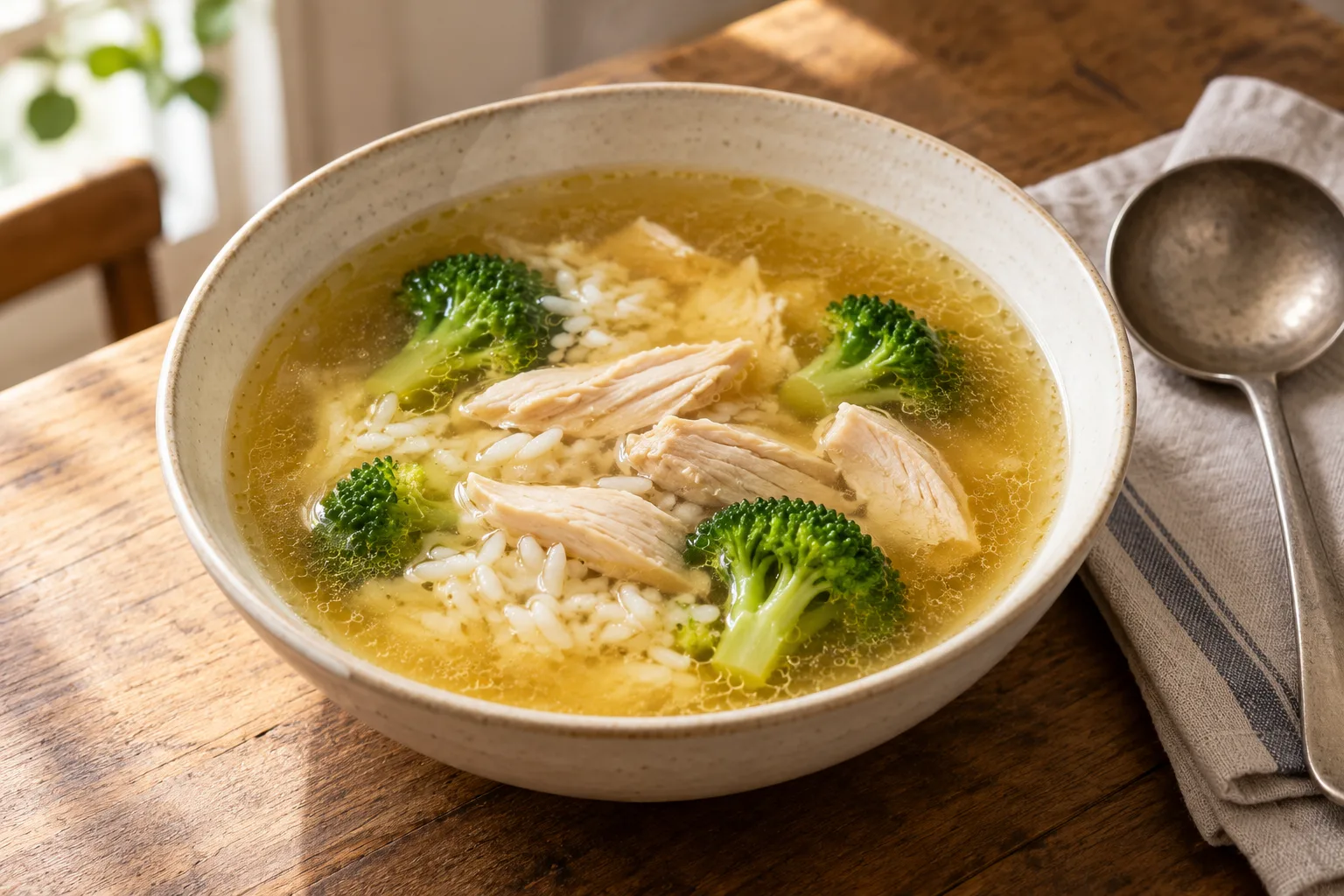
Consider one cup of broth with 75 g cooked roasted chicken breast, 100 g cooked rice and 100 g cooked broccoli. The foods are weighed ready to eat, before extra salt, oil or sauce. This is a calculated meal example, not a tested recipe.
USDA references for roasted chicken breast, cooked enriched white rice and cooked broccoli without added salt supply the solid-food values. Their combined contribution is about 289 calories, 28.3 g protein, 3.7 g fiber and 98 mg sodium. Add the actual cup of broth to that base.
| Calculated bowl with the same solids | Calories | Protein | Fiber | Sodium |
|---|---|---|---|---|
| Regular Swanson Chicken Broth | 299 | 29.3 g | 3.7 g | 958 mg |
| Swanson Natural Goodness | 304 | 30.3 g | 3.7 g | 668 mg |
| Swanson Unsalted | 299 | 30.3 g | 3.7 g | 133 mg |
Totals use unrounded ingredient values before display rounding. In this example, the chicken supplies most of the protein, while the regular broth supplies most of the sodium. Choosing unsalted broth changes that second contribution without removing chicken, rice or vegetables.
This also explains why a plain-broth number should not be used for a full soup. The bowl with unsalted broth has about 30 g protein, but the carton itself has only 2 g per cup. The added foods account for the difference.
For congee, the rice amount and toppings form a different meal calculation; see our congee guide. For dumplings in broth, use the wrapper and filling information in our dumpling guide, alongside the broth actually used.
Homemade broth needs a recipe-specific estimate
There is no single reliable nutrition figure for every homemade chicken broth. Ingredients, water volume, cooking process, removed solids and added salt differ. A strained liquid and an unstrained chicken soup are not interchangeable entries in a food tracker.
If you want a repeatable estimate, record the recipe and final yield. Record added salt and packaged ingredients carefully, and be clear about which solids remain in the food you eat. When extraction into a strained liquid is unknown, do not present a sum of all raw ingredients as a laboratory analysis of the broth.
For routine cooking, a consistent recipe and measured salt addition can still be useful. If you need a tightly controlled nutrient intake, ask a qualified professional how best to handle homemade foods whose composition is uncertain.
Store and reheat it safely
Follow carton instructions for storage before and after opening. Once broth becomes part of a cooked dish, treat the dish as perishable. The CDC’s leftover guidance advises prompt refrigeration and eating refrigerated leftovers within three to four days. Refrigerate within two hours, or one hour above 90°F, and divide a large batch into shallow containers for quicker cooling, as the FDA’s handling guide advises.
The FoodSafety.gov temperature chart lists 165°F/74°C for reheating leftovers. Use a food thermometer, especially when broth contains meat or other solids. A warm surface does not show that the whole portion has reached the same temperature.
Diluting regular broth: a numerical example
Mixing one cup of the regular broth with one cup of water produces two cups of liquid containing the original 860 mg sodium. If divided into two equal cups, each contributes about 430 mg from broth. If you consume both cups, the contribution remains 860 mg.
That option may suit a recipe when you already have regular broth, but it also dilutes the flavor. The unsalted carton supplies a different starting point at 35 mg per cup before your seasoning. Neither calculation includes salt or sauces added later.
For a concentrate or stock cube, follow the package’s preparation ratio before comparing it with ready-to-use broth. Note whether the panel applies to dry product or the prepared liquid. A smaller spoonful of concentrate and a full cup of ready-made broth are not equivalent serving descriptions.
Choose the cooking liquid for the dish, then calculate the amount reaching each serving. For this comparison, sodium makes a much larger difference between cartons than calories or protein.
Prepared with AI assistance. This guide has not been medically reviewed and provides general information, not personal medical advice.
Frequently asked questions
Is unsalted chicken broth sodium-free?
Not necessarily. The Swanson Unsalted product inspected here lists 35 mg sodium per cup and explicitly says it is not a sodium-free food. Check your carton rather than interpreting “unsalted” as zero.
Is chicken broth high in protein?
The three ordinary chicken broths compared here contain 1–2 g protein per cup. Other products may differ. Read the exact label and count chicken, beans or other foods separately when estimating a finished meal.
How much sodium is in two cups of regular broth?
Using the inspected Swanson Chicken Broth label, two cups supply 1,720 mg sodium before other ingredients. That is about 75% of the FDA's 2,300 mg Daily Value. A different product can have a very different total.
Sources
- FDA: Sodium in Your Diet, FDA
- FoodSafety.gov: Safe Minimum Internal Temperatures, FoodSafety.gov
- CDC: Food Safety Tips for Dining Out, CDC
- Swanson: Chicken Broth, Swanson
- Swanson: 33% Less Sodium Chicken Broth, Swanson
- Swanson: Unsalted Chicken Broth, Swanson
- USDA SR Legacy: Rice, white, long-grain, regular, enriched, cooked (FDC 168878), USDA SR Legacy
- FDA: Handling Food Safely While Eating Outdoors, FDA
- USDA SR Legacy: Broccoli, cooked, boiled, drained, without salt (FDC 169967), USDA SR Legacy
- USDA SR Legacy: Chicken, broilers or fryers, breast, meat only, cooked, roasted (FDC 171477), USDA SR Legacy