Sauces and condiments
Healthy BBQ Sauce: 4 Options Compared by Sugar and Sodium
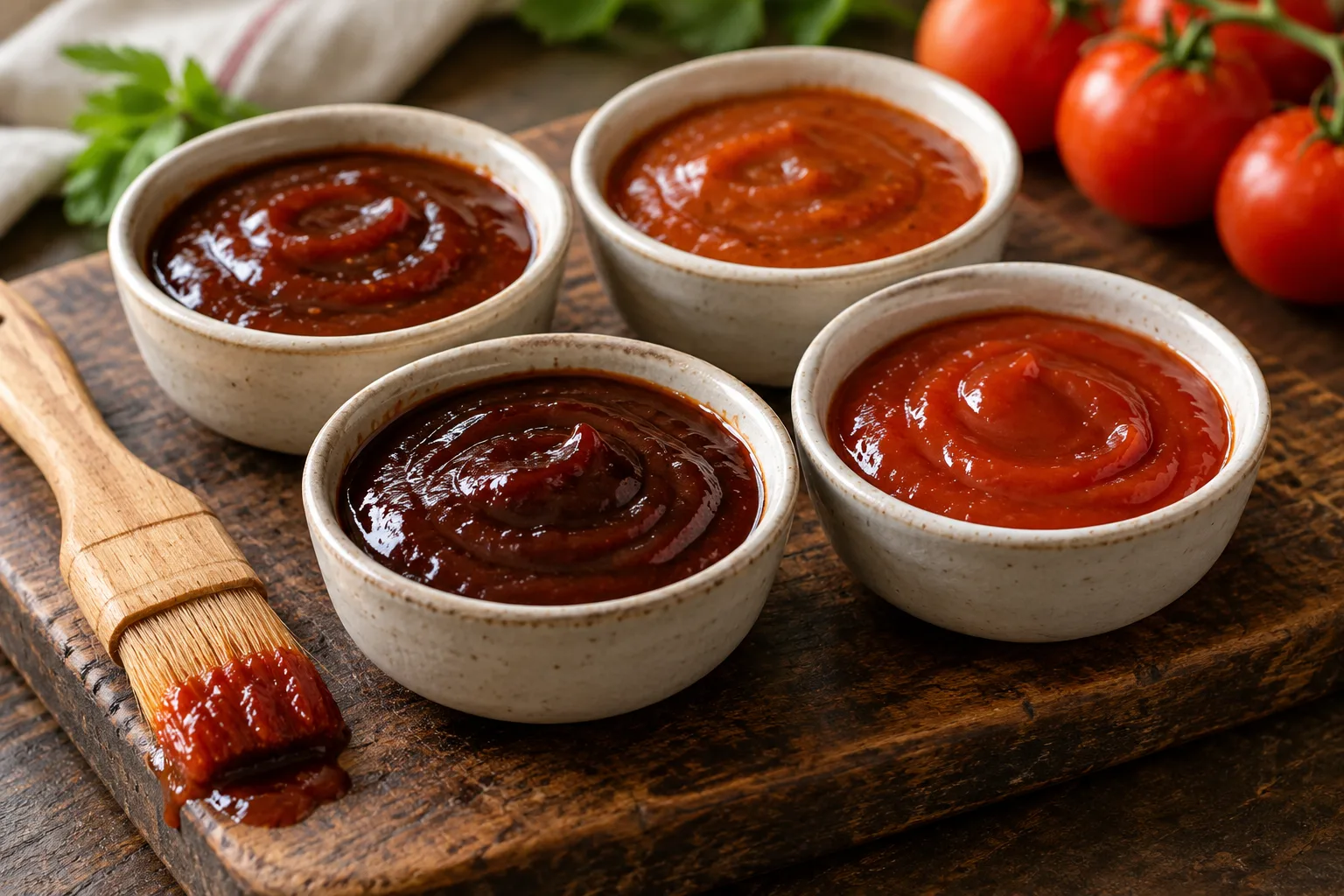
Four identified BBQ sauces offer different sugar, sodium and sweetener profiles. Compare their labels and calculate the amount used for a glaze, dip or shared batch.
The short answer
For less added sugar, Primal Kitchen Classic Unsweetened and G Hughes Original list 0 g per two tablespoons, while Stubb's Original lists 4 g and Sweet Baby Ray's Original lists 16 g. Sodium creates a different ranking: these four servings range from 115 to 290 mg. A healthy BBQ sauce choice starts with the specific change you want, followed by the amount you will eat.
| Nutrient | Sweet Baby Ray’s Original: 2 tbsp (36 g) |
|---|---|
| Calories | 70 kcal |
| Total sugar | 17 g |
| Added sugar | 16 g |
| Sodium | 290 mg |
Manufacturer US Original label inspected 25 October 2026. Added sugar is included in total sugar.
For less added sugar, Primal Kitchen Classic Unsweetened and G Hughes Original list 0 g per two tablespoons, while Stubb’s Original lists 4 g and Sweet Baby Ray’s Original lists 16 g. Sodium creates a different ranking: these four servings range from 115 to 290 mg. A healthy BBQ sauce choice starts with the specific change you want, followed by the amount you will eat.
For the lowest listed sodium among these examples, choose Primal Kitchen. For a zero-sugar sauce sweetened with sucralose, consider the identified G Hughes product. For a sugar-sweetened alternative with less added sugar than Sweet Baby Ray’s Original, Stubb’s provides a middle option. These are nutrition-based comparisons, not taste-test awards or a ranking of every sauce on sale.
Four bottles, with their exact serving weights
The following US manufacturer information was inspected on 25 October 2026, including official nutrition-panel images. All servings say two tablespoons, but their weights differ. Use this table for a labeled-portion comparison, rather than assuming the sauces have identical density.
| Identified sauce | Serving | Calories | Total sugar | Added sugar | Sodium |
|---|---|---|---|---|---|
| Sweet Baby Ray’s Original | 2 tbsp, 36 g | 70 | 17 g | 16 g | 290 mg |
| Stubb’s Original, 18-oz bottle | 2 tbsp, 33 g | 30 | 5 g | 4 g | 250 mg |
| Primal Kitchen Classic Unsweetened | 2 tbsp, 32 g | 20 | 3 g | 0 g | 115 mg |
| G Hughes Original BBQ | 2 tbsp, 30 g | 10 | 0 g | 0 g | 200 mg |
Sources: Sweet Baby Ray’s Original, Stubb’s Original, Primal Kitchen Classic and G Hughes Original. A different flavor or reformulated bottle needs its own panel.
The table shows why a single “healthiest sauce” label is too blunt. G Hughes has the lowest displayed calories, while Primal Kitchen has the lowest sodium. Stubb’s has far less added sugar than Sweet Baby Ray’s at their stated servings, but their sodium values are much closer.
Choose the trade-off that matters at your barbecue
If added sugar is your priority: the two zero-added-sugar examples provide the clearest change from Sweet Baby Ray’s Original. Stubb’s also reduces the listed amount substantially, from 16 to 4 g per two tablespoons, while retaining sugar and molasses in its ingredients.
If sodium is your priority: compare the sodium column separately. Stubb’s saves only 40 mg per labeled serving compared with Sweet Baby Ray’s; Primal Kitchen saves 175 mg. Moving to less sugar does not predict the size of the sodium change.
If you want to avoid sucralose: the inspected G Hughes ingredient image lists it. The Primal Kitchen example offers a different route to zero added sugar. Neither label comparison establishes which flavor or texture you will prefer.
If you want to keep your current bottle: use a smaller finishing amount and count any dip alongside it. Halving the portion halves its displayed nutrient contribution. A change in quantity can be more convenient than buying several bottles for one meal.
What one tablespoon contributes
A tablespoon is useful for a finishing brush or a small dip portion. The following estimates halve each two-tablespoon label; they inherit its rounding.
| One-tablespoon estimate | Calories | Added sugar | Sodium |
|---|---|---|---|
| Sweet Baby Ray’s Original | 35 | 8 g | 145 mg |
| Stubb’s Original | 15 | 2 g | 125 mg |
| Primal Kitchen Classic | 10 | 0 g | About 58 mg |
| G Hughes Original | 5 | 0 g | 100 mg |
For a meal with both glaze and dip, add the amounts together. One tablespoon brushed onto your portion plus one tablespoon eaten as dip is a two-tablespoon total. Moving the sauce into a separate cup makes the amount visible, but the amount consumed still determines the contribution.
You can measure a usual serving once, then use that as a visual reference at the table. For a thicker or thinner sauce, weighing the labeled grams can be easier than estimating how much clings to a spoon.
Glazing a shared batch: a worked example
Suppose eight tablespoons of sauce are distributed through four equal portions, with all of the sauce eaten. That is four label servings in the batch and one label serving per person. Sweet Baby Ray’s contributes 70 calories, 16 g added sugar and 290 mg sodium per portion; Stubb’s contributes 30 calories, 4 g added sugar and 250 mg sodium.
If you use four tablespoons across the same four portions instead, each receives a one-tablespoon estimate from the previous table. The result is different from coating the food with eight tablespoons and then putting another dip on the table.
For a less even coating, treat the calculation as an estimate. Sauce left in a mixing bowl or pan is not necessarily eaten, and one heavily coated serving may receive more than another. The record you need is the amount added and the number of portions, rather than the bottle’s total weight.
Read sugar claims without double-counting
Sweet Baby Ray’s 16 g added sugar is included in its 17 g total sugar. Adding those numbers would count the added portion twice. Primal Kitchen’s 3 g total sugar and 0 g added sugar are also compatible: total sugar can come from ingredients that are not added sweeteners.
The FDA added-sugar guide uses a 50 g Daily Value for a 2,000-calorie reference diet. Sweet Baby Ray’s labeled serving supplies 32% of that reference; Stubb’s supplies 8%. A honey- or maple-sweetened sauce still needs the same added-sugar check.
“Sugar-free” and “unsweetened” also describe different choices. The G Hughes example contains sucralose despite listing 0 g sugar. If you prefer a particular sweetener or want an unsweetened flavor, use the ingredients as well as the nutrition panel to narrow the options.
Sodium in the complete plate
The FDA sodium guide uses a 2,300 mg Daily Value. A two-tablespoon sauce serving here supplies approximately 5–13% of that reference. Seasoned meat, bread, pickles and side dishes add their own amounts.
This matters when changing a sauce for a familiar meal. A smaller sauce portion may be useful, but it does not tell you how much sodium is in a burger or a plate of ribs. Keep the sauce calculation separate from the food underneath it, particularly when that food already contains a seasoning blend.
For example, our turkey-meatball guide separates recipe ingredients and servings. Add the sauce amount actually used to that kind of recipe estimate. For a restaurant coating of unknown quantity, the restaurant’s published information is the more relevant starting point.
Match the sauce to what you are cooking
Decide whether you want a light finishing coat, sauce mixed throughout the food or a dip. For a finishing coat, portion the sauce before brushing; for a mixed batch, record the total. For dipping, start with a measured amount beside the food and add more if you want it.
A fresh condiment can provide another flavor alongside a smaller amount of barbecue sauce. Our pico de gallo guide examines one weighed example. Our brisket guide considers the underlying meat choice and portion, which a condiment swap does not address.
For homemade sauce, keep a weighed ingredient list and record the final yield. Divide the batch nutrients by the portions served, including any sugar, honey, oil or salt in your own recipe.
Keep raw-meat sauce separate from the serving portion
Reserve a clean portion before sauce touches raw meat, following the FDA’s outdoor food-safety guidance. Use clean utensils for the cooked food. This is especially easy to overlook when the same bottle or dipping bowl is used beside the grill.
Check the food’s internal temperature rather than the color of its glaze. The FoodSafety.gov chart lists 165°F/74°C for poultry and 160°F/71°C for ground meat. Follow the sauce bottle’s storage directions after opening.
Prepared with AI assistance. This guide has not been medically reviewed and provides general information, not personal medical advice.
Frequently asked questions
Which compared sauce has the least sodium?
Primal Kitchen Classic Unsweetened has the lowest listed amount here: 115 mg per two tablespoons. G Hughes Original has 200 mg, Stubb's Original 250 mg and Sweet Baby Ray's Original 290 mg. These are labeled servings with different gram weights.
Does zero sugar mean no sweetener?
No. The inspected G Hughes Original ingredient image lists sucralose, while its panel lists 0 g total and added sugar. Check the ingredients if the type of sweetener matters to your choice.
How much added sugar comes from one tablespoon of Original Sweet Baby Ray's?
Halving its two-tablespoon label gives an estimate of 8 g added sugar and 35 calories. Two separate one-tablespoon additions bring you back to the full labeled serving.
Sources
- FDA: Sodium in Your Diet, FDA
- FDA: Added Sugars on the Nutrition Facts Label, FDA
- FoodSafety.gov: Safe Minimum Internal Temperatures, FoodSafety.gov
- Sweet Baby Ray’s: Original Barbecue Sauce, Sweet Baby Ray’s
- Primal Kitchen: Classic BBQ Sauce, Unsweetened, Primal Kitchen
- FDA: Handling Food Safely While Eating Outdoors, FDA
- McCormick: Stubb’s Original Barbecue Sauce, 18 oz, McCormick
- G Hughes: Original BBQ official label, G Hughes