Drinks
Healthiest Red Wine to Drink? Alcohol and Label Facts
No red wine is proven healthiest. Compare serving size and alcohol strength, understand standard drinks, and assess claims about sugar and antioxidants.
The short answer
No No red-wine variety has been established as the healthiest choice. A 5-fl-oz pour at 12% alcohol is one US standard drink, and the USDA red-table-wine reference supplies about 125 calories. If you drink, a smaller pour or lower alcohol percentage reduces alcohol exposure; neither makes wine a health treatment.
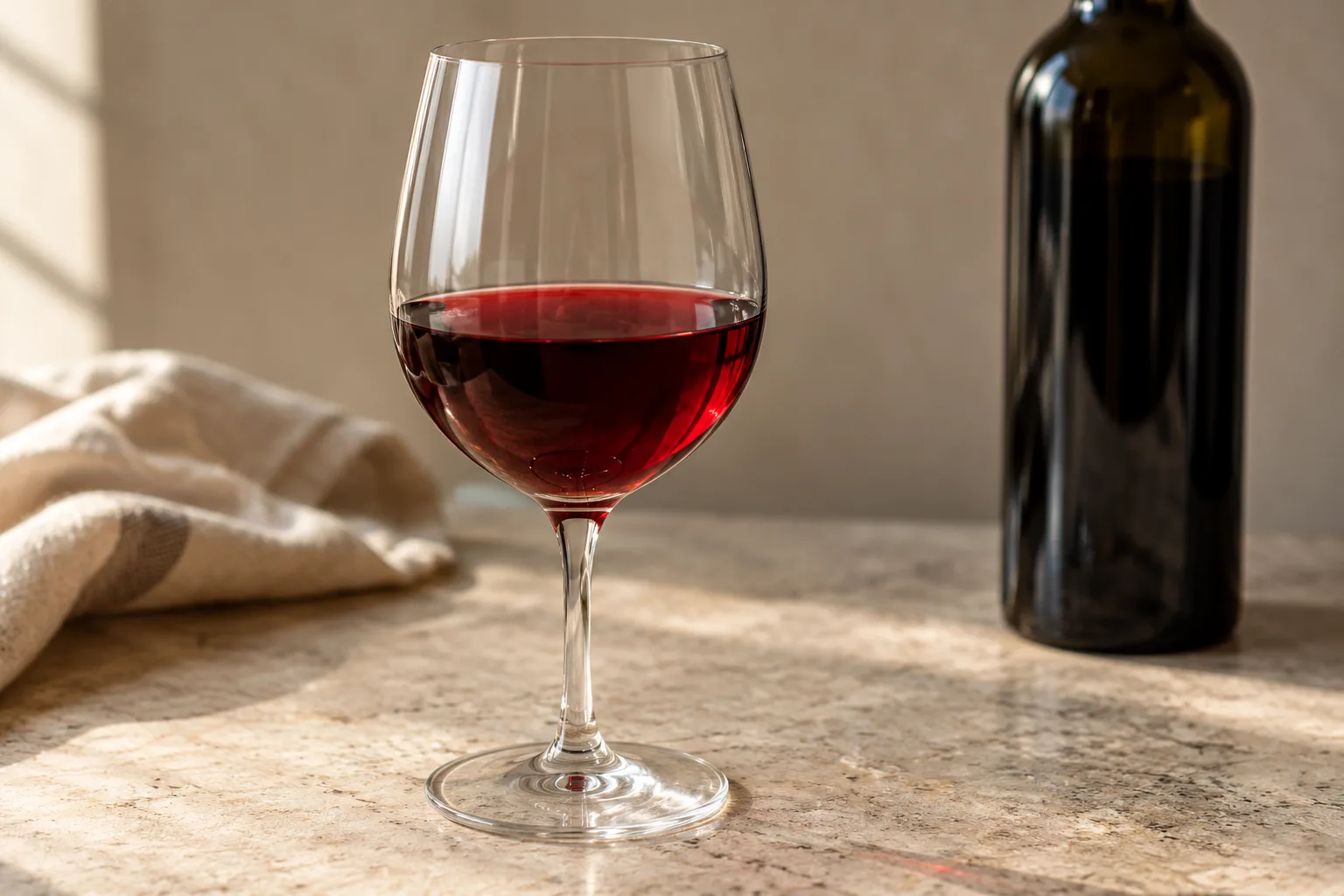
| Nutrient | About 5 fl oz wine (147 g) | Per 100 g |
|---|---|---|
| Calories | 125 kcal | 85 kcal |
| Protein | 0.1 g | 0.1 g |
| Total fat | 0.0 g | 0.0 g |
| Saturated fat | 0.0 g | 0.0 g |
| Carbohydrate | 3.8 g | 2.6 g |
| Fiber | 0.0 g | 0.0 g |
| Total sugar | 0.9 g | 0.6 g |
| Sodium | 6 mg | 4 mg |
| Calcium | 12 mg | 8 mg |
| Iron | 0.7 mg | 0.5 mg |
| Potassium | 187 mg | 127 mg |
USDA FoodData Central, FDC 173190.
You do not need to start drinking for heart health or antioxidants. If you enjoy wine, the useful comparison is how much alcohol you consume, how often, and whether drinking is appropriate for your circumstances.
Why variety rankings are misleading
Lists often name Pinot Noir, Cabernet Sauvignon or another variety as the “healthiest” based on a compound measured in grapes or wine. A compound measured in a wine sample is different evidence from a health benefit in people who drink it. Growing conditions, production and serving size can also vary within a variety.
Wine is fermented grape juice containing alcohol and other compounds. Dryness describes residual sugar rather than the absence of alcohol. An organic, expensive or traditionally made wine can still contain a substantial amount of ethanol. These descriptions should not substitute for reading the alcohol-by-volume figure.
Nutrition for a specified amount
Source: USDA FoodData Central, FDC 173190.
This USDA generic table-wine record is a reference, not an analysis of a particular bottle. The density-based serving is approximate. A glass’s fluid volume and the bottle’s ABV are the better inputs when calculating standard drinks. A wine nutrition table also does not summarize cancer, medication or impairment risks.
Variety data do not tell you a health winner
All rows below use the same 100-g weight.
| Food | Calories (kcal) | Protein (g) | Fat (g) |
|---|---|---|---|
| Alcoholic beverage, wine, table, red | 85 | 0.1 | 0.0 |
| Alcoholic Beverage, wine, table, red, Merlot | 83 | 0.1 | 0.0 |
| Alcoholic Beverage, wine, table, red, Gamay | 78 | 0.1 | 0.0 |
The modest differences between these generic records provide no basis for a health ranking by variety. These figures do not measure a personal health outcome, and a current bottle may have a different composition. Use the comparison to understand the limits of nutrient-based ranking rather than to select a therapeutic drink.
Calculate alcohol exposure from the label
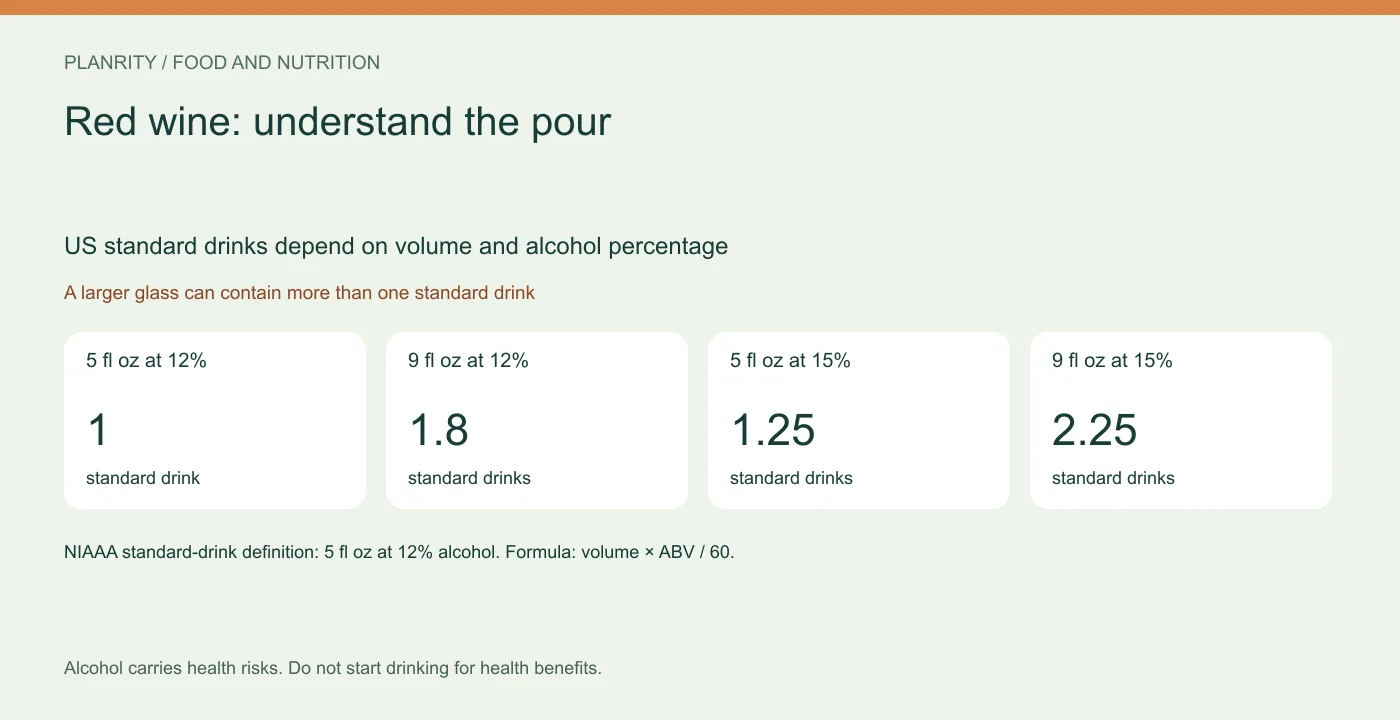
NIAAA defines a US standard drink as approximately 14 grams of pure alcohol. Its wine example is 5 fluid ounces at 12% ABV. A larger glass or stronger wine contains more than that example even if it is described socially as one drink. What Is A Standard Drink? | National Institute on Alcohol Abuse and Alcoholism (NIAAA)
For wine, standard drinks can be estimated as: fluid ounces × ABV as a percentage ÷ 60. This follows from the 5-ounce, 12% example; it is an alcohol-quantity calculation, not a formula for a safe amount.
| Illustrative pour | ABV | Estimated US standard drinks |
|---|---|---|
| 5 fl oz | 12% | 1.00 |
| 5 fl oz | 15% | 1.25 |
| 9 fl oz | 12% | 1.80 |
| 9 fl oz | 15% | 2.25 |
The final row has more than twice the alcohol of the first. That difference is more actionable than an unsupported antioxidant ranking. Measure your usual pour once to learn what your glass holds, because a wide bowl can make fluid volume hard to judge.
What lower sugar does and does not mean
A dry wine may have less residual sugar than a sweet wine, but lower sugar does not remove ethanol. Sugar-free or low-carbohydrate language therefore cannot establish that a wine is healthy. Calories from alcohol are not captured by looking only at carbohydrate grams.
If a label includes nutrition information, compare equal fluid volumes and check whether the serving matches your pour. Do not assume that every bottle of a named variety has the same sugar content. Without a manufacturer analysis, an exact residual-sugar claim should remain unverified.
Health risks deserve more attention than antioxidants
CDC states that alcohol-containing drinks, including red wine, increase cancer risk. Lower consumption or no alcohol can reduce that risk. The presence of grape-derived compounds does not cancel the exposure. CDC guidance on alcohol and cancer
Past observational comparisons can be influenced by differences between people who drink and people who do not. Such studies cannot simply be translated into “this wine protects your heart.” A lower risk observed in a group is not proof that a particular bottle caused the difference.
Risk also depends on circumstances that a nutrition label cannot resolve: driving, operating equipment, medication use, pregnancy, an existing medical condition, or difficulty controlling drinking. A low-calorie claim does not address any of these situations.
Who should avoid alcohol?
CDC advises no drinking for people who are pregnant or might be pregnant, people below the legal drinking age, those with certain medical conditions or interacting medications, and people who cannot control their intake or are recovering from alcohol use disorder. If you currently do not drink, do not start for a health benefit. CDC guidance on moderate alcohol use
If you take medication, ask a pharmacist or prescriber about alcohol rather than assuming a small glass is compatible. If you need to avoid alcohol completely, read alcohol-free product information carefully; do not assume that every “nonalcoholic” description has the same meaning or alcohol content.
A practical shopping and serving approach
- Decide whether drinking fits your circumstances before choosing a bottle.
- Read ABV rather than relying on grape variety or price.
- Compare equal fluid volumes when evaluating labels.
- Measure the pour if you want to understand your intake.
- Consider a smaller serving or an alcohol-free drink you enjoy.
- Avoid using “organic,” “dry” or “low sugar” as a health guarantee.
- Plan transportation before a setting where alcohol may be served.
If the reason for drinking is a supposed nutrient benefit, foods can provide nutrients without requiring wine. An enjoyable meal does not need an alcoholic accompaniment. Water or another suitable alcohol-free drink can accompany the same meal without adding alcohol exposure.
Separate taste choices from health claims
If you choose a wine because you enjoy its flavor, that is a preference rather than a medical justification. A shop description mentioning tannins, fruit or acidity can help with taste, but it does not measure a health outcome. Keep those two decisions separate when comparing bottles. The practical label information remains alcohol strength and the amount poured.
Read the pour as well as the bottle
Start with the pour you actually use. At 12% alcohol, 5 fl oz is one standard drink, while 9 fl oz is 1.8. At 15%, those same pours are 1.25 and 2.25 standard drinks. A restaurant glass or a glass filled at home can therefore contain more alcohol than its single-glass description suggests.
If you already drink and want less exposure, choose a smaller measured pour, a lower alcohol percentage or an alcohol-free alternative. Check the actual label rather than assuming dry means low alcohol. The calorie differences among red varieties are a less useful priority than the amount of alcohol consumed. If alcohol is unsuitable for you, there is no health benefit that requires choosing one of these wines instead of abstaining.
What to take away
Choose wine for enjoyment, not as a source of health benefits. Pinot Noir, Merlot and other red varieties still contain alcohol, and their small nutrient differences do not tell you a healthiest bottle. If you drink, pay attention to the amount poured and the alcohol percentage together. Drinking less reduces exposure; not drinking is also a sound choice. People who should avoid alcohol should not use a dry or lower-calorie label as an exception.
Related food guides
Frequently asked questions
Is Pinot Noir the healthiest red wine?
A variety-based claim needs direct evidence about meaningful health outcomes, not just an antioxidant measurement. This article does not identify a healthiest grape variety. For someone who drinks, the amount consumed and alcohol strength are more useful decision points.
Does dry wine have no health risks?
No. Dryness concerns residual sugar and does not mean alcohol-free. A dry wine can contain as much alcohol as a sweeter bottle, or more. Read ABV and serving volume, and consider the circumstances in which drinking may be inappropriate.
Is one glass always one standard drink?
No. NIAAA’s wine example is 5 fluid ounces at 12% ABV. A larger pour or a higher ABV increases the alcohol quantity. The examples above show why a single large glass can contain more than two standard drinks.
Should I start drinking red wine for antioxidants?
No. Do not start drinking for a claimed health benefit. Grape-derived compounds do not erase the risks associated with alcohol. Choose foods and beverages according to your needs and preferences without treating wine as a required part of healthy eating.
Sources
- Alcoholic Beverage, wine, table, red, Gamay; 171872, USDA
- Alcoholic Beverage, wine, table, red, Merlot; 171925, USDA
- Alcoholic beverage, wine, table, red; 173190, USDA
- What Is A Standard Drink? | National Institute on Alcohol Abuse and Alcoholism (NIAAA)
- CDC guidance on moderate alcohol use, CDC
- CDC guidance on alcohol and cancer, CDC
- How to Understand and Use the Nutrition Facts Label | FDA, FDA